

Attitudes toward social inequality in Canada and the USA
Are Canadians more egalitarian than Americans? Are they more troubled by the existence of various forms of social inequality – such as those between rich and poor, men and women, white and Black – and more inclined to look to government to address them?
March 30, 2026
Looking for something specific?
Public support for autocratic leaders in Canada and the USA
In the current political context, how do Americans and Canadians feel about the powers afforded to their national leader over other branches of government and the media?
February 23, 2026
February 23, 2026politics,united states,democracy,americasbarometer,populismReport
Wealth inequality in Canada and the USA
Income inequality is patently visible in today’s society. To what extent does the public look to their governments to act to narrow the gap between rich and poor, and how have such expectations changed over the past decade or so?
February 4, 2026
February 4, 2026economy,united states,americasbarometer,income inequalityReport
The Atlantic Provinces in Confederation
All four Atlantic provinces have experienced significant political changes in the past year. These developments have taken place against the backdrop of additional major political change at the national and international level.
January 20, 2026
January 20, 2026confederation of tomorrow,federalism,politics,canadian identityReport
Trust in Political Institutions in Canada
The results of the latest survey, conducted in the summer of 2025, provide a comprehensive update. They show that the extent to which Canadians trust political actors and institutions has, in most cases, held steady over the past 15 years. In some cases, trust has increased.
January 8, 2026
January 8, 2026politics,social capital,americasbarometer,trustReport
Social trust in Canada and the USA
Today we live in a time of social and political fracture. Much of what people know and how they communicate with others is happening on social media that channels content through narrow audiences, and feeds conflict and outrage. Amidst the noise of heated political rhetoric and ranting Tik Tok videos, are we losing trust in each other?
January 6, 2026
January 6, 2026united states,social capital,americasbarometer,trustReport
Respect and influence in the Canadian federation
Every year since 2019, the Confederation of Tomorrow survey has been asking Canadians the following three questions about respect, influence and spending in the federation.
December 18, 2025
December 18, 2025confederation of tomorrow,federalism,politicsReport

Rising concerns about the impact of new technologies on employment
In the past few years, evidence has appeared suggesting that concerns about the implications of technological change may be growing. According to the most recent survey waves, a growing proportion of workers are now expressing concern with the pace of change in general, and more specifically with the prospect of automation leading to unemployment.
December 15, 2025
December 15, 2025economy,artificial intelligence,survey on employment and skills,social change,technologyReport
Democracy and the fairness of elections in Canada
Satisfaction with democracy, trust in elections, and the sense that votes are always counted fairly, have all declined steadily and significantly among Conservative Party supporters since the party lost power a decade ago – and in the context of four consecutive election losses.
November 21, 2025
November 21, 2025politics,democracy,americasbarometer,civic engagementReport
Canadian public opinion on our relationships with other countries 2025
In 2025, Canadians find themselves facing a much less certain international situation than they have been used to. Some of this is due to the persistence of conflicts in Ukraine, and in Israel and Gaza, and the wider threats they pose to international peace and security.
October 28, 2025
October 28, 2025international relations,immigration,focus canada,united statesReport
Canadian public opinion about the Middle East conflict
The war between Israel and Hamas is approaching its second anniversary, with no clear prospect of resolution or peace. Over much of this period Canada adopted a principled but cautious position on the conflict.
October 27, 2025
Canadian public opinion about immigration and refugees
A majority of Canadians continue to say there is too much immigration, but opinions have stabilized since 2024 following a sharp increase over the two previous years. Those who express this view increasingly point to poor government management as the problem.
October 16, 2025
Canadians on Reconciliation and Relations with Indigenous Peoples
This year’s report from the 2025 survey provides an opportunity to assess the state of public opinion on these issues 10 years after the completion of the work of the Truth and Reconciliation Commission.
September 29, 2025
September 29, 2025confederation of tomorrow,indigenous peoples,reconciliationReport

Perceptions of trades training gaining traction over university
The latest wave of the Survey on Employment and Skills asked Canadians to think about what advice they would give to a young person regarding their career path.
September 26, 2025
September 26, 2025economy,survey on employment and skills,educationReport
Climate Policy in the Federation
Public concerns about climate change notwithstanding, Canadians are placing increasing priority on economic security over the importance of reducing carbon emissions.
September 21, 2025
September 21, 2025confederation of tomorrow,environment,federalism,politics,climate changeReport
Public Support for Child Care Programs in Canada
The purpose of the YMCA-YWCA National Survey on Child Care Policy in Canada was to explore the extent of public support for government subsidized child care programs in Canada, as well as the main factors influencing that support.
September 10, 2025
September 10, 2025social change,government role,child careReport
The Prairies and B.C. in Confederation
This report draws on the most recent Confederation of Tomorrow survey to present an updated picture of how Western Canadians view their province’s place in the federation. The survey finds that, rather than growing, levels of dissatisfaction in the three Prairie provinces with how federalism works in Canada declined between 2024 and 2025.
August 20, 2025
August 20, 2025confederation of tomorrow,federalism,politicsReport
Ballot questions
As part of its Focus Canada public opinion research program (launched in 1976), the Environics Institute examined the ballot questions for the April 2025 federal election by asking voters to identify which issue was the most important to them personally in choosing which party to support.
August 5, 2025
August 5, 2025focus canada,politics,economy,united states politics,youthReport
Working together in the Canadian federation
Two main political events since the start of this year have affected the context in which the relations between governments in Canada are evolving. First, the imposition of U.S. tariffs, combined with the American president’s threats against Canada’s independence, have created a new sense of urgency.
July 20, 2025
July 20, 2025confederation of tomorrow,federalism,politics,government roleReport

The Impact of Having Children on Careers
This report presents the results of survey questions asking Canadians age 18 to 44 who are in the labour force about their expectations and experiences relating to having children and its impact on their careers.
July 10, 2025
July 10, 2025economy,survey on employment and skills,gender inequalityReport
Attachment and Identity
The issues of Canadian identity and unity came to the fore in the first few months of 2025, in the face of the threatening policies and pronouncements of returning U.S. president Donald Trump.
June 26, 2025
June 26, 2025confederation of tomorrow,federalism,politics,canadian identityReport
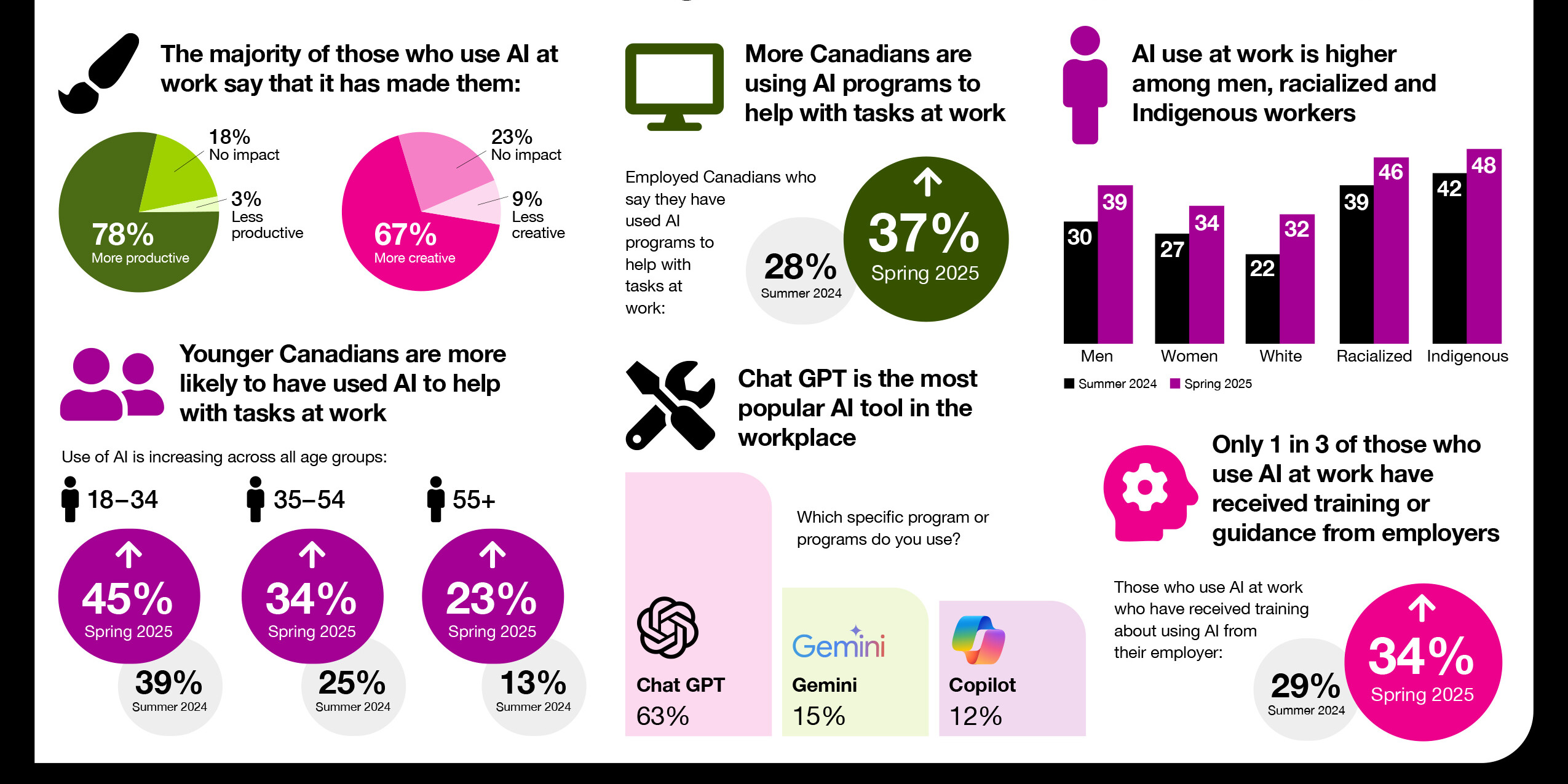
The use of artificial intelligence in the workplace: an update
In 2024, the Survey on Employment and Skills reported that early 3 in 10 employed Canadians are using AI tools in the workplace, but almost one-half of those have not received any formal training.
June 18, 2025
June 18, 2025artificial intelligence,workplace,survey on employment and skills,technologyReport,Infographic
Pride in Being Canadian
Previous Focus Canada surveys have documented a decline in the proportion of Canadians who are proud of being a Canadian. But in the wake of the developments since the return of U.S. President Donald Trump to the White House, has there been a resurgence of national pride in Canada?
June 12, 2025
June 12, 2025focus canada,politics,canadian identity,valuesReport
Public Opinion About Canada-USA Relations
Canada and the United States have enjoyed a strong relationship for more than a century. There have been ups and downs depending on the respective leaders in each country, but underneath remained a solid foundation of trust and partnership.
June 6, 2025
June 6, 2025focus canada,politics,united states politicsReport

Canadians worry about impact of trade wars as pessimism about economy deepens
Concerns about the impact of U.S. tariffs are contributing to a growing pessimism among Canadians about the economy, employment and their own financial situation.
June 4, 2025
June 4, 2025economy,united states,survey on employment and skillsReport

Strong Schools, Stronger Future: What Canadians Expect from Public Education
To explore how Canadians view public education, the latest wave of the Survey on Employment and Skills asked Canadians two questions about schools in their communities. The first addressed the objectives that schools should have, and the second assessed school performance.
June 3, 2025
June 3, 2025survey on employment and skills,education,youthReport
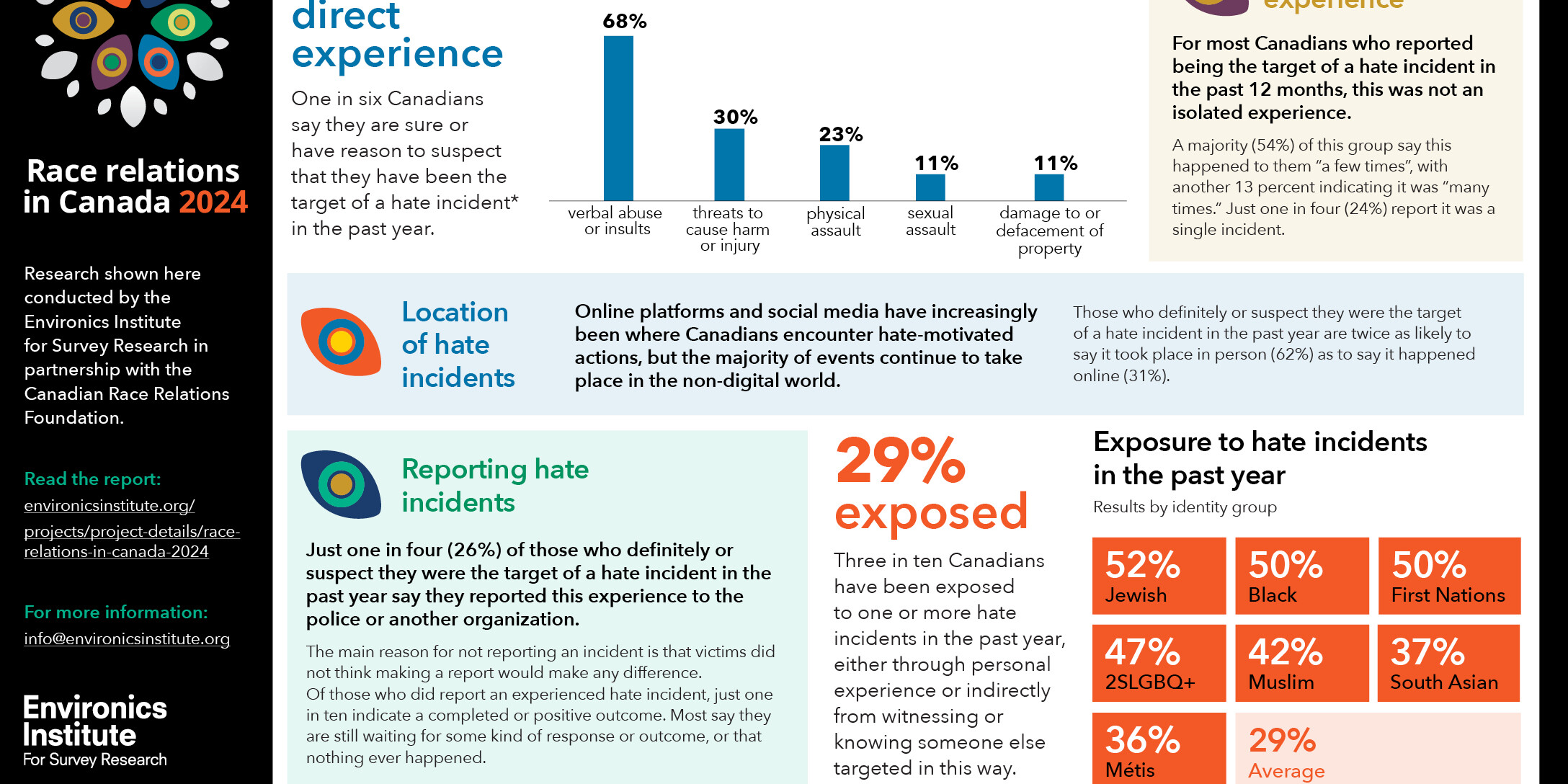
One in six Canadians say they have definitely or possibly been the target of a hate incident in the past year
The Race Relations in Canada 2024 Survey is the most comprehensive national survey to date focusing on Canadians’ experience with hate, a rapidly spreading form of anti-social aggressive racism directed at people, most commonly because of their race, ethnicity or religion.
March 18, 2025
March 18, 2025race relations,racism,race relations in canada survey,diversity equity inclusion (DEI)Report,Infographic
Race Relations in Canada 2024
The research consisted of a main survey conducted online between February 12 and March 13, 2024 with 4,470 Canadians (ages 18+), and a supplementary survey conducted online between November 18 and 25, 2024 with 616 Canadians who identify as Jewish (by religion, ethnicity and/or culture).
March 13, 2025
March 13, 2025immigration,multiculturalism,race relations,racism,race relations in canada survey,religionReport
Perspectives on Growing Older in Canada: The 2024 NIA Ageing in Canada Survey
The NIA Ageing in Canada Survey is a decade-long annual research program designed to capture Canadians’ experiences, perspectives and expectations on ageing.
January 28, 2025
January 28, 2025ageing,health,ageing in canada surveysReport

How working from home is affecting the workplace
Exploring how the shift to working from home is affecting job satisfaction, productivity, teamwork, and equity and inclusion is an important step in assessing the current state of the workplace in Canada.
November 28, 2024
November 28, 2024economy,survey on employment and skills,social changeReport
Inter-generational Mobility in Canada
The 2024 survey finds that the proportions of Canadians who feel financially worse off today than their parents were at their age, and who feel that the next generation will be worse off than they are, are both trending upwards.
November 13, 2024
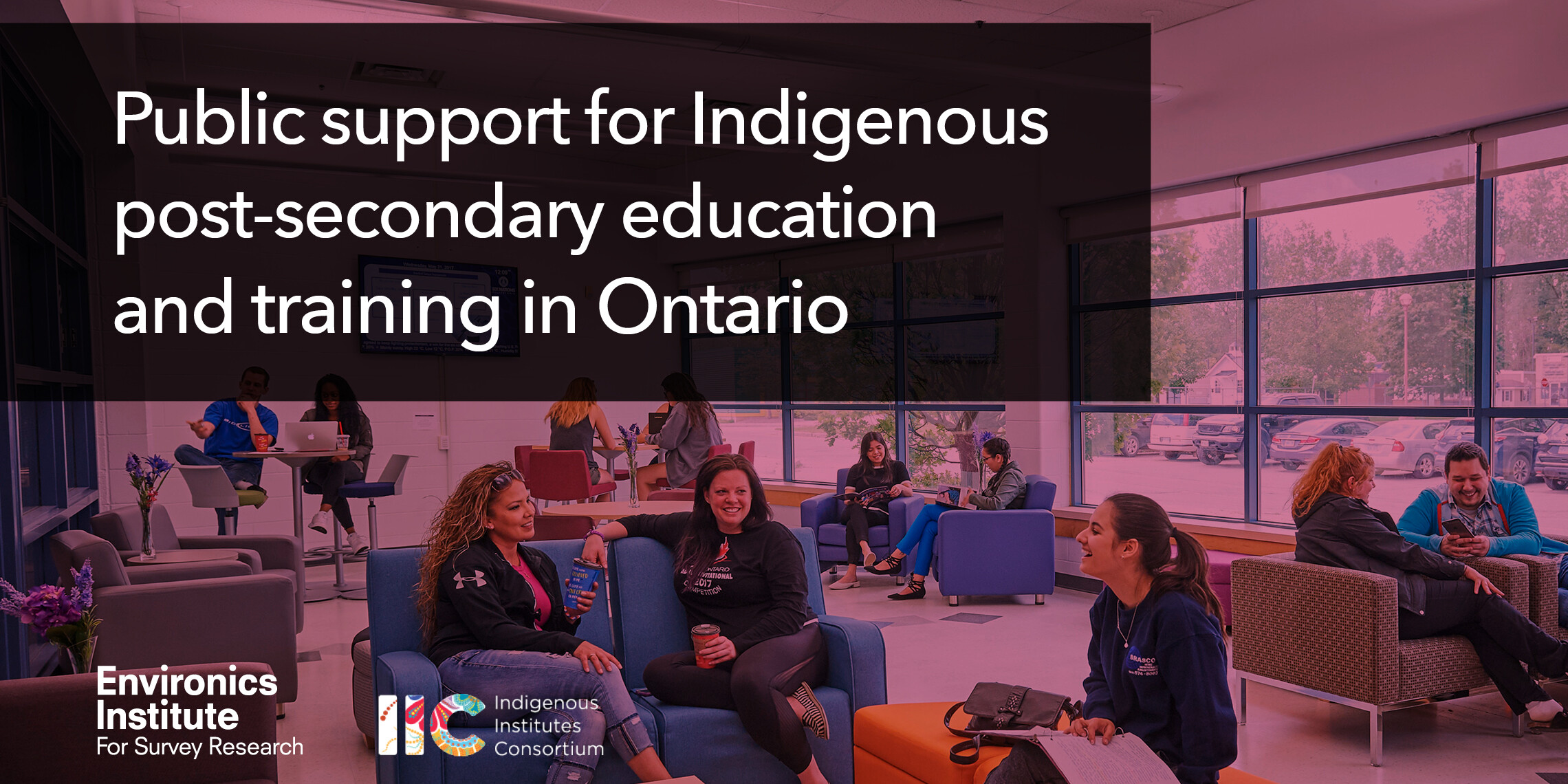
Public support for Indigenous post-secondary education and training in Ontario
The Calls to Action issued in 2015 by the Truth and Reconciliation Commission of Canada included a number of items relating to education. These included calls for measures to eliminate gaps in educational attainment between Indigenous Peoples and non-Indigenous people in Canada, to provide adequate and equitable funding of education for Indigenous students, and to develop culturally appropriate educational curricula.
October 29, 2024
Canadian public opinion about immigration and refugees 2024
For the first time in a quarter century, a clear majority of Canadians say there is too much immigration, with this view strengthening considerably for the second consecutive year.
October 17, 2024
October 17, 2024immigration,multiculturalism,focus canadaReport
Canadians and the U.S. Presidential Election
The American presidential election has transfixed not only citizens of the United States, but many around the world as well. One way or another, everyone will be affected by the outcome of the vote on November 5.
October 14, 2024
October 14, 2024focus canada,politics,united states,united states politicsReport

Canadian public opinion about conflict in the Middle East 2024
The outbreak of war between Israel and Hamas in Gaza has had an unprecedented impact on Canada. Since last fall, the country has witnessed rising levels of hate-motivated actions against Jews, Muslims and Arabs, sustained protests on university campuses, and heated rhetoric from public figures over what should be done.
July 23, 2024
July 23, 2024international relations,focus canada,middle east conflict,religion,government roleReport

Developing a material deprivation index
In Canada, we commonly measure the extent of poverty by determining a poverty line. An alternative approach is to assess a household’s standard of living by looking at the goods and services it has, or has access to, and the activities in which it participates. This method of measuring poverty is called a material deprivation index (MDI).
July 4, 2024
Attachment and identity in the Canadian federation
The annual Confederation of Tomorrow surveys explore the relationships between different types of identity. It asks about attachment to and identification with Canada and one’s province or territory; it also asks Indigenous Peoples about their attachment to their Indigenous nation or community.
June 30, 2024
June 30, 2024confederation of tomorrow,indigenous peoples,federalism,canadian identityReport
Canada’s Changing Population: Key Trends Shaping our Future
In 2024, YMCA Canada commissioned several reports to explore areas where significant changes lie ahead. The reports were launched at the 2024 YMCA National Conference in Halifax in June. The report on demographic change was prepared by the Environics Institute.
June 26, 2024
Reconciliation and Relations with Indigenous Peoples
How do Canadians today see relations between Indigenous and non-Indigenous people and how the process of reconciliation unfolding? Confederation of Tomorrow surveys have been addressing this topic since 2019, and the 2024 survey provides a fresh update on public attitudes from both Indigenous and non-Indigenous perspectives, and how they have evolved over time.
June 20, 2024
June 20, 2024confederation of tomorrow,indigenous peoples,politics,canadian identity,canadian politicsReport
Federal-provincial relations: public perceptions
The study finds that views on whether federal and provincial governments are working well together have not changed that much over the past two decades. However, compared to the early 2000s, Canadians are less likely to blame both governments equally when conflict arises, and more likely to take sides by blaming either the federal government or their provincial government.
June 6, 2024
June 6, 2024confederation of tomorrow,federalism,politics,canadian politics,democracyReport
Support for bilingualism and learning a second language
The 2024 Confederation of Tomorrow survey revisits the topic of official bilingualism and the importance of children learning to speak a second language. It finds that support for bilingualism as a policy, and interest in children learning a second language, both remain fairly high.
May 30, 2024
May 30, 2024immigration,confederation of tomorrow,indigenous peoples,canadian identityReport
Addressing climate change in the Canadian federation
Canadians are evenly divided on the relative priority that should be given to protecting the environment versus protecting jobs. The emphasis placed on environmental protection has declined since 2023 across the population.
May 10, 2024
May 10, 2024confederation of tomorrow,environment,federalism,economy,government role,democracyReport
Affordable housing: approval of federal, provincial and local governments
The availability and affordability of housing has emerged as a top public policy issue. And it is one in which all governments – federal, provincial and territorial, and local – have a role to play.
April 23, 2024
April 23, 2024confederation of tomorrow,politics,economy,government roleReport
Trusting federal and provincial government decision-making on key issues
Canadians are losing trust in the ability of both the federal government and their provincial governments to deal with key issues such as health care, climate change, immigration or the economy.
April 17, 2024
April 17, 2024confederation of tomorrow,federalism,politics,democracyReport
Trust in Political Institutions in Canada
The AmericasBarometer surveys measure trust in a range of political institutions and actors on a seven-point scale. Here is a summary of the most recent results for Canada, showing the trend since 2010.
March 17, 2024
March 17, 2024politics,social capital,democracy,americasbarometerReport
The Perspectives of Second-generation Immigrants in Canada
Outcomes for second-generation immigrants are typically measured in terms of educational attainment, employment rates and income. These indicators are important, but they tell us little about the experience that second-generation have balancing the values and expectations of their immigrant parents with those of Canadian society more generally.
March 7, 2024
March 7, 2024immigration,multiculturalism,canadian identity,economy,millennials & genzReport
Support for Democracy in Canada
This report focuses on the extent of public support for democracy in Canada, and examines whether this support has been weakening over time. The analysis is based on the results of the Canadian portion of the AmericasBarometer surveys, which track opinions on a consistent set of questions about democracy and its alternatives.
March 7, 2024
March 7, 2024politics,economy,democracy,americasbarometerReport
2023 NIA Ageing in Canada Survey
In less than 10 years, one-quarter of Canada’s population will be aged 65 years and older. Fully understanding the circumstances and evolving needs of this ageing population requires collecting regular and reliable data from older Canadians themselves.
January 31, 2024
January 31, 2024economy,health,lived experience,ageing in canada surveysReport
The Burden of Care: Addressing Challenges in Employment in the Nonprofit Sector
This report examines the perceptions of workers in the nonprofit sector and how these differ from workers in other sectors. Workers in the nonprofit sector have lower job satisfaction than workers in either the public or private sectors.
December 12, 2023
December 12, 2023economy,survey on employment and skillsReport

The Lingering Effects of COVID-19
This report helps to fill the information gap by documenting how many Canadians have missed work or school due to COVID-19 in the 12 months prior to the time of the survey in March 2023, and the length of their absences.
December 7, 2023
December 7, 2023economy,COVID-19,survey on employment and skills,healthReport

Participation in Skills Training
The COVID-19 pandemic severely disrupted the workplace. Some businesses closed either temporarily or permanently. Others enabled their employees to work from home.
November 23, 2023
November 23, 2023economy,COVID-19,survey on employment and skillsReport

Housing Affordability
As immediate concern with the COVID-19 pandemic faded, new issues have appeared on the public’s agenda, the most prominent of which have been the cost of living and the affordability of housing.
November 20, 2023
Public Opinion about Immigration & Refugees
In 2023, Canada reached a historic milestone – the country’s population surpassed 40 million people. The number of people living in Canada rose by more than one million in 2022 – 96 percent due to international migration.
October 28, 2023
October 28, 2023immigration,multiculturalism,focus canadaReport
Citizen Voice
Are citizens feeling increasingly ignored by their governments in Canada? The evidence from the Canadian portion of the 2023 AmericasBarometer survey is mostly reassuring.
October 26, 2023
October 26, 2023politics,democracy,americasbarometer,civic engagementReport
Connection, Engagement and Well-being
How can communities best measure the well-being of their citizens? Often this is done using economic measures of employment, income and inequality. There are also statistics reporting on incidences of crime, of homeless or of disease (most recently focusing on cases of COVID-19).
October 24, 2023
October 24, 2023COVID-19,health,civic engagement,toronto social capital studyReport
Trust in Elections
Political news headlines in 2023 have been dominated by concerns about potential interference by foreign governments in recent Canadian elections, with opposition parties calling for a public inquiry into the matter.
September 25, 2023
September 25, 2023politics,democracy,americasbarometer,civic engagementReport

Spotlight on Atlantic Canada
The outlook in Atlantic Canada has changed significantly over the past two years. In 2021, almost a year into the COVID-19 pandemic, people in the region stood out from other Canadians as being much more satisfied with the direction of the country in general, and with the way both the federal government and their provincial governments had managed the crisis so far.
July 11, 2023
July 11, 2023confederation of tomorrow,federalism,politics,gender inequality,healthReport
Reconciliation and Relations with Indigenous Peoples
The Confederation of Tomorrow surveys have covered relations with Indigenous Peoples from the beginning in 2019, documenting a gradual shift in Canadian public opinion toward greater support for the rights of Indigenous Peoples and the process of reconciliation.
June 21, 2023
June 21, 2023confederation of tomorrow,indigenous peoples,politicsReport
Yukon @ 125!
The Yukon came into existence as a separate territory on June 13, 1898. To mark the occasion, the Confederation of Tomorrow survey looks at how Yukoners’ opinions differ from those of other Canadians.
June 12, 2023
June 12, 2023confederation of tomorrow,federalism,canadian identity,valuesReport,Infographic
Religion, Rights and the Role of the Courts
Last year marked the 40th anniversary of the Canadian Charter of Rights and Freedoms. While the Charter as a whole remains popular, the occasional use by governments of its provision allowing them to override certain Charter rights (Section 33) continues to spark controversy.
May 29, 2023
May 29, 2023confederation of tomorrow,federalism,politics,canadian identity,values,religionReport

Confidence in Leaders
In 2021, almost a year into the COVID-19 pandemic, the Confederation of Tomorrow Survey of Canadians addressed the issue of public confidence in scientists, government medical advice and political leaders.
May 2, 2023
May 2, 2023confederation of tomorrow,politics,social capital,democracyReport
Support for equalization: 2023 update
Key findings are: Overall support for the equalization program in Canada remains steady; Support has increased in Alberta since 2019; Support remains steady in non-recipient provinces, but has fallen by 8 points since 2019 in recipient provinces. A 29-point gap between levels of support in Quebec and Alberta has narrowed to a 6-point gap.
April 26, 2023
April 26, 2023confederation of tomorrow,federalism,politics,canadian identity,economy,valuesReport

Spotlight on Alberta
In Alberta, the level of discontent with the federation remains high, but has been declining gradually since 2019. This overall change, however, masks two distinct trends. On the one hand, those who support the provincial government continue to express high levels of dissatisfaction with federalism.
April 5, 2023
April 5, 2023confederation of tomorrow,federalism,politicsReport
The Evolution of the Canadian Identity
The Canadian identity is in constant evolution, in response to changing political forces and cultural influences. One of the more important potential sources of change in recent years is the growing ethno-cultural diversity of the population, driven by immigration and, in particular, by the growing number of immigrants arriving from Asian and Africa.
December 23, 2022
December 23, 2022focus canada,canadian identity,valuesReport
2022 NIA Ageing in Canada Survey
The National Institute on Ageing (NIA) and the Environics Institute for Survey Research partnered on an annual survey of ageing in Canada to track Canadians' experiences of growing older and their expectations for the future.
December 20, 2022
December 20, 2022government role,ageing,health,lived experience,ageing in canada surveysReport
Syrian Refugee Lived Experience Project
In 2015, through an unprecedented national mobilization of government, the settlement sector and Canadian citizens, the country opened its doors to accept refugees fleeing the humanitarian crisis in Syria, resettling close to 40,000 refugees within the space of a year. How have these refugees fared in their new country and lives, and what can be learned from their experience that might benefit future refugees?
December 17, 2022
December 17, 2022immigration,multiculturalism,canadian identity,values,syria,lived experience,syrian refugee lived experience projectReport

Satisfaction, Outlook and Opportunities
The survey finds that younger Canadians have grown more dissatisfied with the way things are going in the country, and more pessimistic about prospects for the next generation.
December 16, 2022
December 16, 2022focus canada,politics,canadian identity,economy,COVID-19,democracyReport
Public Opinion in Canada and the United States
The diminishing concern about the impact of free trade on Canada’s cultural identity coincides with some sharp differences of opinion between Canadians and Americans on prominent social issues.
December 9, 2022
December 9, 2022focus canada,politics,canadian identity,racism,government role,democracy,discriminationReport
Toronto Social Capital Study 2022
How can communities best measure the well-being of their citizens? Often this is done using economic measures of employment, income and inequality. There are also statistics reporting on incidences of crime, of homeless or of disease (most recently focusing on cases of COVID-19).
November 22, 2022
November 22, 2022COVID-19,social capital,health,civic engagement,toronto social capital studyReport
Canadian public opinion about immigration and refugees
The latest Focus Canada research reveals that, despite the many disruptions and challenges facing Canadians today, the public as a whole has never been more supportive of their country's welcoming path when it comes to immigration and refugees.
October 25, 2022
October 25, 2022immigration,multiculturalism,focus canadaReport

The shift to remote work
The majority of those who have been working from home say they prefer this arrangement and want it to continue once the pandemic is over. And most of those who want to continue to work from home prefer to do so on a regular basis, rather than occasionally.
September 15, 2022
September 15, 2022economy,COVID-19,survey on employment and skillsReport

Disconnecting from work
The Survey on Employment and Skills confirms that many Canadians find it a challenge to keep their work, family and personal lives in balance. But experiences vary widely. Some workers, such as those who are self-employed, are more likely to appreciate the flexibility of modern work arrangements
September 15, 2022
September 15, 2022economy,survey on employment and skills,government roleReport
Social norms and racism in Canada
A new national research project documents for the first time the social norms that govern how Canadians think about and act on different types of racial micro-aggressive actions directed at people who are Indigenous or Black.
June 22, 2022
June 22, 2022racism,public opinion research,social change,government role,lived experience,discriminationReport
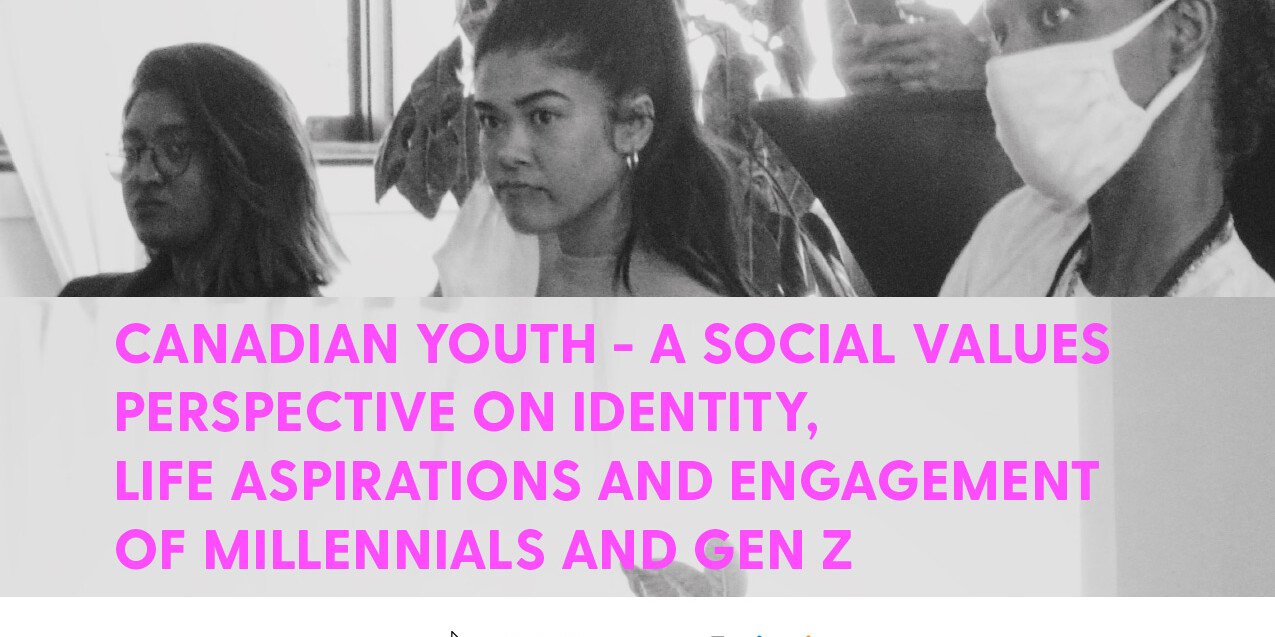
Canadian Youth
A new national research project documents for the first time the social norms that govern how Canadians think about and act on different types of racial micro-aggressive actions directed at people who are Indigenous or Black.
March 31, 2022
March 31, 2022canadian identity,social values,values,youth,millennials & genz,civic engagementReport

Women’s Equality and the Women’s Movement: an Update
The study provides an analysis of Canadian public opinion on issues facing women in Canada today and on the impact of the women’s movement. It compares the latest results to those from previous surveys conducted in the 1980s, 1990s and 2000s.
January 4, 2022
January 4, 2022focus canada,social change,gender inequalityReport

Working when sick
Efforts to improve public health and contain the spread of serious illness must focus on both the lack of paid sick days for many workers and the behaviour of those who have access to paid sick days but choose not to use them because of the prevailing workplace culture.
December 28, 2021
December 28, 2021economy,survey on employment and skills,government roleReport
Democracy and Political Polarization in Canada and the U.S.
This presentation compares the results in Canada and the United Sates. It shows that American politics remains highly polarized in several senses; for instance, there are significant gaps in trust in the political system between those who identify as liberals and those who identify as conservatives.
December 20, 2021
December 20, 2021politics,united states,democracy,americasbarometerReport

Making up time
This report explores the experiences during the pandemic of younger adults, defined as those between the ages of 18 and 34.
November 30, 2021
November 30, 2021economy,survey on employment and skills,government roleReport
Race Relations in Canada 2021
This latest research once again confirms the reality of racism in Canada. A significant proportion of the population experiences discrimination because of their race or ethnic background at least occasionally, if not more often, and has witnessed other people encounter similar treatment.
November 3, 2021
November 3, 2021race relations,racism,race relations in canada survey,discriminationReport
Canadian public opinion about immigration and refugees 2021
Results from the latest Focus Canada survey reveal that Canadians continue to be largely positive and supportive about immigrants and refugees, who are much more likely to be viewed as making a positive contribution to the country than posing a threat.
October 22, 2021
October 22, 2021immigration,multiculturalism,focus canada,racism,discriminationReport

Canadian Public Opinion about Indigenous Peoples and Reconciliation
The survey reveals that, in the wake of these events, attitudes in Canada have shifted. There is a growing awareness of the mistreatment of Indigenous Peoples in Canada, including through the system of residential schools, and a growing willingness to say that the policies of Canadian governments is the main obstacle to achieving economic and social equality.
September 29, 2021
September 29, 2021focus canada,indigenous peoples,social changeReport
Respect, Influence and Fairness in the Canadian Federation
Did the federal, provincial and territorial responses to the crisis alleviate or exacerbate public discontent with how federalism works in Canada?
September 27, 2021
September 27, 2021confederation of tomorrow,federalism,politics,government roleReport

Support for Democracy in Canada
This report explores the current state of public trust in democratic institutions and actors in Canada, and how this may have changed over time. The data are drawn from the 2021 AmericasBarometer survey in Canada.
September 6, 2021

Lessons learned
For many students, the short-term effect of the COVID-19 pandemic, through the switch to online learning, has been to effectively “privatize” our educational infrastructure, as families have had to rely on their own resources to provide the spaces, tools and connections needed for ongoing learning.
September 1, 2021
September 1, 2021COVID-19,survey on employment and skills,educationReport
Attachment and Advantages
The mid-point of each calendar year offers an ideal opportunity for Canadians to reflect on issues related to national identity.
July 8, 2021
July 8, 2021confederation of tomorrow,federalism,canadian identity,united statesReport
Indigenous Relations and Reconciliation
In the early months of 2020, prior to the arrival of the COVID-19 pandemic in Canada, news headlines in the country were focused on the protests taking place over issues relating to Indigenous Peoples’ rights and control over national resource development.
June 21, 2021
June 21, 2021confederation of tomorrow,indigenous peoplesReport
Addressing climate change in the Canadian federation
Prior to the onset of the COVID-19 pandemic, climate change had emerged as one of Canadians’ top concerns. The situation a year later is completely different: naturally, the pandemic now eclipses all other issues as the one Canadians see as most important.
June 18, 2021
June 18, 2021confederation of tomorrow,environment,federalism,politics,climate changeReport

Private Refugee Sponsorship in Canada
Given the high profile that refugee resettlement received over the past five or so years, it is not surprising that there is widespread public awareness.
June 17, 2021
June 17, 2021immigration,multiculturalism,canadian identity,values,government role,civic engagementReport

Mind and body
This report focuses on Canadians’ perceptions of their physical and mental health, and how these have changed during the pandemic. It also highlights implications for governments and employers as they begin to prepare for the post-pandemic recovery.
June 2, 2021
June 2, 2021COVID-19,mental health,survey on employment and skills,healthReport

Widening inequality
This report from Wave 2 of the Survey on Employment and Skills examines the overall impact of the pandemic, as well as more specific experiences such as loss of hours of work, loss of employment or loss of income.
May 14, 2021
May 14, 2021economy,COVID-19,survey on employment and skillsReport
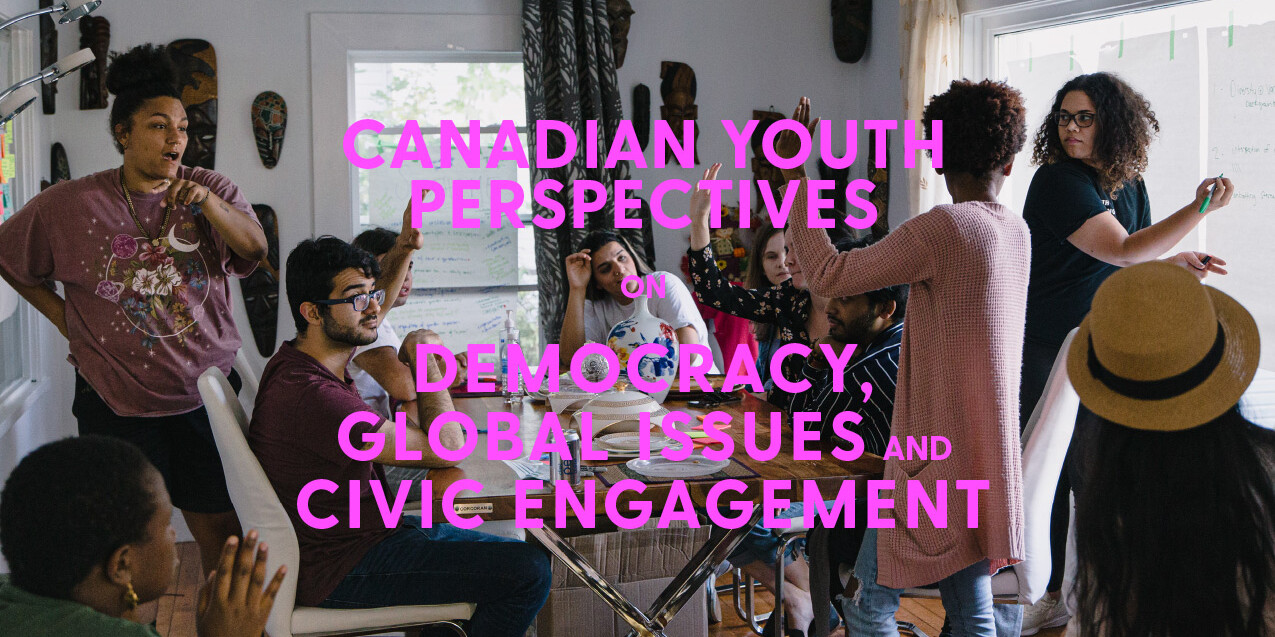
Canadian youth perspectives on democracy, global issues and civic engagement
This study covers a large and diverse population but it is nonetheless possible to draw from it a broad portrait of leading-edge Generation Z and Millennial Canadians.
May 13, 2021
The Role of Governments and the Division of Powers
The COVID-19 pandemic has presented governments in Canada with enormous challenges. While the current priority remains stemming the spread of the virus and accelerating the pace of vaccinations, governments are also looking ahead to the measures needed to shape an economic recovery.
April 19, 2021
April 19, 2021confederation of tomorrow,federalism,government roleReport

Work at home or live at work
This report from Wave 2 of the Survey on Employment and Skills focuses on the experience of working from home.
April 12, 2021
April 12, 2021economy,COVID-19,survey on employment and skillsReport

All in this Together?
A year into the COVID-19 pandemic, efforts to limit the spread of the virus continue to depend in large part on the willingness of citizens to modify their behaviours to conform with public health guidelines, notably those relating to physical distancing and wearing masks.
April 8, 2021
April 8, 2021confederation of tomorrow,federalism,government roleReport

Impact of the Covid-19 Pandemic on Millennial and GenZ Canadians
This report examines how Millennial and GenZ Canadians have experienced the COVID-19 pandemic. It finds that a majority of Canada’s younger generations (those between the ages of 18 and 40) say that the COVD-19 pandemic has had either a major or at least a moderate impact on their lives.
March 16, 2021
Indigenous – non-Indigenous Relations
This report focuses on the perspectives of both Indigenous Peoples and non-Indigenous Canadians with respect to current relations between their communities, reconciliation, Indigenous representation in federal institutions, and Indigenous control over development on their traditional territories.
December 18, 2020

A Better Canada: Community, Citizenship and Engagement
The events of 2020 have disrupted every aspect of Canadians’ daily lives. What is less clear is the extent to which they have also changed their longer-term outlook.
December 18, 2020
December 18, 2020canadian identity,values,social change,civic engagementReport

COVID-19, public policy and government decision-making
The latest Focus Canada research reveals that, despite the many disruptions and challenges facing Canadians today, the public as a whole has never been more supportive of their country's welcoming path when it comes to immigration and refugees.
November 18, 2020
November 18, 2020focus canada,politics,COVID-19,government roleReport
Identity, Values and Language
The third report explores issues relating to identity, values and language.
October 29, 2020
October 29, 2020confederation of tomorrow,federalism,canadian identity,values,social change,religionReport

Canadian public opinion about racism and discrimination
The killing of George Floyd, an African-American, by white police officers in Minneapolis earlier this year sparked anti-racism protests across the United States and around the world, along with a wider public discussion of anti-Black racism and systemic racism.
October 24, 2020
October 24, 2020focus canada,racism,social change,discriminationReport

Changing opinions about the United States, China and Russia
Over the past few years, the foreign policy challenges facing Canada have multiplied.
October 15, 2020
October 15, 2020focus canada,politics,united states,foreign affairsReport
Regional Perspectives on the Economy and Climate Change
Regional Perspectives on the Economy and Climate Change is the first in a series of reports that presents the results of this research. It focuses on the evolution of attitudes related to federalism, regionalism and nationalism, and more specifically on the related issues of energy and climate change policies in Canada.
October 14, 2020
October 14, 2020confederation of tomorrow,federalism,government roleReport
The Division of Powers and Resources
Regional Perspectives on the Economy and Climate Change is the first in a series of reports that presents the results of this research. It focuses on the evolution of attitudes related to federalism, regionalism and nationalism, and more specifically on the related issues of energy and climate change policies in Canada.
October 14, 2020
October 14, 2020confederation of tomorrow,federalism,government roleReport
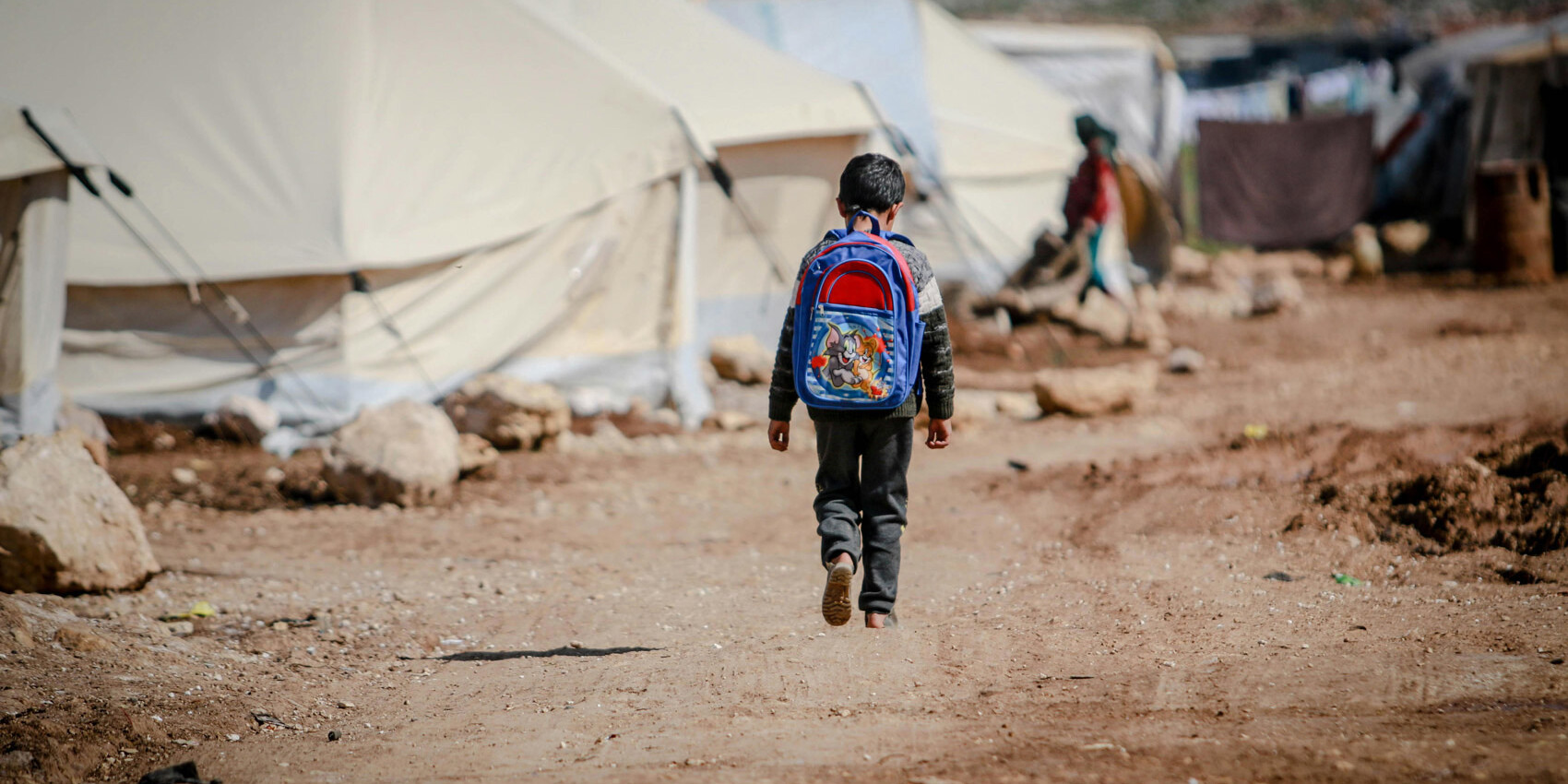
Canadian public opinion about immigration and refugees
The year 2020 has been unprecedented in Canada and worldwide, starting with a global pandemic the likes of which have not been seen in 100 years, causing the greatest economic slowdown since the Great Depression.
October 7, 2020
October 7, 2020immigration,multiculturalism,focus canada,politics,racism,discriminationReport
A Better Canada: Values and Priorities after COVID-19
Five months after the onset of the COVID-19 pandemic in Canada, the Environics Institute for Survey Research and the Vancouver City Savings credit union joined forces to conduct a comprehensive study of public opinion about what Canadians are expecting from their governments, from corporations and from one another.
September 22, 2020
September 22, 2020politics,COVID-19,social change,democracyReport

Adapting to the changing world of work
The survey finds that Canadians tend to have a positive assessment of both the impact of technological change and the value of the post-secondary education and skills training that they have received.
September 16, 2020
September 16, 2020economy,survey on employment and skills,social changeReport
Canadians’ shifting outlook on employment
The survey finds that Canadians tend to have a positive assessment of both the impact of technological change and the value of the post-secondary education and skills training that they have received.
May 20, 2020
May 20, 2020economy,COVID-19,survey on employment and skillsReport

Political Polarization in Canada and the U.S.
This report explores the issue of political polarization in Canada and the United States through an analysis of public opinion data about democracy collected over the past decade.
March 17, 2020
March 17, 2020politics,united states,democracy,americasbarometerReport

Public Support for Canada’s Political System
Previous research has shown that satisfaction with political institutions and trust in political actors in Canada has gradually been rising over the past decade. This report pushes this analysis deeper, by focusing not only on the national trend, but on sub-national ones as well.
January 27, 2020
January 27, 2020federalism,politics,democracy,americasbarometerReport

Intergenerational Mobility in Canada
A succession of economic downturns over the last decades has led many to express concerns that the next generation of Canadians will be less, and not more, well-off than the ones that preceded it.
January 15, 2020
January 15, 2020focus canada,economy,social change,youthReport
Race Relations in Canada 2019
This study confirms the reality of racism in Canada. Also important, it shows that this reality is widely if not universally acknowledged. Many Canadians across different racial backgrounds report experiences of racism and discrimination due to race, and also recognize that it also affects others of their own race and from other racial groups.
December 10, 2019
December 10, 2019race relations,racism,race relations in canada survey,social change,lived experience,discriminationReport

Influence in Canadian Politics
Concerns have long been expressed about the extent of influence exercised by powerful or well-connected groups in society over the direction of the government.
November 19, 2019
November 19, 2019focus canada,politics,social change,democracyReport

Regional Perspectives on Politics and Priorities
The latest Environics Institute Focus Canada survey, conducted during the last two weeks of the recent federal election campaign, highlights some of the regional differences in outlook in Canada that are now reflected in the distribution of seats in the House of Commons.
November 12, 2019
November 12, 2019focus canada,federalism,government roleReport
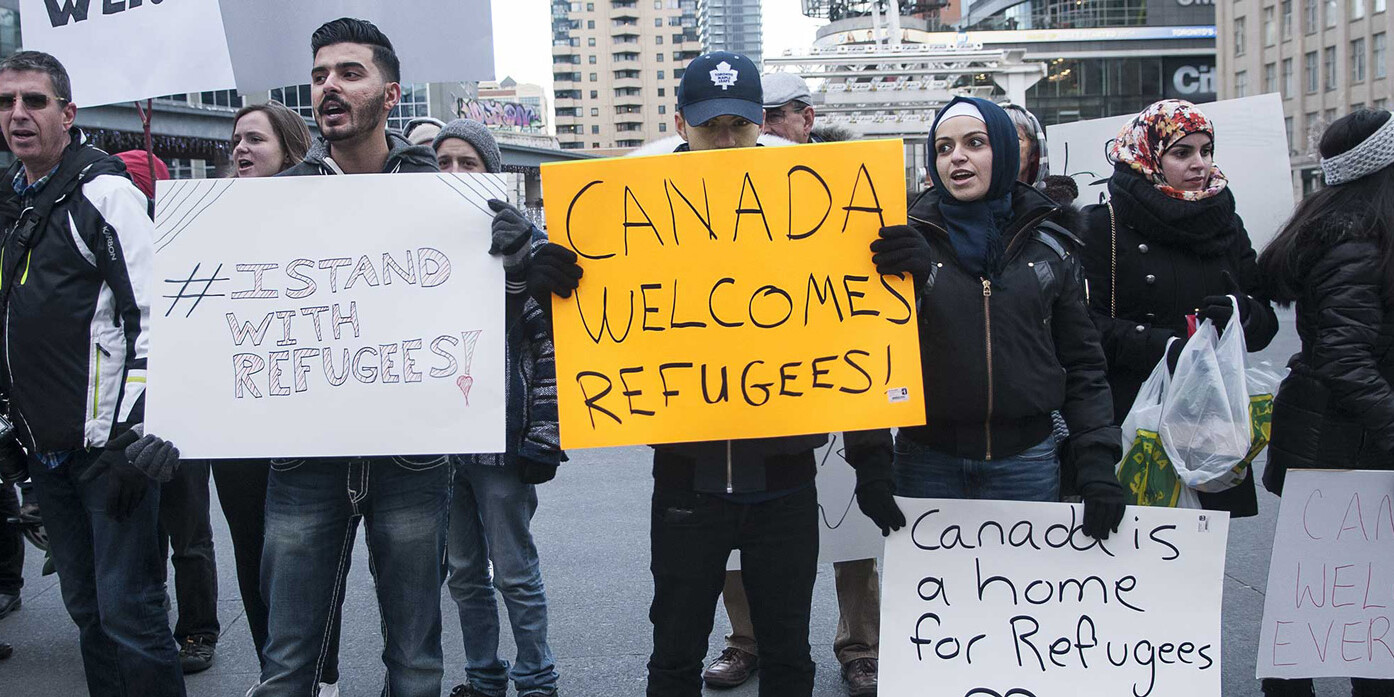
Canadian public opinion on immigration and refugees
The 43rd Canadian Federal Election just concluded was a tightly-contested campaign in which the incumbent Liberal Government led by Justin Trudeau found itself in a tough fight for reelection just a few years after it took office on a promise of “sunny ways” and broad political support.
November 5, 2019
November 5, 2019immigration,focus canada,canadian identity,racism,values,discriminationReport

Public Opinion in Metropolitan Canada
This report examines public opinion on a range of issues in Canada’s four largest metropolitan areas – Montreal, Toronto, Calgary-Edmonton (combined) and Vancouver – areas that together hold 43 percent of the country’s total population.
October 16, 2019
October 16, 2019confederation of tomorrow,federalism,politics,canadian identity,valuesReport
Towards Reconciliation: Indigenous and non-Indigenous Perspectives
No attempt to assess, modernize or reimagine the Canadian federation today is complete without including the perspectives of Indigenous Peoples, and addressing issues relating to the prosperity and well-being of Indigenous Peoples and communities.
October 15, 2019
October 15, 2019confederation of tomorrow,indigenous peoples,reconciliationReport
Confidence in Democracy and the Political System
This report examines current levels of public support for democracy, democratic institutions and the political system in Canada and how these have evolved over the past decade.
September 11, 2019
September 11, 2019democracy,americasbarometer,civic engagementReport

Canadians’ Satisfaction with Public Services
How satisfied are Canadians with some of the most important services that governments provide? This report tackles this question by providing an updated look at Canadian public opinion, as it is changing over time and in comparison to other countries around the world.
September 11, 2019
September 11, 2019politics,racism,democracy,discrimination,public servicesReport
Perceptions of Gender and Political Leadership
New survey data collected by the Environics Institute suggest that one obstacle to recruiting more female candidates for public office is the difference in the degree to which men and women see themselves as qualified to run for election, and the extent of the encouragement that they receive to do so.
September 5, 2019
September 5, 2019politics,gender inequality,democracy,americasbarometerReport
Canadian Youth Reconciliation Barometer 2019
Canada’s relationship with the Indigenous Peoples who first inhabited this land continues to be largely unresolved and fraught with controversy.
July 9, 2019
Official Bilingualism at 50
Fifty years after the passage of the Official Languages Act, more than eight in ten Canadians support the policy of official bilingualism.
May 21, 2019
May 21, 2019confederation of tomorrow,federalism,politics,canadian identity,valuesReport
Canada: Pulling Together or Drifting Apart?
This report looks at Canadians' identity within the country, and how they see their province or territory's place in the federation.
March 21, 2019
March 21, 2019confederation of tomorrow,federalism,canadian identity,valuesReport
Making Federalism Work
This report focuses on the ways in which the country’s federal, provincial and territorial governments should work together as federal partners to address key issues.
March 21, 2019
March 21, 2019confederation of tomorrow,federalism,canadian identity,valuesReport

2018 Survey of Jews in Canada
A major survey was conducted in 2018 by the Environics Institute for Survey Research, in partnership with the University of Toronto and York University. The survey is the first of its kind in Canada to explore the perspectives of Jews in Canada, addressing themes of identity, practice and experience.
March 11, 2019
March 11, 2019racism,religion,lived experience,discrimination,identityReport
Canadian public opinion on immigration, refugees and the USA
The past year has been a contentious one for immigration and refugee issues in many parts of the world. In the USA, the Trump administration is taking a harsher stance on migrants (e.g. separating children from parents) and the political climate is turning ever more xenophobic.
November 18, 2018
November 18, 2018immigration,multiculturalism,focus canada,racism,discriminationReport
Toronto Social Capital Study 2018
How can communities best measure the well-being of their citizens? Often this is done using economic measures of employment, income and inequality. There are also statistics reporting on incidences of crime, of homeless or of disease (most recently focusing on cases of COVID-19).
October 8, 2018
October 8, 2018social capital,civic engagement,toronto social capital studyReport
Canada’s World Survey 2018
The survey was the first to ever ask Canadians about how they see their place in the world, and that of their country – not simply what they believe their governments should be doing: What do they see as the top global issues, and how do they orient personally to the world outside of the national borders, in terms of their interests, travel and personal connections?
April 16, 2018
April 16, 2018canadian identity,values,foreign affairsReport
Canadian Public Opinion on Immigration and Minority Groups
Canada is generally seen as a welcoming and tolerant country when it comes to immigration and cultural diversity, and public opinion research has shown that a majority of Canadians have consistently held generally (if not unequivocally) positive views towards immigrants and citizens with ethnic backgrounds much different from their own.
March 22, 2018
March 22, 2018immigration,multiculturalism,focus canada,racism,discriminationReport
Black Experience Project in the GTA
A groundbreaking research study of the "lived experience" of individuals across the Greater Toronto Area who self-identify as Black or of African heritage.
July 31, 2017
July 31, 2017racism,black experience project,civic engagement,lived experience,discriminationReport
AmericasBarometer 2017
The AmericasBarometer is a 29 country public opinion survey on democracy, governance and civic engagement, conducted every two to three years by a consortium of of research partners across the western hemisphere.
June 30, 2017
June 30, 2017politics,social capital,government role,democracy,americasbarometer,civic engagementReport

Canadian Public Opinion About Immigration and the USA
In the past six months, the surprising election of Donald Trump to the US presidency has sent shock waves through that country, and reverberations around to globe. His administration is charting an unpredictable new course in domestic and foreign policy, and among the first steps has been a tightening of restrictions for visitors, immigrants and refugees seeking to enter the USA.
May 31, 2017
May 31, 2017immigration,multiculturalism,focus canada,racism,foreign affairs,discriminationReport
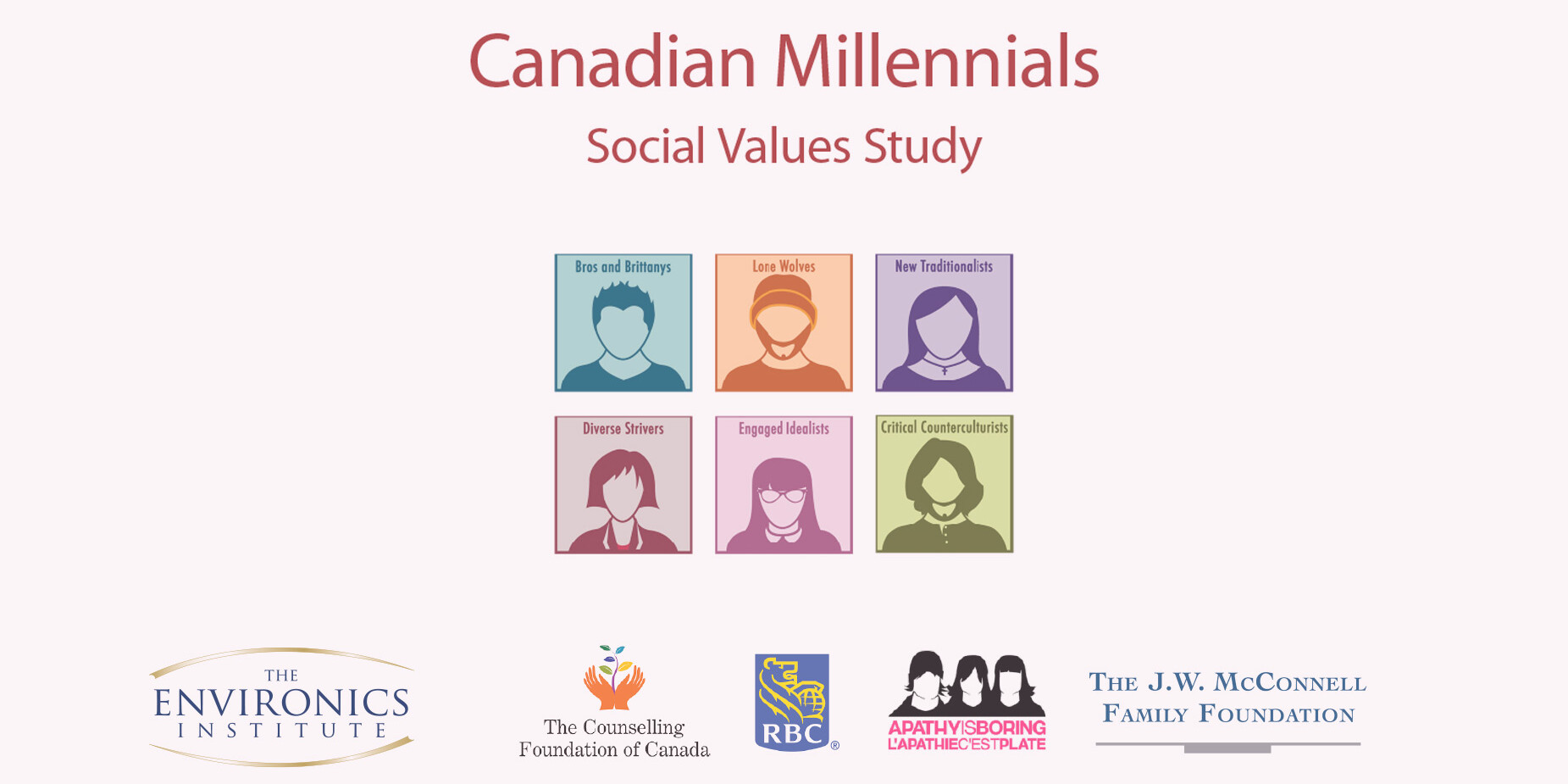
Canadian Millennial Social Values Study
A major national survey conducted in 2016 reveals a bold portrait of Canada’s Millennials (those born between 1980 and 1995), that for the first time presents the social values of this generation, and the distinct segments that help make sense of the different and often contradictory stereotypes that so frequently are applied to today’s young adults.
February 28, 2017
February 28, 2017social values,social change,youth,millennials & genz,michael adamsReport

Global Survey on Women as National Leaders
Throughout history, politics has been largely a man’s world. The 20th century witnessed significant changes, through women’s suffrage and the emergence of women as leaders of parties and nations, albeit at a slow pace and unevenly across the globe.
February 28, 2017

2016 Survey on Immigration and Citizenship
Migration levels are now at an all-time high worldwide, due in large part to massive numbers of refugees fleeing conflict in such countries as Syria and Iraq. Many are seeking a safe refuge in European countries, where governments are implementing new border controls, and the number of attacks against immigrants is on the rise.
October 31, 2016
October 31, 2016immigration,multiculturalism,focus canada,canadian identity,valuesReport
Public Opinion About Aboriginal Issues in Canada 2016
Canada’s relationship with the Aboriginal Peoples who first inhabited this land continues to be largely unresolved and fraught with controversy. The findings from the Truth and Reconciliation Commission is the latest compelling evidence of a troubled history and its contemporary legacy.
June 30, 2016
June 30, 2016indigenous peoples,racism,government role,discriminationReport
Canadian Public Opinion About Governance 2016
The world is changing rapidly, due in large part to fundamental transformations brought about by globalization, the digital revolution and social trends.
June 30, 2016
International Report Card on Public Education
As countries across the world battle to put the years of recession behind them and establish the right conditions for a sustained economic recovery, attention invariably turns to the role of education.
June 30, 2015

2015 Survey on Immigration and Multiculturalism
The last few years have not been good ones for immigrants and multicultural diversity – worldwide or in Canada. At the global level, the flow of migrants is now higher than at any time in human history.
June 30, 2015
June 30, 2015immigration,multiculturalism,focus canada,canadian identity,racism,values,discriminationReport
Survey of Muslims in Canada 2016
Muslims represent the fastest growing religious minority in Canada today, but their emerging presence has been contentious, fuelled in part by security concerns (in the long wake of 9/11) and some religious practices (e.g., Sharia law).
April 30, 2015
April 30, 2015immigration,multiculturalism,racism,religion,lived experience,discrimination,identity,muslimsReport

2015 Canadian Public Opinion on Climate Change
As part of its ongoing Focus Canada public opinion research program, the Environics Institute partnered with the David Suzuki Foundation to ask Canadians about climate change, to determine how perceptions have changed (or not) over the past year or so.
March 2, 2015
March 2, 2015focus canada,environment,government role,climate changeReport
Canadian Public Opinion on Governance and the Public Service
What does the public expect from governments, and how well do they believe their country, province and local municipality are governed?
December 31, 2014
AmericasBarometer 2014
The AmericasBarometer is a multi-country public opinion survey on democracy, governance and civic engagement, conducted every two years by a consortium of of research partners across the western hemisphere. The 2014 survey included 26 countries, encompassing 99% of the population of the Americas.
November 30, 2014
Democracy in the 21st Century: 2013 Trudeau Foundation Annual Survey
What is current Canadian public opinion as it relates to people and their environment, human rights and dignity, responsible citizenship, and Canada's role in the world?
November 30, 2013

Canadian Public Opinion About Climate Change 2013
Where does the Canadian public stand today on the issue of climate change? Have Canadians lost interest or do they remain concerned and want strong actions to address the problem?
November 30, 2013
November 30, 2013focus canada,environment,government role,climate changeReport
Focus Canada 2012
Focus Canada is an ongoing public opinion research program that provides a credible, independent and sustained source of Canadian public opinion data on important issues facing the country.
February 28, 2013
February 28, 2013focus canada,politics,economy,government roleReport
AmericasBarometer 2012
The public speaks on democracy and governance in Canada and across the Americas.
November 30, 2012
The Common Good – Who Decides? 2012 Trudeau Foundation Annual Survey
In conjunction with the Ninth Annual Pierre Elliott Trudeau Foundation Conference, entitled "The Common Good: Who Decides?”, the Environics Institute for Survey Research conducted a national survey of Canadians around this theme of defining the common good.
November 30, 2012
November 30, 2012government role,democracy,civic engagementReport,Presentation

Canadians on Hockey 2012
Hockey has long held a central place in Canada, and the National Hockey League is the flagship arena for the sport. Professional hockey has long stood out for the aggressive style of play, which has largely been accepted as just a part of the game.
May 31, 2012
Focus Canada 2011
Public opinion matters – in all countries, but especially in democracies like ours. Public opinion research in the public interest makes an essential contribution to good governance and meeting societal challenges.
March 31, 2012
March 31, 2012focus canada,politics,economy,government roleReport
Canadians on Citizenship
Canada’s history is one of successive waves of people arriving on its shores, each having to find their place among those who preceded them.
February 7, 2012
February 7, 2012canadian identity,values,democracy,civic engagementReport

Focus Canada 2010
Public opinion matters – in all countries, but especially in democracies like ours. Public opinion research in the public interest makes an essential contribution to good governance and meeting societal challenges.
February 28, 2011
February 28, 2011focus canada,politics,economy,government roleReport
Urban Aboriginal Peoples Study
The Environics Institute conducted the Urban Aboriginal Peoples Study (UAPS) as a landmark national study focusing on Aboriginal Peoples living in Canada’s major urban centres.
April 30, 2010
Canada’s World Survey
The Institute co-sponsored a national survey of Canadians’ engagement and involvement with the world outside our borders, as part of the Canada’s World initiative.
January 31, 2008
January 31, 2008united states,government role,lived experienceReport

2007 Survey of Afghans
The Institute sponsored the first-ever Canadian-initiated public opinion survey of the people of Afghanistan on issues related to quality of life, reconstruction, and Canadian military presence in the country.
October 31, 2007
October 31, 2007public opinion research,foreign affairsReport
Survey of Canadian Muslims
The Institute’s first project was a national survey to examine the relationship between Canadian Muslims and Canadian society at large. This research was conducted as part of Environics Research FOCUS CANADA, and built upon an earlier study conducted by the US-based Pew Research Center with Muslims and non-Muslims that covered 13 countries (but not Canada).
February 28, 2007
February 28, 2007immigration,multiculturalism,racism,lived experience,discrimination,muslimsReport