

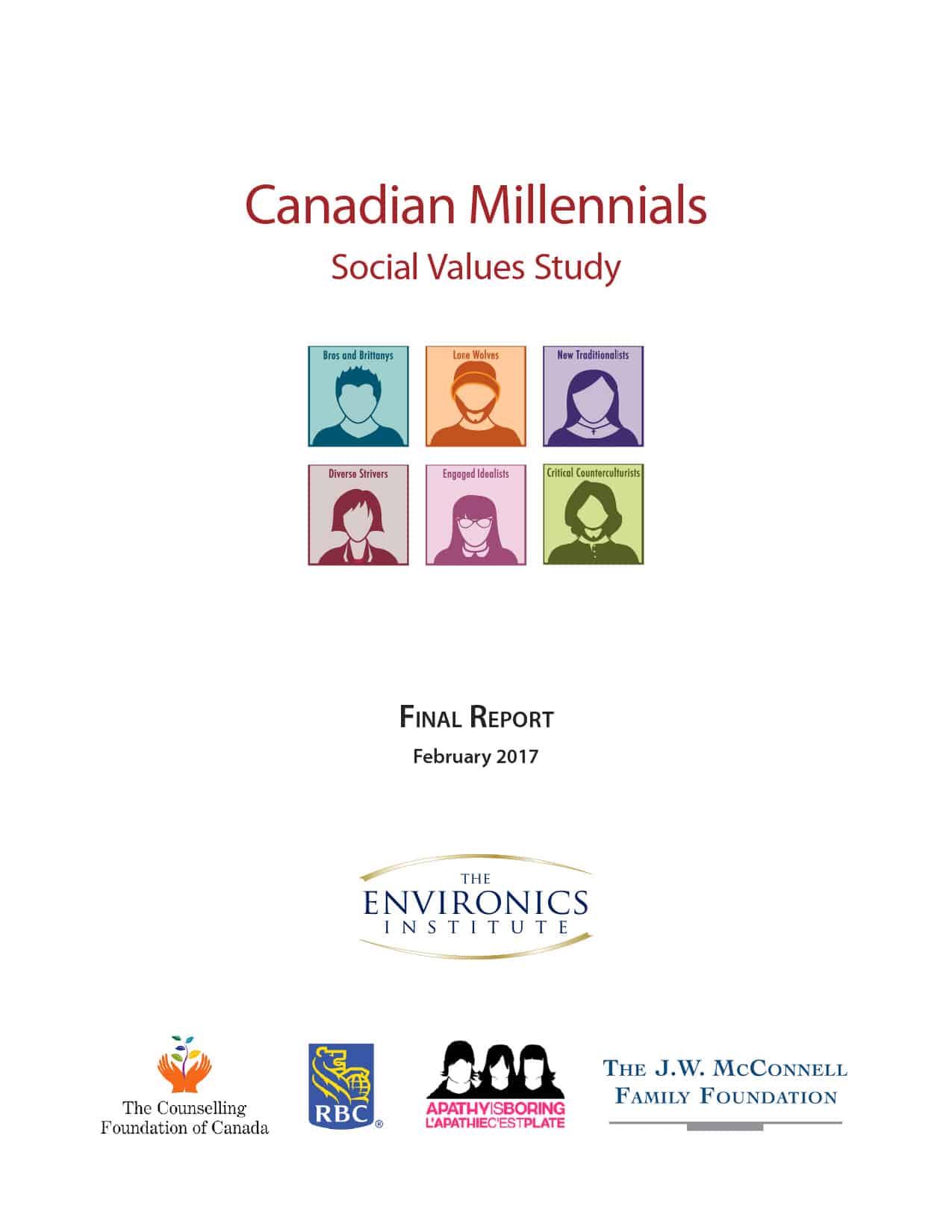
A major national survey conducted in 2016 reveals a bold portrait of Canada’s Millennials (those born between 1980 and 1995), that for the first time presents the social values of this generation, and the distinct segments that help make sense of the different and often contradictory stereotypes that so frequently are applied to today’s young adults.
The results show that Millennials cannot be lumped into a single group defined by their age, or by other demographic characteristics such as gender, region or socio-economic status. They are a diverse part of the Canadian society, made up of six social values “tribes”, each reflecting a distinct worldview and approach to life. While Millennials may share some common experiences and aspirations as befits their stage in life, there are notable differences in outlook and life path across these tribes, be they “Engaged Idealists,” “Bros and Brittanys,” or “Lone Wolves.”
The study built on the foundation of Environics’ Research leading-edge social values research to better understand how Millennials are taking their place in society through the lens of their social values, with a focus on their life goals and what it means to be an adult, career aspirations and work experience, and political and social engagement.
Survey Details
The survey is based on interviews conducted online with a representative sample of 2,072 Canadians aged 21 to 36 across the country between July 6 and August 31, 2016. The sample was stratified by age, gender and region (margin of error statistics do not apply to online surveys that employ non-probability samples).
Partners
The study was conducted by the Environics Institute for Survey Research, in partnership with The Counselling Foundation of Canada,Royal Bank of Canada, the J.W. McConnell Family Foundation and Apathy is Boring.
Related reading

Toronto Social Capital Study Video
Conducted more than two years after the start of the pandemic, the 2022 Toronto Social Capital Study assesses whether the crisis brought the city’s residents closer together or pushed them further apart.
Canadian Youth
A new national research project documents for the first time the social norms that govern how Canadians think about and act on different types of racial micro-aggressive actions directed at people who are Indigenous or Black.
Toronto Social Capital Study 2018
How can communities best measure the well-being of their citizens? Often this is done using economic measures of employment, income and inequality. There are also statistics reporting on incidences of crime, of homeless or of disease (most recently focusing on cases of COVID-19).