

Work at Home or Live at Work: The Complexities of New Working Arrangements
A report from the Survey on Employment and Skills (2nd wave)
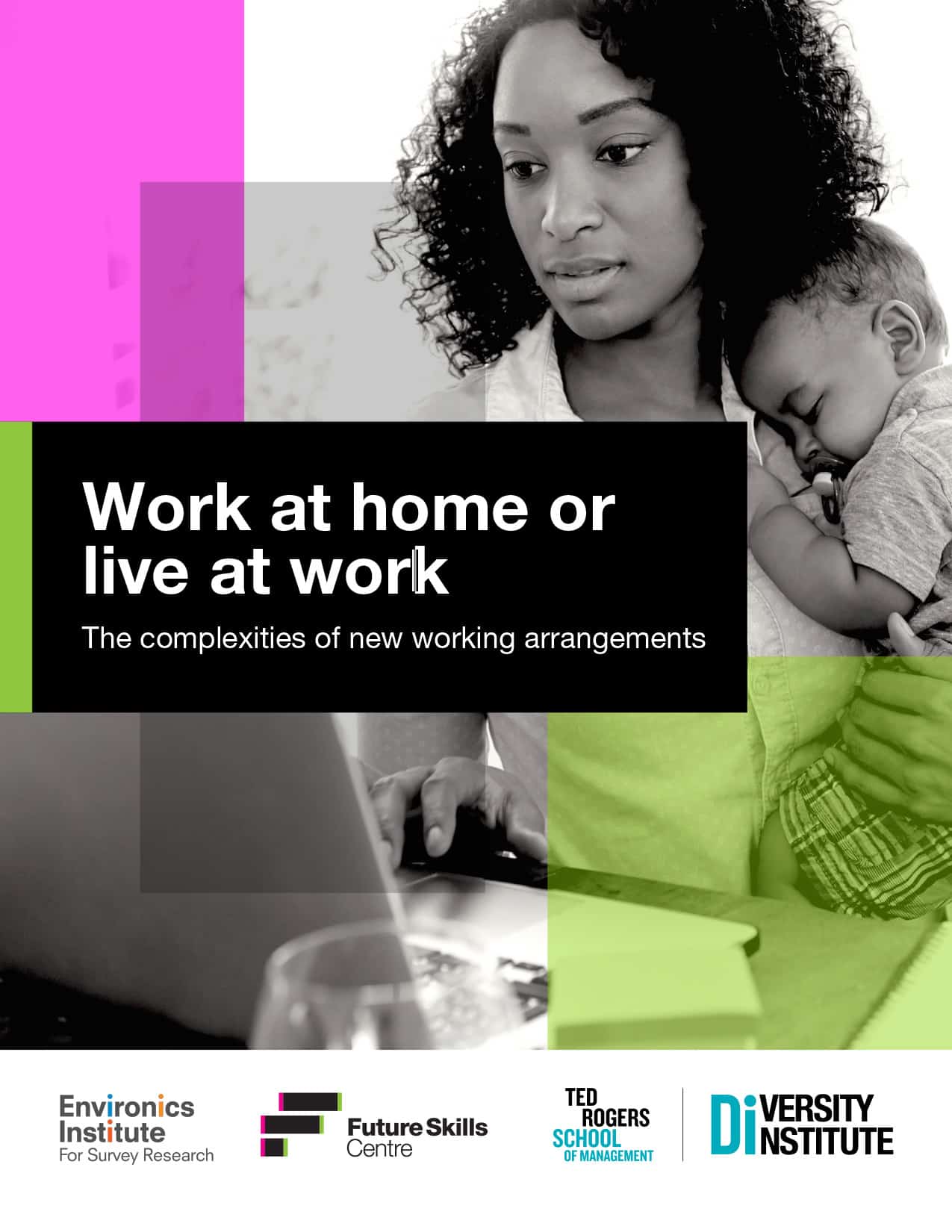
This report from Wave 2 of the Survey on Employment and Skills focuses on the experience of working from home. It examines who has been working from home during the pandemic and who has had to continue to work at their regular workplace; the challenges and benefits of working from home; and how these experiences vary among different types of employee.
Survey Details
The Survey on Employment and Skills is conducted by the Environics Institute for Survey Research, in partnership with the Future Skills Centre and the Diversity Institute at Toronto Metropolitan University.
The second wave of the study consists of a survey of 5,351 Canadians age 18 and over, conducted between November 24 and December 22, 2020, in all provinces and territories. It was conducted both online (in the provinces) and by telephone (in the territories).
Funder
The Survey on Employment and Skills is funded primarily by the Government of Canada’s Future Skills Centre / Le sondage sur l’emploi et les compétences est financé principalement par le Centre des Compétences futures du gouvernement du Canada.

Corps et âme : l’impact de la pandémie sur la santé physique et mentale
Ce rapport se concentre sur la perception des Canadiens et des Canadiennes à l’égard de leur santé physique et mentale ainsi que les façons dont celle-ci a changé durant la crise sanitaire. Il met également en lumière ce que ce constat implique pour les gouvernements et les employeurs, alors que ceux-ci se préparent à la relance postpandémique.
Selon le rapport, entre avril 2019 et décembre 2020, la perception des Canadiens et des Canadiennes sur leur santé physique, et particulièrement sur leur santé mentale, s’est détériorée. En ce qui a trait à la santé mentale, le changement a été particulièrement marqué chez les 65 ans et plus. Si le déclin dans la perception de la santé mentale s’est fait davantage sentir chez les personnes âgées que chez les adultes plus jeunes, il n’en demeure pas moins que les jeunes Canadiens et Canadiennes, en particulier les jeunes femmes, continuent d’évaluer leur santé mentale comme étant moins bonne que celle de la population en général.
L’enquête sur l’emploi et les compétences est menée par l’initiative d’Environics Institute for Survey Research en partenariat avec le Centre des Compétences futures et le Diversity Institute de la Toronto Metropolitan University.
La deuxième phase de l’étude a été réalisée auprès de 5 351 Canadiens et Canadiennes âgés de 18 ans et plus dans toutes les régions du Canada entre le 24 novembre et le 22 décembre 2020. Elle a été menée à la fois en ligne (dans les provinces) et par téléphone (dans les territoires).
The Survey on Employment and Skills is conducted by the Environics Institute for Survey Research, in partnership with the Diversity Institute at Toronto Metropolitan University and the Future Skills Centre.
Related reading

Disconnecting from work
The Survey on Employment and Skills confirms that many Canadians find it a challenge to keep their work, family and personal lives in balance. But experiences vary widely. Some workers, such as those who are self-employed, are more likely to appreciate the flexibility of modern work arrangements

The shift to remote work
The majority of those who have been working from home say they prefer this arrangement and want it to continue once the pandemic is over. And most of those who want to continue to work from home prefer to do so on a regular basis, rather than occasionally.
Making Federalism Work
This report focuses on the ways in which the country’s federal, provincial and territorial governments should work together as federal partners to address key issues.