

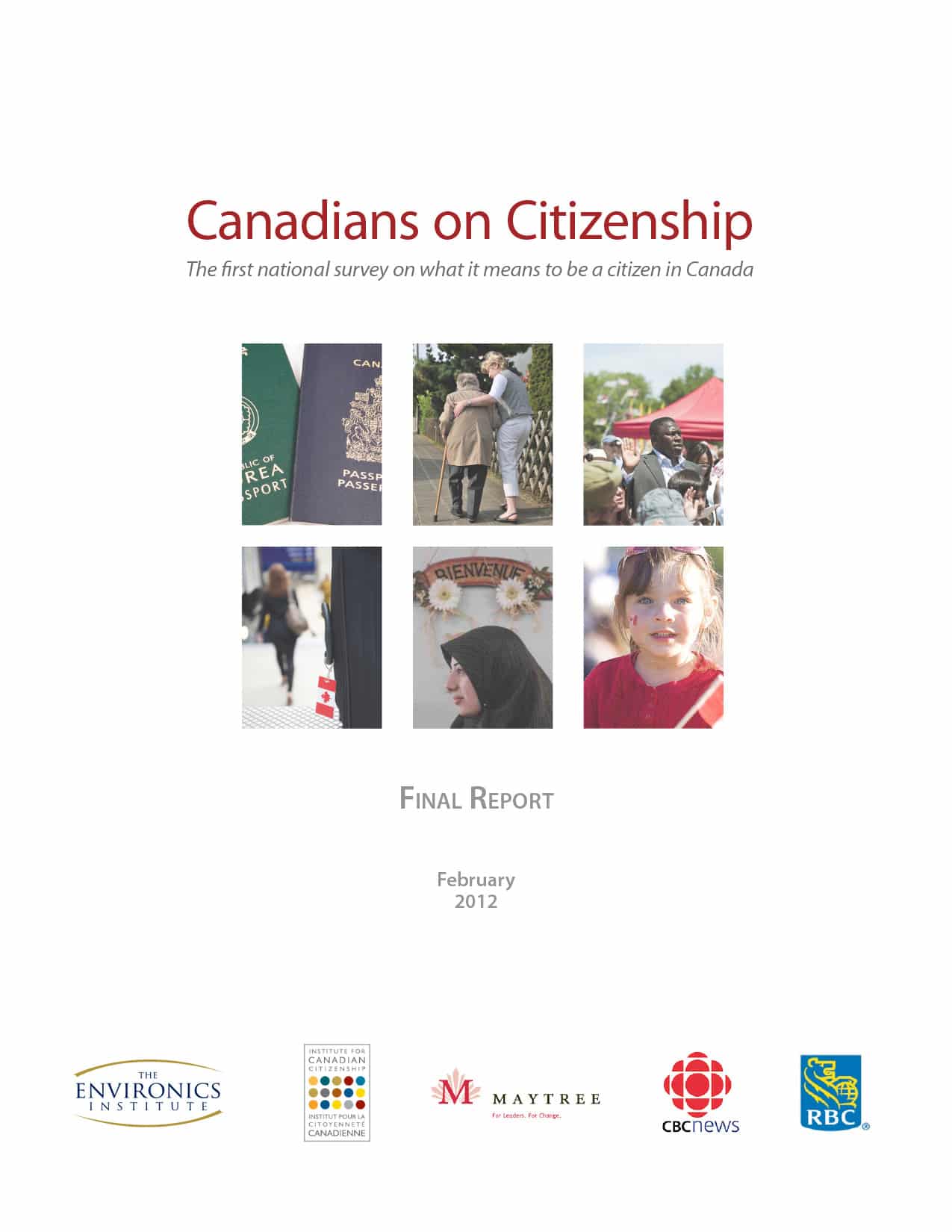
Canada’s history is one of successive waves of people arriving on its shores, each having to find their place among those who preceded them.In the early 21st century, perhaps Canada’s most defining characteristic is the broad diversity of cultures and peoples; this is widely seen elsewhere as a success story, and at home a source of pride for many.But what does it mean to be a citizen of a country that is increasingly populated by people arriving from so many other countries around the world?
Such a country requires a unique definition of citizenship that does not rely on concepts drawn from other countries with a more homogeneous population and deeply-rooted national character. Canada’s approach has been to treat this issue with little reflection and notable flexibility, but current trends are raising fundamental questions about the nature of citizenship, and its associated rights and responsibilities.
These trends include increasing apathy towards traditional political institutions and process (especially among youth); new communications technology that allow Canadians to be actively engaged with other parts of the world (including one’s country of origin); increasing racial, ethnic and religious diversity; a growing expatriate community (with more than 3 million Canadians now living abroad); and increasing levels of income inequality.
Survey Details
The research was conducted by the Environics Research Group, and is based on telephone interviews conducted between November 18 and December 17, 2011 with a representative sample of 2,376 Canadian residents (aged 18 and over) living in the 10 provinces. The sampling frame for this survey consisted of all Canadian households with an operating landline telephone connection. The survey sample was stratified to provide for adequate representation of smaller population subgroups (e.g., regions, urban areas, permanent residents), with the final data weighted so the total results are proportionate to the actual population distribution.
A sample of this size would be expected to produce results accurate to within plus or minus 2.0 percentage points in 95 out of 100 samples (the margin of error is greater for results for regional and other subgroups of the total sample).
Canada-USA comparisons. Comparative data on selected questions were also collected from the American population, based on an omnibus telephone survey conducted January 19 to 22, 2012 by CARAVAN with a representative sample of 1,014 adults (18 years and older) in the continental United States. This sample consisted of households with landline telephones (764) and cell-phone only (250) service. The total sample drawn from the population would be expected to produce results accurate to within plus or minus 3.1 percentage points (in 95 out of 100 samples).
Related reading

Canadians on Hockey 2012
Hockey has long held a central place in Canada, and the National Hockey League is the flagship arena for the sport. Professional hockey has long stood out for the aggressive style of play, which has largely been accepted as just a part of the game.

A Better Canada: Community, Citizenship and Engagement
The events of 2020 have disrupted every aspect of Canadians’ daily lives. What is less clear is the extent to which they have also changed their longer-term outlook.

2016 Survey on Immigration and Citizenship
Migration levels are now at an all-time high worldwide, due in large part to massive numbers of refugees fleeing conflict in such countries as Syria and Iraq. Many are seeking a safe refuge in European countries, where governments are implementing new border controls, and the number of attacks against immigrants is on the rise.