

Reconciliation and Relations with Indigenous Peoples
A majority continues to feel that individual Canadians have a role to play in efforts to bring about reconciliation, while a plurality continues to say governments have not gone far enough to advance reconciliation.

Building Faster?
Most Canadians support the federal government’s intention to act quickly to expand the country’s infrastructure, but not in the absence of agreements with its provincial or Indigenous partners.
Canadians on Reconciliation and Relations with Indigenous Peoples
This year’s report from the 2025 survey provides an opportunity to assess the state of public opinion on these issues 10 years after the completion of the work of the Truth and Reconciliation Commission.
Indigenous experiences with racism in Canada
This year marks 10 years since the Truth and Reconciliation Commission finished its work investigating the history and impacts of Canada’s Indian Residential School system. The commission’s final report marked the completion of a painful yet essential process of testimony and revelation, but even more important the starting point for the country’s reckoning with its colonial legacy.
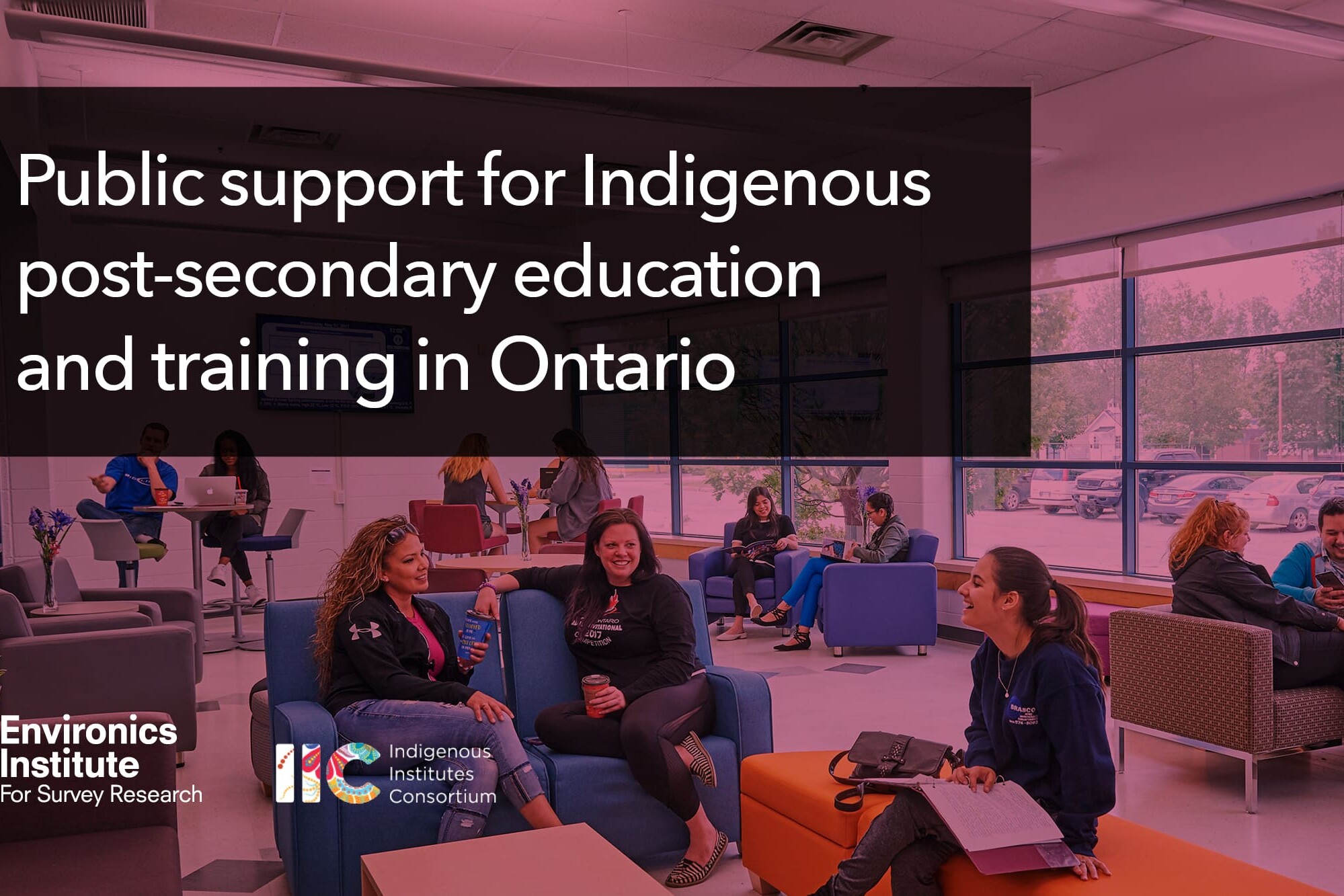
Public support for Indigenous post-secondary education and training in Ontario
The Calls to Action issued in 2015 by the Truth and Reconciliation Commission of Canada included a number of items relating to education. These included calls for measures to eliminate gaps in educational attainment between Indigenous Peoples and non-Indigenous people in Canada, to provide adequate and equitable funding of education for Indigenous students, and to develop culturally appropriate educational curricula.

Canadians don’t need to worry about identity politics
Should Canadians be worried about identity politics? Some commentators lament the current obsession with identity, which they say focuses on what makes us different from one another rather than on what we have in common; that identity politics only serve to divide society into resentful silos. | By Michael Adams & Andrew Parkin
Attachment and identity in the Canadian federation
The annual Confederation of Tomorrow surveys explore the relationships between different types of identity. It asks about attachment to and identification with Canada and one’s province or territory; it also asks Indigenous Peoples about their attachment to their Indigenous nation or community.
Reconciliation and Relations with Indigenous Peoples 2024
How do Canadians today see relations between Indigenous and non-Indigenous people and how the process of reconciliation unfolding? Confederation of Tomorrow surveys have been addressing this topic since 2019, and the 2024 survey provides a fresh update on public attitudes from both Indigenous and non-Indigenous perspectives, and how they have evolved over time.
Support for bilingualism and learning a second language
The 2024 Confederation of Tomorrow survey revisits the topic of official bilingualism and the importance of children learning to speak a second language. It finds that support for bilingualism as a policy, and interest in children learning a second language, both remain fairly high.

Canada is sorry – a lot. We shouldn’t apologize for that
A lighthearted stereotype of Canadians holds that we’re prone to apologizing, and under an absurdly broad array of circumstances. When someone steps on the toes of a Canadian, the joke goes, it’s the Canadian who will say sorry.