

In Canada, we commonly measure the extent of poverty by determining an income level, called a poverty line, for households of different compositions and in a variety of locations. Yet Food Banks Canada has suspected for some time that our income-based measurement of poverty may not be telling the full story about how many, and which, households in Canada are poor. During the crisis period of the pandemic, the number of visitors to food banks across Canada increased dramatically, and it has continued to rise at an alarming rate.
An alternative approach to measuring a household’s standard of living is to look at outcomes rather than inputs – that is, assessing a household’s standard of living by looking at the goods and services it has, or has access to, and the activities in which it participates. This method of measuring poverty is called a material deprivation index (MDI). Could this alternative way of measuring poverty help explain the gap between the official poverty rate and the experience of food banks across Canada?
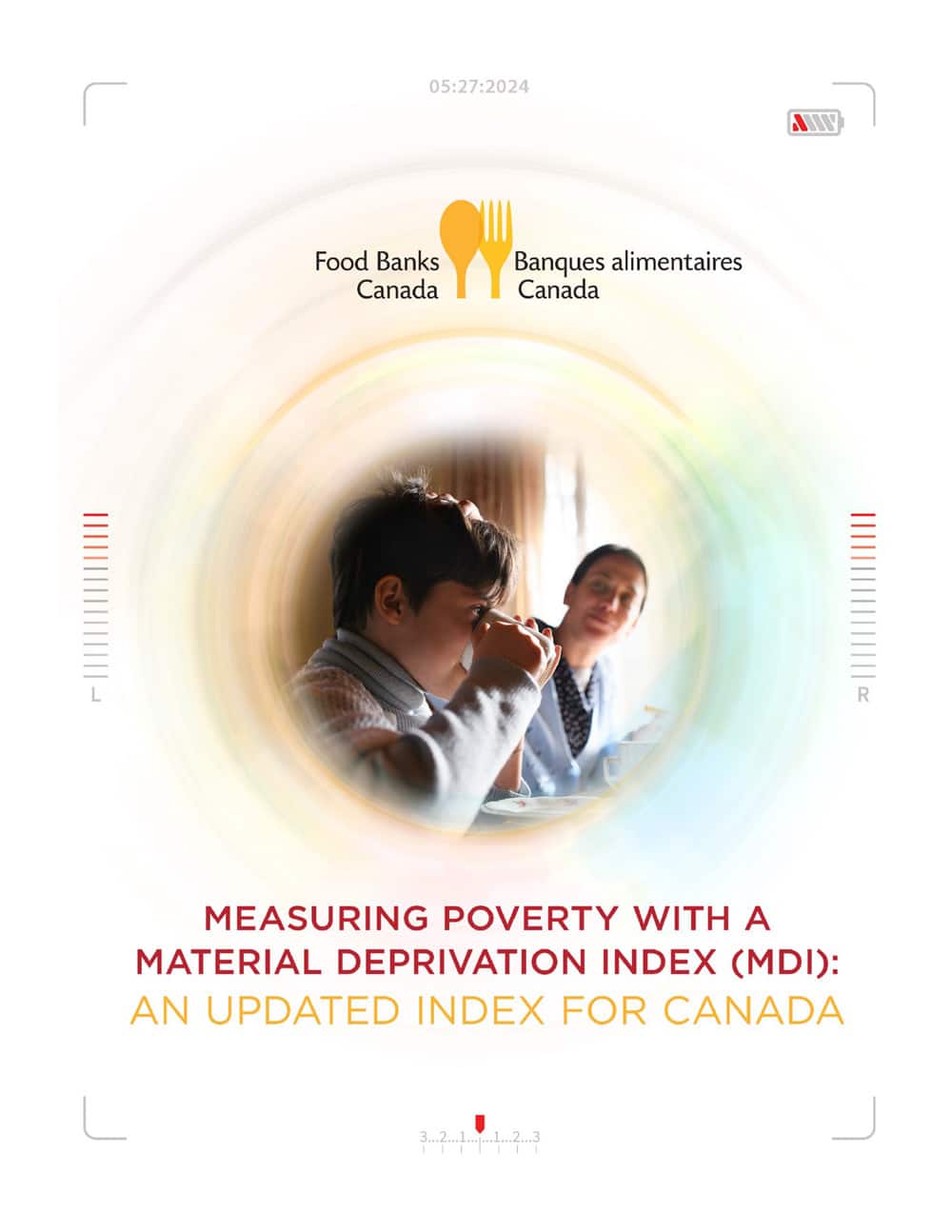
To answer this question, Food Banks Canada, in collaboration with the Maple Leaf Centre for Food Security and Maytree, initiated a project to develop and apply an MDI in Canada. The team’s completed research report, Measuring Poverty with a Material Deprivation Index (MDI): An Updated Index for Canada is now available in English and French. That report describes the research process in detail, including the rigorous analytic techniques that were used to develop and apply a Canadian MDI to describe poverty in Canada. A shorter summary report, Poverty in Canada Through a Deprivation Lens, has also been published. Both reports are available on this page, as well as on the Food Banks Canada website.
Survey Details
The new MDI was developed on the basis of a two-phased survey of Canadian residents, conducted in collaboration with the Environics Institute for Survey Research.
- The Phase One survey asked a representative sample of approximately 2,000 Canadian residents about the goods and services they would expect to find in a household with an acceptable standard of living in this country. Based on the results of the Phase One survey, and supplemented by a series of focus groups, the team selected an initial list of 14 items to include in the deprivation index.
- The Phase Two survey of 4,625 Canadian residents was then carried out in April and May of 2023. Respondents were asked if they had used or participated in any of the 14 items, and if they did not, whether this was because they could not afford to. Further testing resulted in an MDI consisting of 11 items that considers a person deprived if they cannot afford 2 or more items.
Based on the MDI, 25 percent of Canadians are in poverty. The proportion is much higher for single parents, those with a disability, and those who identify as Black or Indigenous. This finding is more consistent with the reality that food banks are seeing today.
The study shows that an MDI can complement existing income-based poverty measures, and should incorporated as part of the set of indicators used to assess levels of poverty in Canada.
Survey Partners
Food Banks Canada, in collaboration with the Maple Leaf Centre for Food Security and Maytree.
Acknowledgements
This research was led by Geranda Notten (Graduate School of Public and International Affairs, University of Ottawa), Sofia Seer (Food Banks Canada), Michael Mendelson (Maytree Fellow) and Richard Matern (Food Banks Canada); the survey development and implementation was supported by Andrew Parkin (Environics Institute).
Related reading

Identity, Values and Language
The third report explores issues relating to identity, values and language.
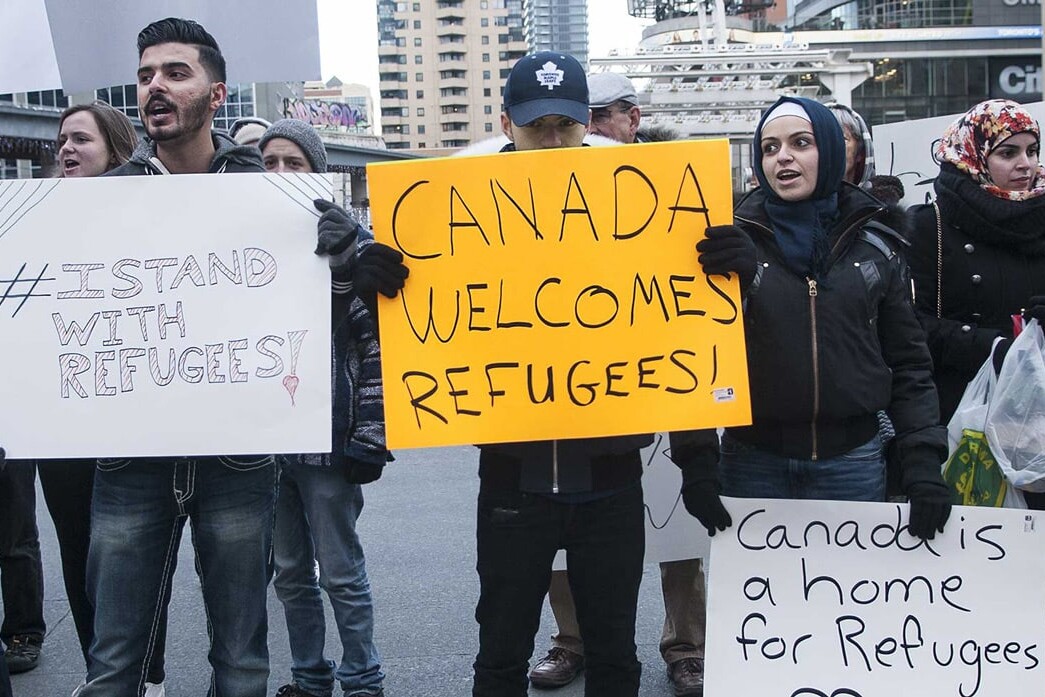
Survey of Canadian Muslims
The Institute’s first project was a national survey to examine the relationship between Canadian Muslims and Canadian society at large. This research was conducted as part of Environics Research FOCUS CANADA, and built upon an earlier study conducted by the US-based Pew Research Center with Muslims and non-Muslims that covered 13 countries (but not Canada).