

Attitudes toward social inequality in Canada and the USA
Are Canadians more egalitarian than Americans? Are they more troubled by the existence of various forms of social inequality – such as those between rich and poor, men and women, white and Black – and more inclined to look to government to address them?
South Asian experiences with racism in Canada
What has been the experience of South Asian people in terms of encountering racism, and how does this compare with other racialized groups in Canada? | By Keith Neuman
Black experiences with racism in Canada
This month marks the five-year anniversary of George Floyd’s tragic murder at the hands of the Minneapolis Police in May 2020. This event took place at a time of growing tension around police violence directed at the Black community in a number of cities, and sparked a massive wave of protests and demonstrations across the USA and other countries advocating for racial justice.
Indigenous experiences with racism in Canada
This year marks 10 years since the Truth and Reconciliation Commission finished its work investigating the history and impacts of Canada’s Indian Residential School system. The commission’s final report marked the completion of a painful yet essential process of testimony and revelation, but even more important the starting point for the country’s reckoning with its colonial legacy.
Personal experience with hate in Canada
Hate motivated aggression is becoming alarmingly common in Canada. This typically takes the form of blatant disrespect, abuse and sometimes violence motivated by hatred or bias directed at physical symbols (such as a mosque or synagogue), individuals or groups of people, or communities as a whole. | By Keith Neuman

Now is not the time for Canada to walk away from diversity, equity and inclusion
Canada is a much different place than it was three years ago. In 2021, the topic of racial justice was front and centre in the public discourse in response to George Floyd’s tragic murder, the Black Lives Matter movement, anti-Asian harassment, and uneven progress toward reconciliation with Indigenous peoples. | By Michael Adams, Marva Bailey-Wisdom & Keith Neuman
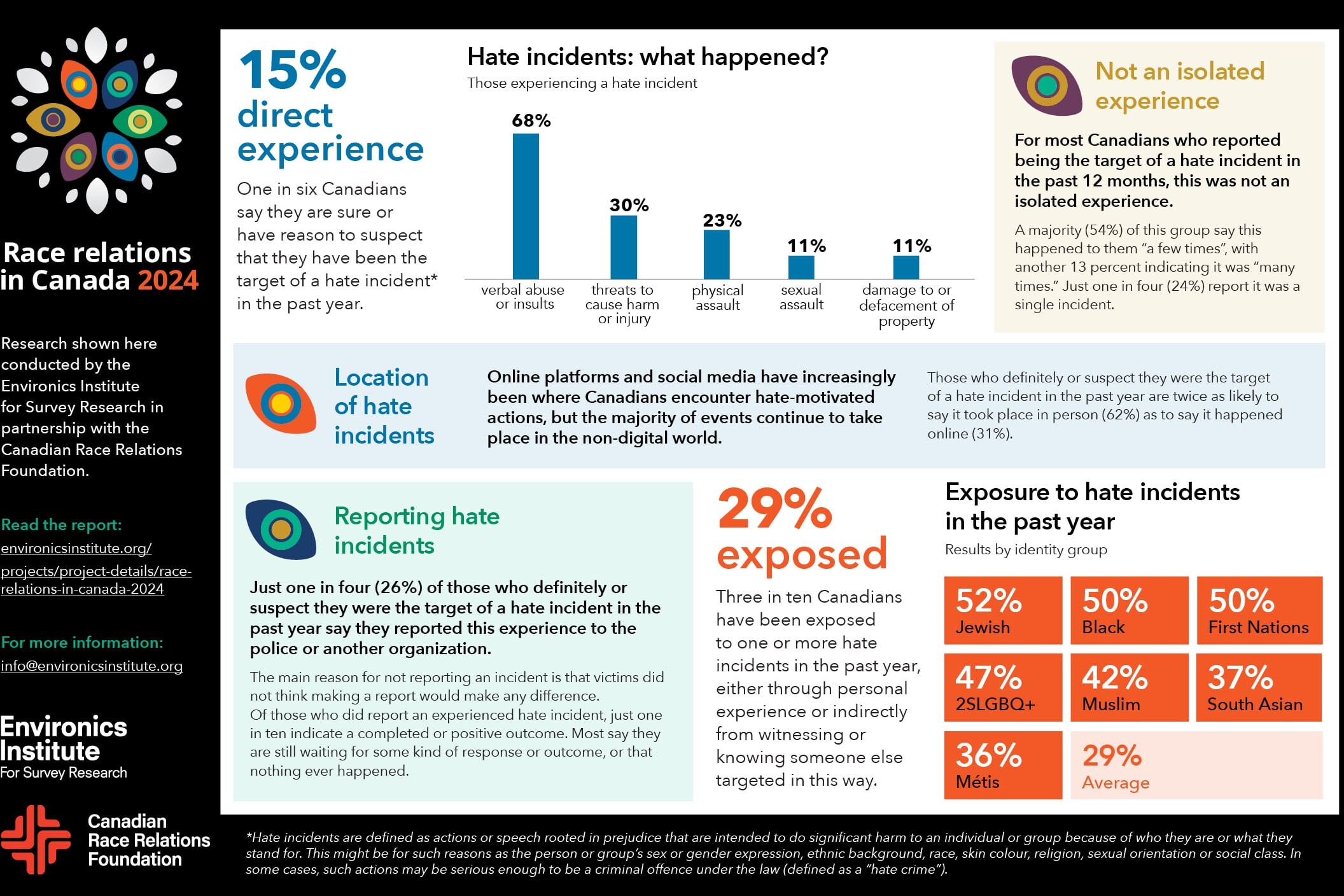
One in six Canadians say they have definitely or possibly been the target of a hate incident in the past year
The Race Relations in Canada 2024 Survey is the most comprehensive national survey to date focusing on Canadians’ experience with hate, a rapidly spreading form of anti-social aggressive racism directed at people, most commonly because of their race, ethnicity or religion.

Race Relations in Canada 2024
The research consisted of a main survey conducted online between February 12 and March 13, 2024 with 4,470 Canadians (ages 18+), and a supplementary survey conducted online between November 18 and 25, 2024 with 616 Canadians who identify as Jewish (by religion, ethnicity and/or culture).

Canada is sorry – a lot. We shouldn’t apologize for that
A lighthearted stereotype of Canadians holds that we’re prone to apologizing, and under an absurdly broad array of circumstances. When someone steps on the toes of a Canadian, the joke goes, it’s the Canadian who will say sorry.
Canadians aren’t just adapting to diversity – there are data to show we’re embracing it
This past year offered Canadians plenty of reasons to question their national identity. The angry occupation of Ottawa last winter, on the edge of Parliament Hill, clashed with our stereotype of Canadians as polite compromisers.