

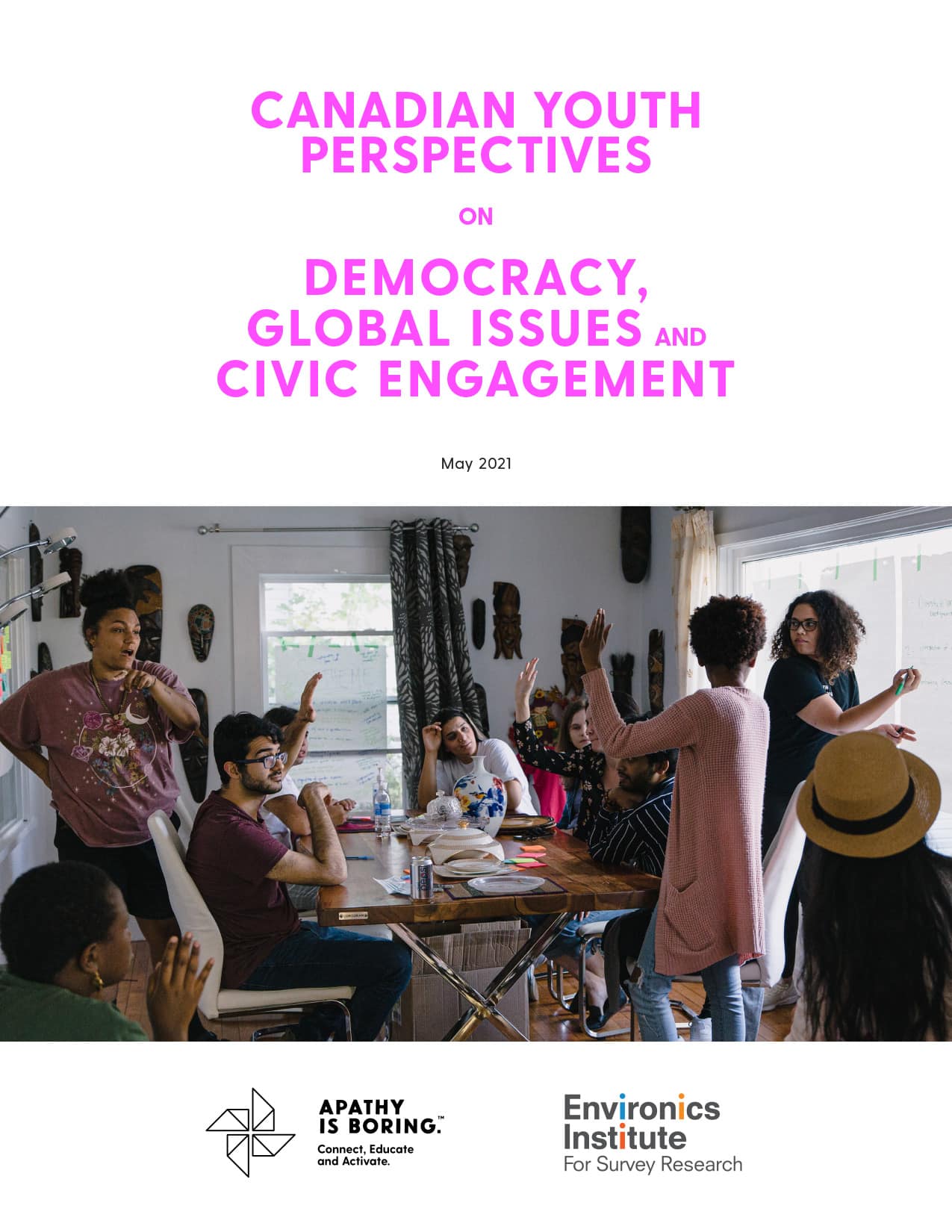
This study covers a large and diverse population but it is nonetheless possible to draw from it a broad portrait of leading-edge Generation Z and Millennial Canadians. In viewing the world as it is today, Canadian youth are cognizant of the serious challenges facing society, and likely less optimistic about the future than were youth in previous generations. Apart from the immediate crisis of the worldwide Covid-19 pandemic, the country’s younger generations are especially focused on global warming and environmental degradation as the most pressing global issue that needs to be addressed, but also attentive to other major issues such as racism and economic inequality.
As for how younger Canadians see the capacity of their country’s institutions to meet these and other challenges, the picture is mixed. On the one hand, youth are more likely than not to believe their country has a functioning democracy and governments that work, albeit with major problems. Most express confidence in public and nonprofit institutions (health care, education, major charities). On the other hand, there is widespread agreement that governments need to change in a variety of ways (even if there is no consensus on which changes are most essential), and youth express lower levels of trust in the private sector and media. At the same time, there is clear evidence of hope for the future, as many believe in the potential for making real progress on major global issues such as gender inequality and racism, and in the power of collective action at the local level.
Survey Details
The research consisted of an in-depth survey conducted online with a representative sample of 5,264 Canadians ages 18 to 40 across the country, which included Millennials (ages 25 to 40) and the leading-edge of Generation Zers (ages 18 to 24).1 The survey was administered by Environics Research between September 8 and November 9, 2020, and the sample was stratified to ensure representation by province, age and gender, according to the most current population statistics (2016 Census).2 In addition, oversamples were collected with individuals who self-identify as Black or Indigenous, in order to provide for sufficient representation of each group for analysis. The survey was conducted in English and French (as per respondent’s preference).
Related reading
Canadian Youth Reconciliation Barometer 2019
Canada’s relationship with the Indigenous Peoples who first inhabited this land continues to be largely unresolved and fraught with controversy.
Canadian Youth
A new national research project documents for the first time the social norms that govern how Canadians think about and act on different types of racial micro-aggressive actions directed at people who are Indigenous or Black.
A Better Canada: Community, Citizenship and Engagement
The events of 2020 have disrupted every aspect of Canadians’ daily lives. What is less clear is the extent to which they have also changed their longer-term outlook.