

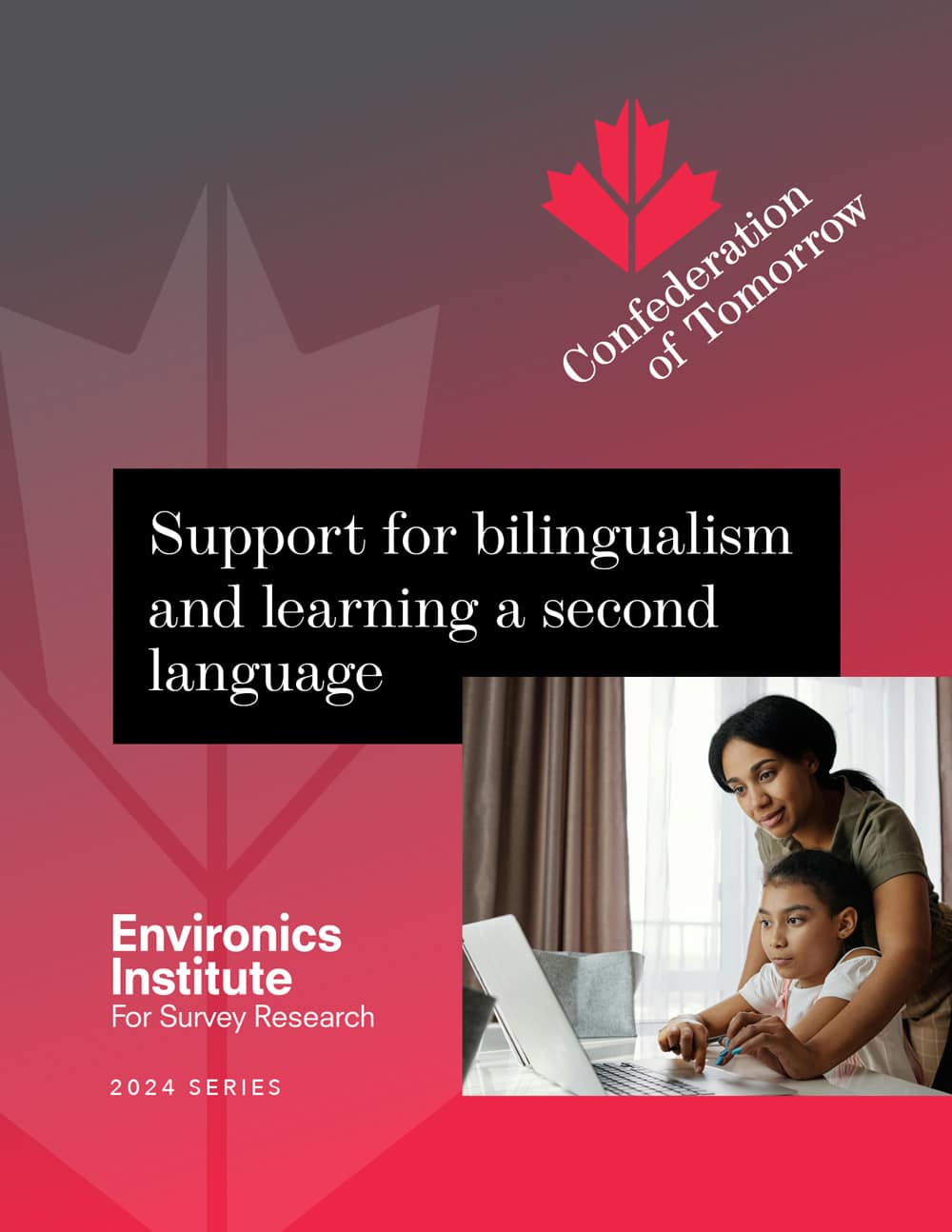
The 2024 Confederation of Tomorrow survey revisits the topic of official bilingualism and the importance of children learning to speak a second language. It finds that support for bilingualism as a policy, and interest in children learning a second language, both remain fairly high. And most Canadians outside Quebec who think it is important that children learn a second language also think that the specific language they should learn is French. Support for official bilingualism and interest in children learning French as a second language are both much higher among anglophones who have close friends who are francophone.
The survey confirms, however, that for some Canadians at least, opinions on bilingualism are linked to sentiments of regional resentment. Those who say their own region is treated unfairly in the Canadian federation, or who believe that Quebec is favoured, are much less likely to support official bilingualism.
Generally speaking, the preferred alternative for those who oppose English-French bilingualism is not another form of bilingualism (or multilingualism), but rather English unilingualism. In other words, a plurality of those who are not interested in having their children learn French do not think it is important for children to learn any second language. This suggests that a focus on English-French bilingualism in Canada is not in tension with the promotion of other languages, and remains the best pathway for strengthening second language proficiency of any kind.
Survey Details
The 2024 study consists of a survey of 6,036 adults, conducted between January 13 and April 13, 2024 (82% of the responses were collected between January 17 and February 1); 94% of the responses were collected online. The remaining responses were collected by telephone from respondents living in the North or on First Nations reserves.
Funder
This project benefits from the financial support of the Research Support Program of the Secrétariat du Québec aux relations canadiennes (SQRC) / Ce projet bénéficie de l’appui financier du Programme d’appui à la recherche du Secrétariat du Québec aux relations canadiennes (SQRC).


The Confederation of Tomorrow surveys give voice to Canadians about the major issues shaping the future of the federation and their political communities. They are conducted annually by an association of the country’s leading public policy and socio-economic research organizations.
More from this Series


Related reading
Support for equalization: 2023 update
Key findings are: Overall support for the equalization program in Canada remains steady; Support has increased in Alberta since 2019; Support remains steady in non-recipient provinces, but has fallen by 8 points since 2019 in recipient provinces. A 29-point gap between levels of support in Quebec and Alberta has narrowed to a 6-point gap.
Support for Democracy in Canada
This report focuses on the extent of public support for democracy in Canada, and examines whether this support has been weakening over time. The analysis is based on the results of the Canadian portion of the AmericasBarometer surveys, which track opinions on a consistent set of questions about democracy and its alternatives.

Support for Democracy in Canada
This report explores the current state of public trust in democratic institutions and actors in Canada, and how this may have changed over time. The data are drawn from the 2021 AmericasBarometer survey in Canada.