

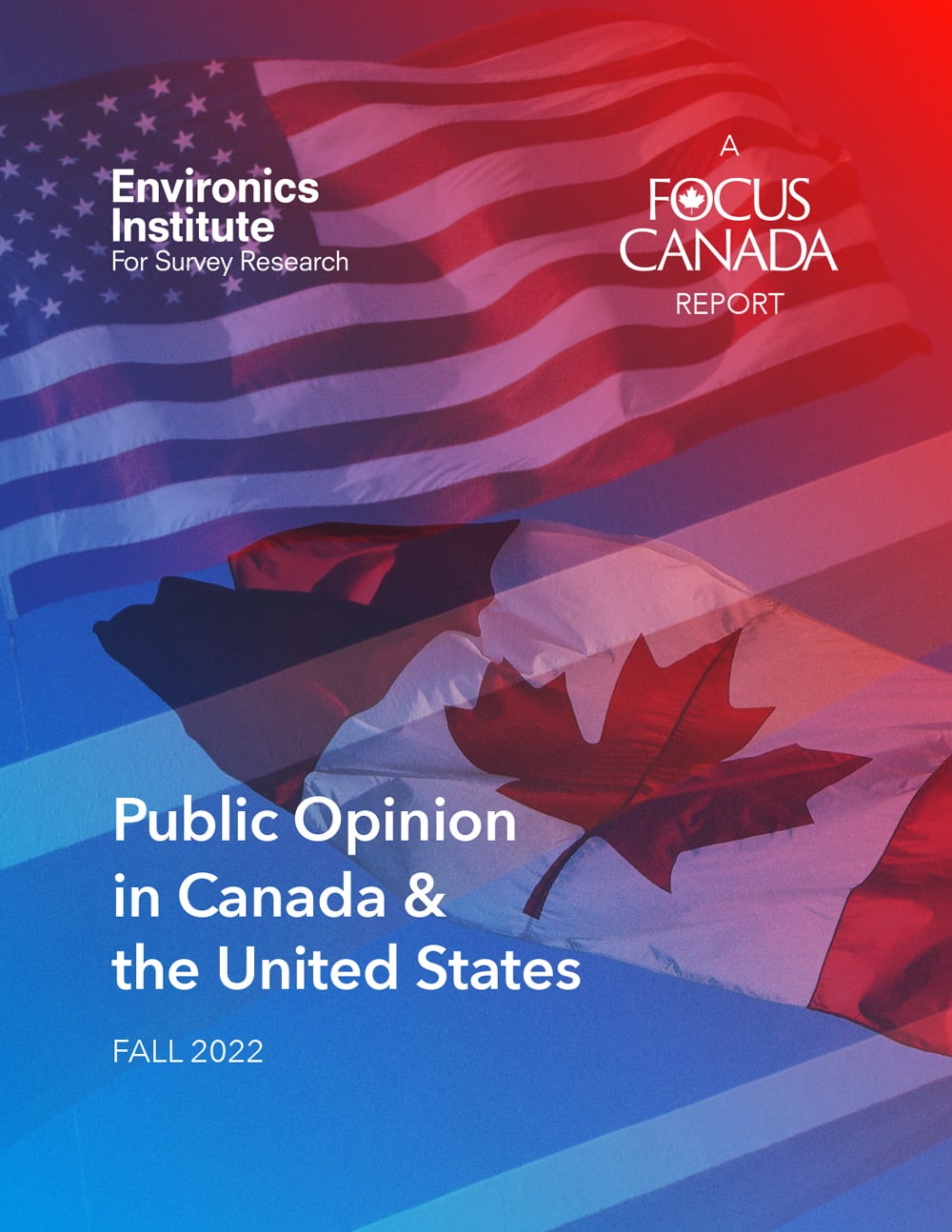
The presidency of Donald Trump put considerable strain on the historically strong relationship between Canada and the United States. It did so not only by creating friction between the two governments on issues such as trade, but also by rapidly eroding the Canadian public’s traditionally favourable view of their neighbours – and shining a spotlight on growing differences in the values of the two societies.
During the latter decades of the 20th century, a majority of Canadians held a favourable view of the United States – despite the occasional disagreement between Ottawa and Washington on particular policy issues. Canadian opinions about the United States became more divided under the Presidency of George W. Bush, but returned to historical norms after the election victory of Barak Obama in 2008. But favourable opinions fell dramatically and reached new lows after 2016 and the election victory of Donald Trump. The latest Focus Canada survey shows that Canadians’ opinion of the United States improved somewhat with the election of Joe Biden – but not to the levels reached during the administrations of previous Democratic Party presidents.
While general opinions of the United States have become more negative over time, views of free trade with the United States have become more positive. In fact, Canadians have never been as supportive of North American free trade as they are today. Over time, Canadians have become more convinced of the economic benefits of free trade, and less concerned about the potential loss of the country’s cultural identity or political independence. Moreover, the partisan divide on the issue has disappeared. Whereas the level of support for free trade among Conservatives was previously twice as high as that among supporters of the NDP, now the views of two groups of partisans are virtually identical.
Survey Details
As part of its Focus Canada public opinion research program (launched in 1976), the Environics Institute updated its research on Canadian attitudes about the United States. It also asked questions on social issues in parallel surveys in both Canada and the U.S. The Canadian survey is based on telephone interviews conducted (via landline and cellphones) with 2,000 Canadians between September 6 and 30, 2022. A sample of this size drawn from the population produces results accurate to within plus or minus 2.2 percentage points in 19 out of 20 samples. The American survey is based on telephone interviews conducted (via landline and cellphones) with 1,001 adults in the continental United States who are registered voters between September 21 and 26, 2022. A sample of this size drawn from the population produces results accurate to within plus or minus 3.1 percentage points in 19 out of 20 samples.

Focus Canada
Focus Canada is the longest running and most comprehensive public opinion research program on public policy issues in Canada.


Related reading
Public Opinion About Canada-USA Relations
Canada and the United States have enjoyed a strong relationship for more than a century. There have been ups and downs depending on the respective leaders in each country, but underneath remained a solid foundation of trust and partnership.

Public Opinion in Metropolitan Canada
This report examines public opinion on a range of issues in Canada’s four largest metropolitan areas – Montreal, Toronto, Calgary-Edmonton (combined) and Vancouver – areas that together hold 43 percent of the country’s total population.
Public Opinion About Aboriginal Issues in Canada 2016
Canada’s relationship with the Aboriginal Peoples who first inhabited this land continues to be largely unresolved and fraught with controversy. The findings from the Truth and Reconciliation Commission is the latest compelling evidence of a troubled history and its contemporary legacy.