


Building Faster?
Most Canadians support the federal government’s intention to act quickly to expand the country’s infrastructure, but not in the absence of agreements with its provincial or Indigenous partners.
May 11, 2026
May 11, 2026Reportconfederation of tomorrow,indigenous peoples,federalism,politics
Looking for something specific?
Attitudes toward social inequality in Canada and the USA
Are Canadians more egalitarian than Americans? Are they more troubled by the existence of various forms of social inequality – such as those between rich and poor, men and women, white and Black – and more inclined to look to government to address them?
March 30, 2026
March 30, 2026economy,racism,united states,gender inequality,youth,americasbarometer,discriminationReport
Ballot questions
As part of its Focus Canada public opinion research program (launched in 1976), the Environics Institute examined the ballot questions for the April 2025 federal election by asking voters to identify which issue was the most important to them personally in choosing which party to support.
August 5, 2025
August 5, 2025focus canada,politics,economy,united states politics,youthReport

Strong Schools, Stronger Future: What Canadians Expect from Public Education
To explore how Canadians view public education, the latest wave of the Survey on Employment and Skills asked Canadians two questions about schools in their communities. The first addressed the objectives that schools should have, and the second assessed school performance.
June 3, 2025
June 3, 2025survey on employment and skills,education,youthReport
Inter-generational Mobility in Canada
The 2024 survey finds that the proportions of Canadians who feel financially worse off today than their parents were at their age, and who feel that the next generation will be worse off than they are, are both trending upwards.
November 13, 2024
Housing Affordability
As immediate concern with the COVID-19 pandemic faded, new issues have appeared on the public’s agenda, the most prominent of which have been the cost of living and the affordability of housing.
November 20, 2023
Canadian Youth
A new national research project documents for the first time the social norms that govern how Canadians think about and act on different types of racial micro-aggressive actions directed at people who are Indigenous or Black.
March 31, 2022
March 31, 2022canadian identity,social values,values,youth,millennials & genz,civic engagementReport
Canadian youth perspectives on democracy, global issues and civic engagement
This study covers a large and diverse population but it is nonetheless possible to draw from it a broad portrait of leading-edge Generation Z and Millennial Canadians.
May 13, 2021

Impact of the Covid-19 Pandemic on Millennial and GenZ Canadians
This report examines how Millennial and GenZ Canadians have experienced the COVID-19 pandemic. It finds that a majority of Canada’s younger generations (those between the ages of 18 and 40) say that the COVD-19 pandemic has had either a major or at least a moderate impact on their lives.
March 16, 2021

Intergenerational Mobility in Canada
A succession of economic downturns over the last decades has led many to express concerns that the next generation of Canadians will be less, and not more, well-off than the ones that preceded it.
January 15, 2020
January 15, 2020focus canada,economy,social change,youthReport
Canadian Youth Reconciliation Barometer 2019
Canada’s relationship with the Indigenous Peoples who first inhabited this land continues to be largely unresolved and fraught with controversy.
July 9, 2019
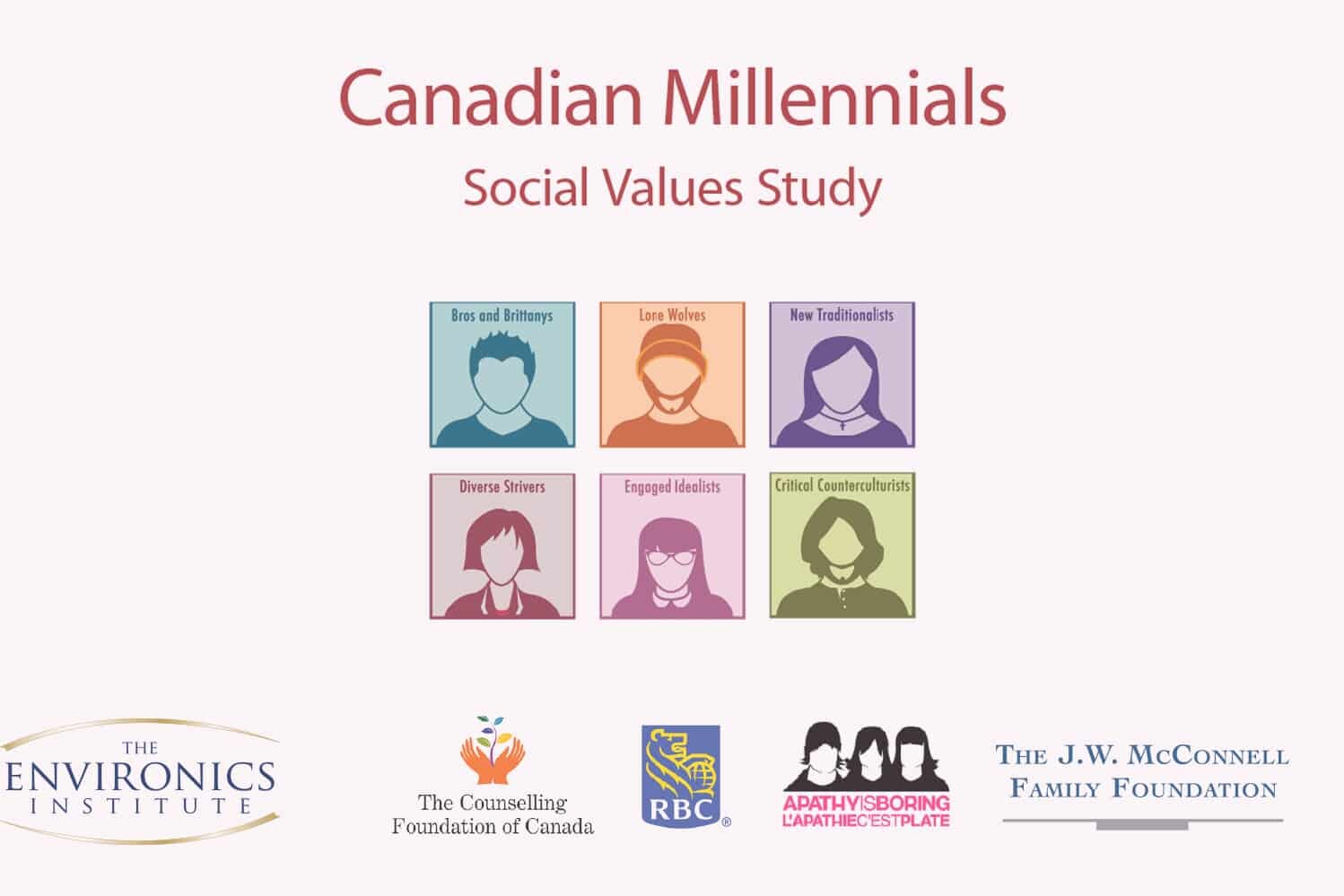
Canadian Millennial Social Values Study
A major national survey conducted in 2016 reveals a bold portrait of Canada’s Millennials (those born between 1980 and 1995), that for the first time presents the social values of this generation, and the distinct segments that help make sense of the different and often contradictory stereotypes that so frequently are applied to today’s young adults.
February 28, 2017
February 28, 2017social values,social change,youth,millennials & genz,michael adamsReport