

This is the second in a series of short insight pieces on race relations in Canada today and how it is changing, based on a national survey research program conducted by the Environics Institute for Survey Research, in partnership with the Canadian Race Relations Foundation. The research presented is drawn from the Race Relations in Canada Survey 2024.
Introduction
This year marks 10 years since the Truth and Reconciliation Commission finished its work investigating the history and impacts of Canada’s Indian Residential School system. The commission’s final report marked the completion of a painful yet essential process of testimony and revelation, but even more important the starting point for the country’s reckoning with its colonial legacy. The TRC’s 10 principles of reconciliation and 94 calls to action staked out the essential guideposts and markers defining how the relationship between Indigenous and non-Indigenous peoples in Canada must be repaired. Since that moment, the record shows that some progress has been made in fulfilling the TRC’s recommended calls to action, but much work remains to be done.
Apart from the efforts of governments, Indigenous communities and others to realize this vision of reconciliation, what has been the experience of Indigenous Peoples in their day-to-day relationship with other Canadians? To what extent do Indigenous Peoples continue to confront discrimination and racism, and is there evidence this is changing since the TRC completed its work a decade ago?
Valuable insight into these questions can be found in the results of a research program conducted by the Environics Institute for Survey Research in partnership with the Canadian Race Relations Foundation. The research consists of national surveys conducted in 2019, 2021 and 2024 with large samples of Canadians, structured to provide reportable results by country’s largest racial, ethnic and religious groups, including Indigenous Peoples (see here for further details on the research).
The research examines Canadians’ perspectives and experiences with respect to race and discrimination from a variety of perspectives. This short piece focuses on three specific questions directed at Indigenous Peoples who participated in the survey: a) how frequently do they personally experience racism and discrimination; b) have they witnessed such mistreatment of someone else of their own group; and c) do they believe in a better future for themselves and the next generation? The research looks at current perspectives and how they have changed (or not) over the previous five years.
Personal experience with racial discrimination
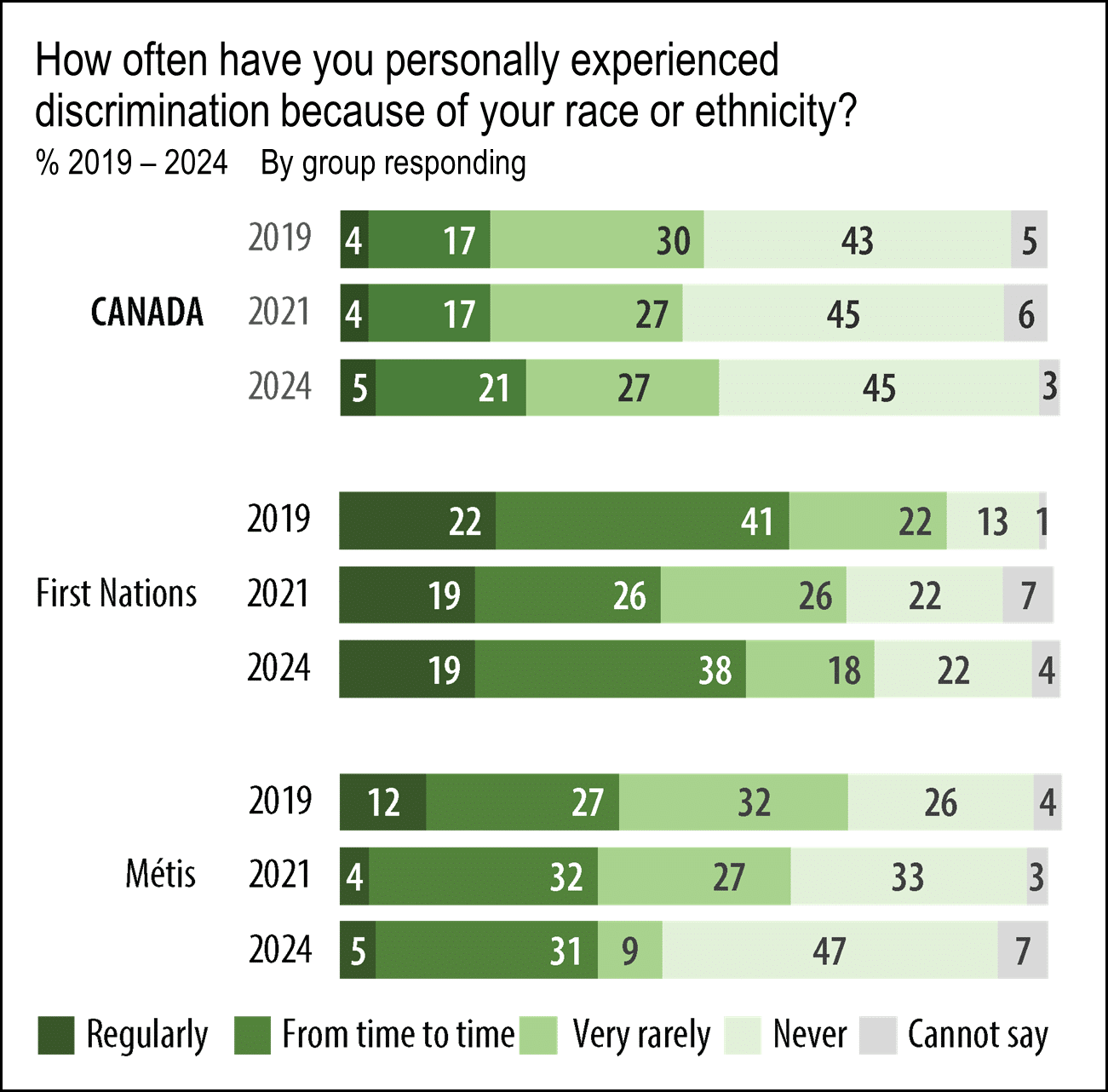
The survey asked Canadians about their personal experience with discrimination or unfair treatment because of their race or ethnicity. For the population as a whole in 2024, one in four say they this has happened to them regularly (5%) or from time to time (21%), with most indicating it has happened very rarely (27%) or never (45%). The results have held notably consistent since 2019.
Such experiences are, of course, much more common for racialized people, including Indigenous Peoples of whom about half say this happens regularly or from time to time.[1] But the research reveals the story is not the same for First Nations and Métis people.[2]
In 2024, First Nations people were the most likely of any identifiable group in Canada to report personal experiences of discrimination and racism, with close to six in ten saying this has happened to them regularly (19%) or from time to time (38%). This proportion indicating this took place “from time to time” increased since 2021, although it remains smaller than what was reported in 2019. In comparison with other groups, the frequency of racism experienced by First Nations people is similar to that reported by Black Canadians.
Métis people are much less likely to report personal experiences racial discrimination, with just over one-third indicating this has happened to them regularly (5%) or from time to time (31%). This proportion has remained stable since 2019, but the percentage reporting it never happening has been growing steadily over time (from 26% in 2019 to 47% in 2024). The frequency with which Métis people are directly targeted with racial mistreatment is closer to that reported by white Canadians than that reported by other racialized groups such as South Asian and Chinese people.
Witnessing discrimination against other Indigenous Peoples
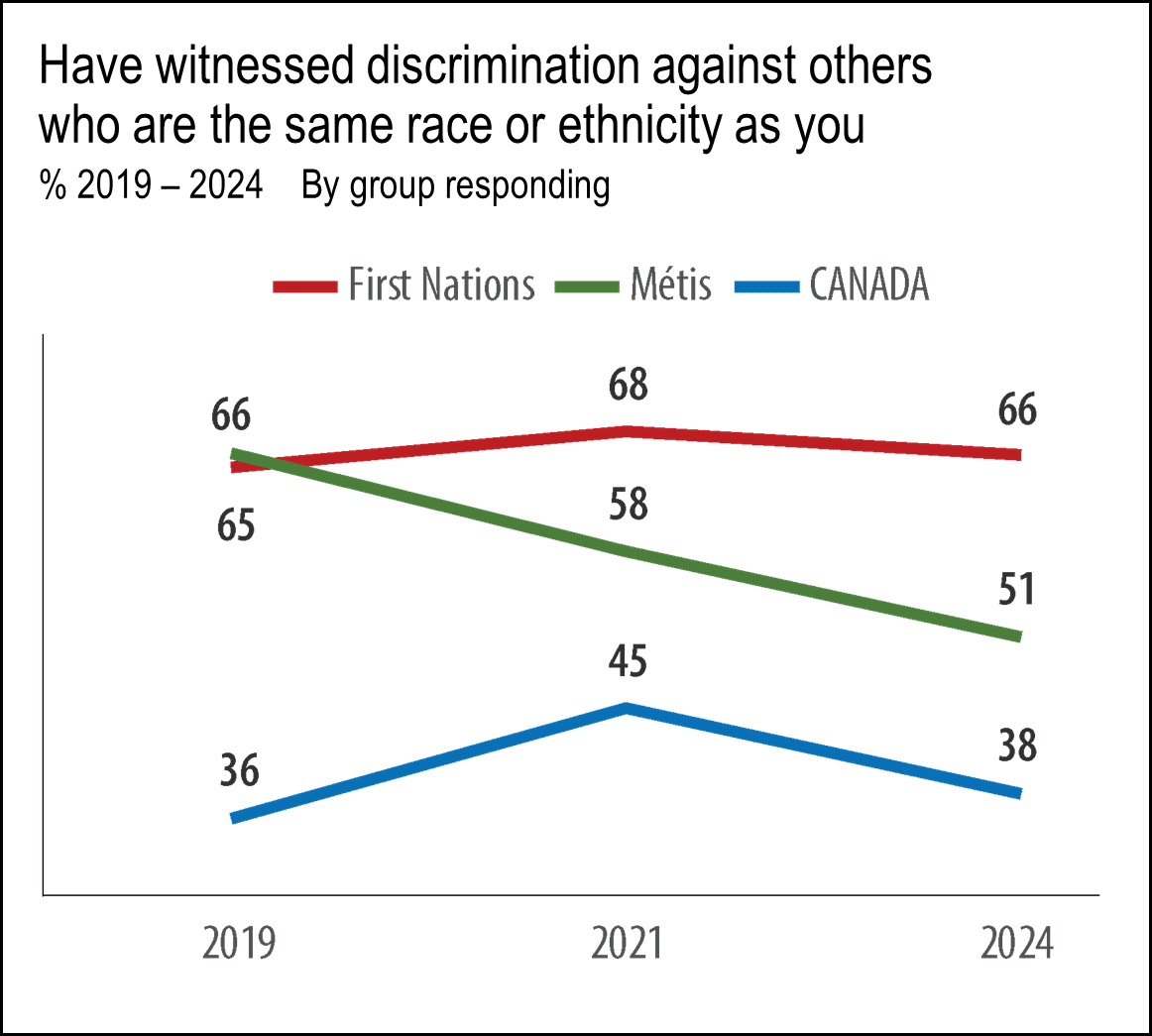
Apart from their own personal experiences, a majority (57%) of Indigenous people surveyed say they have witnessed discrimination or unfair treatment of someone else who is the same race as themselves, because of their race. The proportion reporting this is a bit lower than in 2019 or 2021, but remains higher than for other Canadians except those who are Black or Jewish (65%, respectively). For Canadians as a whole, just under four in ten (38%) report witnessing someone of their race experiencing discrimination or mistreatment.
As with personal experience, witnessing mistreatment of someone else is more commonly reported by First Nations people (66%) than those who are Métis (51%). For First Nations people, the proportion reporting such witnessing has remained relatively steady since 2019, but for Métis people such incidents have declined noticeably (by 15 percentage points) over this time period.
Future outlook of racial equality
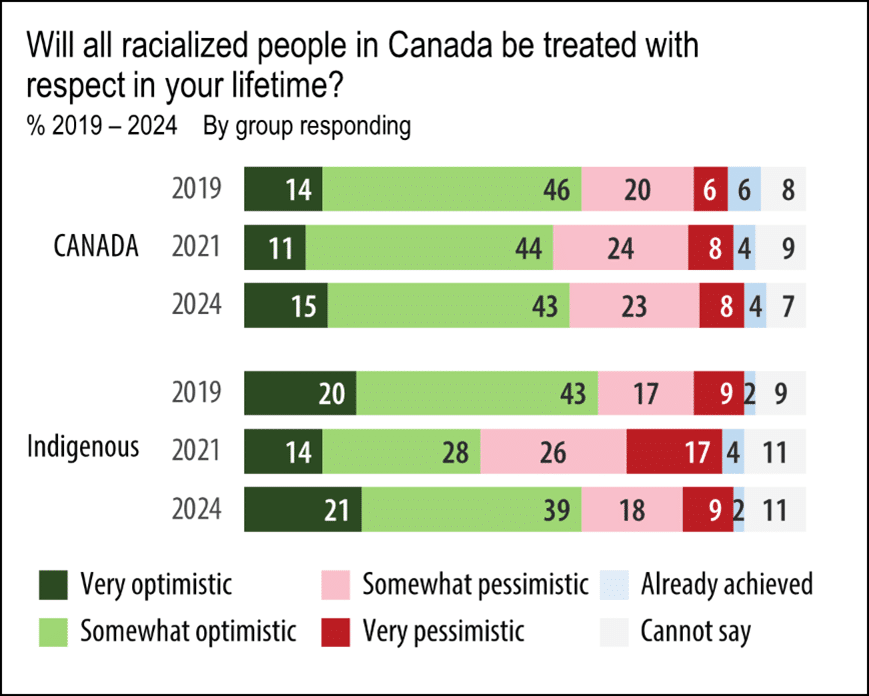
The present day reality of racism notwithstanding, how do Indigenous Peoples feel about the future, for themselves and their children? In general terms most express hope for progress toward racial equality in their lifetimes. Six in ten are very (21%) or somewhat (39%) optimistic that all racialized people in Canada will be treated with the same respect as other people in their own lifetime, compared with 27 percent who are pessimistic about such progress.
Indigenous Peoples are now more positive about the future than in 2021 (up 18 percentage points), and they are also now more hopeful for a future of racial equality than Canadians as a whole (58% optimistic, versus 31% pessimistic). On this measure, it is First Nations who more likely to express optimism (61%) than Métis people (50%), although both groups show improvement since 2021.
When the focus shifts to the future treatment of one’s own group, opinions are less definitive. Fewer than four in ten (37%) Indigenous Peoples believe the next generation of their people will face less discrimination and stereotyping as they themselves do today, compared with one-fifth (21%) who expect they will face more; the remainder expect conditions to remain about the same or cannot offer an answer to the question.
Opinions on this question are largely the same as were expressed in 2019, although an increasing percentage (mostly Métis) cannot offer a clear response to the question.
Compared with other racialized groups in Canada, Indigenous Peoples are less likely to be optimistic about the treatment of the next generation.
Conclusion
This research provides compelling evidence of what is already well documented: Indigenous Peoples in Canada commonly experience racial discrimination and mistreatment by others, and more so than most other racialized people in this country. The evidence indicates that the frequency with which this takes place has remained largely stable over the past five years; whatever initiatives and progress may have been launched over this period have yet to make a notable difference in the lives of those most affected.
It is also apparent that this reality is not the same for everyone. First Nations people are more likely to be confronted by racial abuse, compared with Métis people for whom this type of experience has become less frequent over the past five years. This growing gap may be a reflection of how the Indigenous world is diverse and evolving over time. The Métis population has been expanding rapidly as a growing number of Canadians are self-identifying through their historical roots. Compared with their First Nations counterparts, many Métis people are not as visibly racialized and so less apt to be targeted on sight. This allows them to downplay their Indigenous identity, as indeed our research shows that Métis people are the most likely of all racialized Canadians to consciously do so on a regular basis.
In the absence of clear progress toward a reconciled Canada over the past five years, the research offers two important insights that offer hope for the future. First, despite the persistence of ongoing racism, Indigenous Peoples express a notable optimism that Canada will become in their lifetimes a more welcoming society for everyone regardless of race or ethnicity. Second, the prevalent injustice experienced by Indigenous Peoples is now widely recognized and acknowledged by other Canadians, even if many may not fully appreciate the scope and harm it inflicts. These complementary perspectives provide essential building blocks to realizing meaningful reconciliation in the days and years ahead.
References
[1] Indigenous Peoples do not constitute a race as the term is generally applied, but they nevertheless experience systemic discrimination as do other racialized groups in Canada, with this treatment often described as “racism.”
[2] First Nations and Métis people are two of the three categories of Indigenous Peoples formally recognized in the Canadian Constitution. The third category is the Inuit, whose population is too small to be effectively represented in this type of national survey.

In 2019, the Environics Institute for Survey Research partnered with the Canadian Race Relations Foundation (CRRF) to conduct the first-ever national survey on race relations in Canada. This landmark research established new benchmark indicators across the country from the perspective of its citizens, and provides the foundation for monitoring progress over time.
Related reading
Black experiences with racism in Canada
This month marks the five-year anniversary of George Floyd’s tragic murder at the hands of the Minneapolis Police in May 2020. This event took place at a time of growing tension around police violence directed at the Black community in a number of cities, and sparked a massive wave of protests and demonstrations across the USA and other countries advocating for racial justice.
Social norms and racism in Canada
A new national research project documents for the first time the social norms that govern how Canadians think about and act on different types of racial micro-aggressive actions directed at people who are Indigenous or Black.
South Asian experiences with racism in Canada
What has been the experience of South Asian people in terms of encountering racism, and how does this compare with other racialized groups in Canada? | By Keith Neuman