

This is the third in a series of short insight pieces on race relations in Canada today and how it is changing, based on a national survey research program conducted by the Environics Institute for Survey Research, in partnership with the Canadian Race Relations Foundation. The research presented is drawn from the Race Relations in Canada Survey 2024.
Introduction
This month marks the five-year anniversary of George Floyd’s tragic murder at the hands of the Minneapolis Police in May 2020. This event took place at a time of growing tension around police violence directed at the Black community in a number of cities, and sparked a massive wave of protests and demonstrations across the USA and other countries advocating for racial justice. In Canada, policing practices came under greater scrutiny, and attention was directed at other forms of systemic racism directed at the Black community and other racialized peoples. Governments and companies began to look internally at how their own practices and institutional culture might be contributing to the problem.
This anniversary is a good time to ask about the state of race relations in Canada today, and how it has changed over the past five years. What has been the experience of Black people in terms of encountering racism and their perspectives on racial justice?
Valuable insight into these questions can be found in the results of a research program conducted by the Environics Institute for Survey Research in partnership with the Canadian Race Relations Foundation. The research consists of national surveys conducted in 2019, 2021 and 2024 with large samples of Canadians, structured to provide reportable results by country’s largest racial, ethnic and religious groups, including Black people (see here for further details on the research).[1]
The research examines Canadians’ perspectives and experiences with respect to race and discrimination from a variety of perspectives. This short piece focuses on a few specific questions asked of Black people who participated in the survey: a) how frequently have they personally experienced discrimination due to their race or ethnicity; b) how often do they believe this happens to other Black Canadians; and c) do they believe in a better future for themselves and the next generation? The research looks at current perspectives (as recorded in 2024) and how they have changed (or not) over the previous five years.
Personal experience with racism
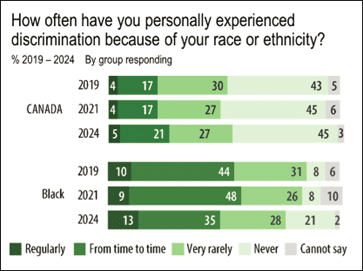
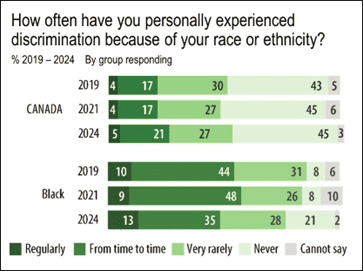
The survey asked Canadians about their personal experience with discrimination or unfair treatment because of their race or ethnicity. For the population as a whole in 2024, one in four said this has happened to them regularly (5%) or from time to time (21%), with most indicating it has happened very rarely (27%) or never (45%). These results have held notably consistent since 2019, although changes have occurred among some groups.
Such experiences, of course, happen mostly to racialized people, and especially those who are First Nations or Black. This is also a reality for many South Asian Canadians, with four in ten reporting discrimination regularly (7%) or from time to time (33%) due to their ethnicity or race. This proportion is a bit lower than what was recorded in 2021 (9% and 38%, respectively), during a time of heightened anti-Asian sentiment arising from the COVID-19 pandemic, but very close to results for 2019 (5% and 33%). A similar bump in 2021 is reflected in the reported experiences of discrimination among Chinese and Black Canadians, but not other groups.[3]
Racial discrimination takes many forms and can often involve subtle or insensitive treatment in day-to-day life (often described as “micro-aggressions”). The survey reveals that many Canadians experience such treatment, especially those who are Black or Indigenous.
Among Black survey participants who report having experienced discrimination in the past 12 months, two-thirds say they have encountered situations in which they were regularly or from time to time treated as they were not smart (66%) or treated suspiciously by others (66%). Smaller but notable proportions reported insensitive treatment happening at least time to time in the form of being ignored or overlooked in a restaurant or store (46%), treated differently by an employer (43%), mistaken for someone who serves others (43%) or unfairly stopped by police (39%).
General treatment of Black people in Canada
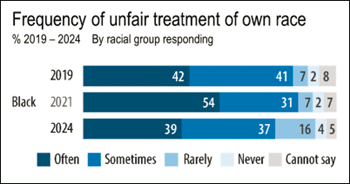
Apart from one’s own experience, how do people believe their own racial or ethnic group is treated in Canadian society? In 2024, three-quarters of Black survey participants said that Black people in this country are treated unfairly due to their race or culture regularly (39%) or sometimes (37%), compared with few who believe this happens rarely (16%) or never (4%).
This large proportion seeing anti-Black racism as widely experienced is noticeably lower than in 2021 when the response to the George Floyd murder was at its peak. The percentage who described anti-Black racism has happening often declined by 15 percentage points over this three year period, and remained lower than what was recorded in 2019. This improvement notwithstanding, Black Canadians continue to be more likely than other racialized groups to say their community is often treated unfairly due to their race or culture.
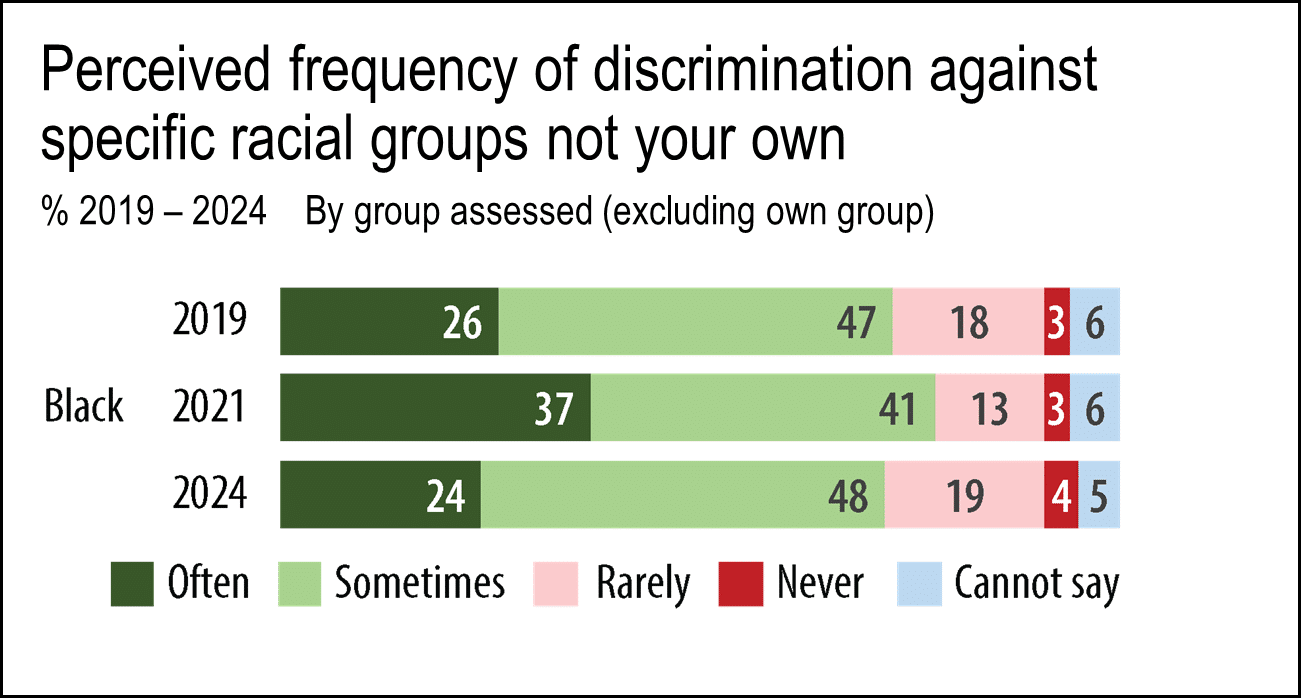
The survey also reveals that a clear majority of other Canadians recognize that most Black people are subjected to discrimination. In 2024, seven in ten (non-Black) Canadians said this happens to Black people often (24%) or sometimes (48%), compared with those who say rarely (19%) or never (4%).
As with the views of Black people, the perceptions of anti-Black racism among other Canadians peaked in 2021, and have since declined back to the level recorded in 2019.
Future outlook for racial equality
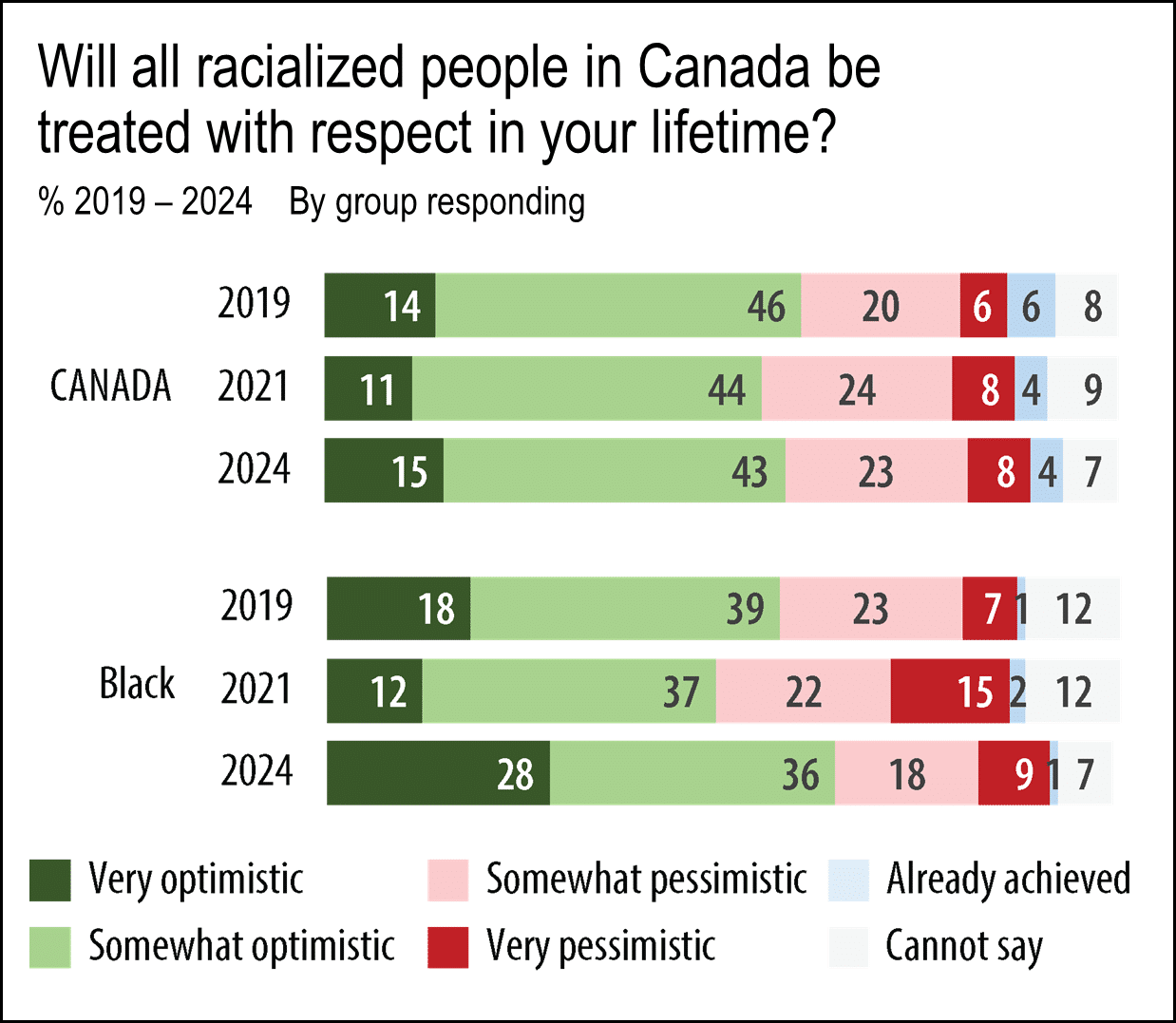
How do Black people in Canada feel about the future, for themselves and their children? In general terms most express hope for progress toward racial equality in their lifetimes, and such optimism has strengthened over the past few years. In 2024 almost two-thirds said they were very (28%) or somewhat (36%) optimistic that all racialized people in Canada will be treated with the same respect as other people in their own lifetime, an overall increase of 15 percentage points from 2021 and entirely accounted for in the bump among those who were “very optimistic.”
Black Canadians are now the most optimistic about the country’s future for racial equality compared with both other racialized groups and those who identify as white.
Growing optimism about progress toward racial equality is also evident in how people anticipate the future for one’s own group. Close to half (45%) of Black Canadians believe the next generation of their people will face less discrimination as they do today, up from 33 percent who expressed this view in 2019. By comparison, fewer than half as many (18%) expect the next generation will face more discrimination, with the remainder anticipating little change (27%) or have no opinion to offer (10%).
Among other racialized groups in Canada, only South Asians express comparatively greater optimism for their community’s future.
Conclusion
This research provides yet further documentation of the widespread racism experienced by Black people in Canada, with close to half encountering discrimination and mistreatment from time to time if not regularly; more so than any other racial or ethnic group apart from Indigenous Peoples. The frequency of such experiences has declined somewhat since 2021, but it is premature to conclude this marks a trend.
The data also reveals how perspectives are influenced by broader events. The 2021 survey recorded increasing awareness and recognition of racism in Canada in the aftermath of George Floyd’s murder and the Black Lives Matter movement. These events are now several years removed, and the trajectory of public perspectives on race and racism has settled back closer to what was recorded in 2019. What is notable is that each of these shifts in perspective has taken place among both Black people and other Canadians.
Racism remains entrenched in Canadian society, but the research offers evidence of progress and prospects for further change. First, most Canadians now recognize and acknowledge the reality of persistent racism experienced by Black and other racialized people in this country, even if many may not fully appreciate the scope and harm it inflicts. Very few Canadians now express the opinion that racism does not exist.
The gap between the views of racialized and non-racialized Canadians has narrowed over the past few years, and in some cases has disappeared entirely. The research confirms that Canadians from different racial backgrounds are now more or less on the same page when it comes to their assessment of race relations in this country – an important exception to the widely held assumption that we live in an increasingly polarized society. Canadians’ current preoccupation with other pressing concerns does not mean they have lost sight of the important aspiration of racial equality.
Second, the persistence of experienced racism notwithstanding, a growing majority of Black Canadians are optimistic that this country will in their lifetimes become a welcoming society for everyone regardless of race or ethnicity. This community is in fact among the most hopeful of all about what is possible for what Canada can become for their children and grandchildren
References
[1] The sample size for each survey is as follows: 2019 (national total is 3,019, of which 287 self identified as Black or of African ancestry); 2021 (3,698, 403); 2024 (5,086, 472).

In 2019, the Environics Institute for Survey Research partnered with the Canadian Race Relations Foundation (CRRF) to conduct the first-ever national survey on race relations in Canada. This landmark research established new benchmark indicators across the country from the perspective of its citizens, and provides the foundation for monitoring progress over time.
Related reading

Yes Canada, we too have an anti-Black racism problem
The anguish and confrontations spreading across the United States in response to the killing of George Floyd, a Black man, by a white police officer have captured the attention of news audiences in that country and around the world.
Indigenous experiences with racism in Canada
This year marks 10 years since the Truth and Reconciliation Commission finished its work investigating the history and impacts of Canada’s Indian Residential School system. The commission’s final report marked the completion of a painful yet essential process of testimony and revelation, but even more important the starting point for the country’s reckoning with its colonial legacy.
Social norms and racism in Canada
A new national research project documents for the first time the social norms that govern how Canadians think about and act on different types of racial micro-aggressive actions directed at people who are Indigenous or Black.