

This is the third in a series of short insight pieces on race relations in Canada today and how it is changing, based on a national survey research program conducted by the Environics Institute for Survey Research, in partnership with the Canadian Race Relations Foundation. The research presented is drawn from the Race Relations in Canada Survey 2024.
Introduction
Hate motivated aggression is becoming alarmingly common in Canada. This typically takes the form of blatant disrespect, abuse and sometimes violence motivated by hatred or bias directed at physical symbols (such as a mosque or synagogue), individuals or groups of people, or communities as a whole. The rise in hate crimes (or “incidents” where the aggression doesn’t meet the threshold of a criminal act) is most visible on social media that has enabled anonymity and loosened social norms around acceptable behaviour toward others.
Official statistics show the number of police-reported hate crimes rose by more than 80 percent between 2019 and 2022, with racialized communities the primary target. More recently, the outbreak of conflict in Gaza in response to the Hamas terrorist attack on Israel in October 2023 led to a surge in hate-motivated incidents in Canada directed at Jewish, Muslim and Arab communities. Even these alarming numbers do not capture the scope of the problem as it is estimated that eight in ten hate crimes are never reported by those affected.
How prevalent is the experience of hate in Canada today? Who is affected and how, and where do such incidents typically take place? These questions were addressed through a national survey of Canadians conducted in 2024 by the Environics Institute for Survey Research in partnership with the Canadian Race Relations Foundation. This is the first national survey to document the public’s experience with hate incidents and crimes in such depth. The research consisted of two online surveys conducted with a representative sample of 5,086 Canadians that was structured to provide reportable results by the largest racial, ethnic and religious groups in the population (see here for further details on the research).
Who is the target of hate?
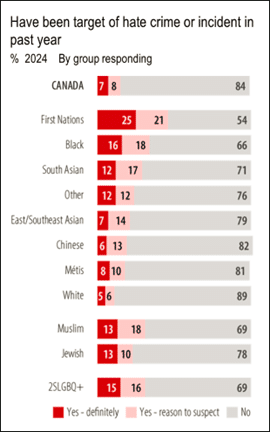
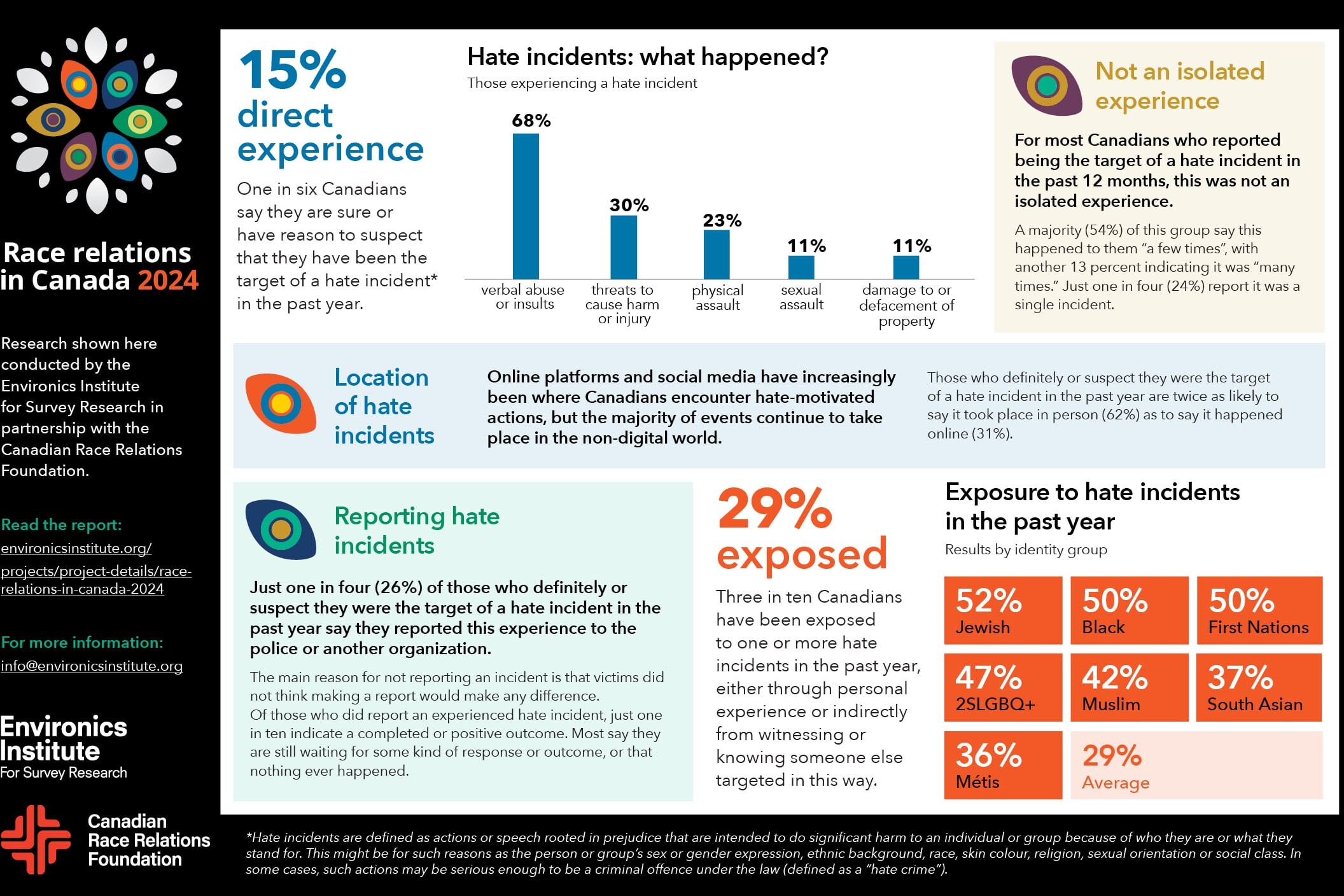
For the Canadian population as a whole, seven percent (7%) report they had “definitely” been the target of a hate incident in the past year, with another eight percent (8%) who say they have reason to suspect this to have taken place.[1] When combined, this means one in six Canadians (or roughly 4.5 million people) have been confronted with hate-motivated speech or action, first or second hand, in the previous year.
Consistent with police reports, the likelihood of being targetted by hate is much greater for some people than others. Among the groups that could be identified in the survey, personal experience with hate in the past year is most widely reported by those who are First Nations (46% say definitely or suspected), followed by those who identify as Black (34%), South Asian (29%), Muslim (31%), 2SLGBQ+ (31%) or Jewish (23%). By comparison, such experiences are reported by one in ten (11%) Canadians who identify white.
Canadians’ experiences with hate also appear to be a function of age, regardless of other backgrounds and identities. Reports of definite or suspected events are most common among those ages 18 to 29 (34%), with this prevalence declining with each successive generation (down to only 4% among Canadians ages 65 and over). This pattern shows up in the Institute’s other research with various groups in Canada who experience prejudice due to race, ethnicity, religion or sexual orientation. It may be that younger people more often find themselves in situations where such discrimination happens, and as well they may be more sensitized to how society treats people with different backgrounds and identities.
Personal experience with hate is also more common among urban (18%) than rural (10%) residents, and by men (18%) in comparison with women (13%).
Experience with hate is not limited just to those who are directly targeted, but encompasses others who may be exposed to it indirectly. The research found that one in six (17%) Canadians report witnessing a hate incident being committed against another person, while one in five (19%) say they know someone else who has been the target of such an event. Combining these categories with direct experience reveals that three in ten (29%) Canadians have been exposed to hate either directly or indirectly in the past year. This proportion jumps to roughly half of people who are First Nations (50%), Black (50%), Jewish (56%) or 2SLGBQ+ (47%).
Where does hate take place?
Hate-fueled aggression is most widely visible on social media platforms, but in fact such incidents are more likely to happen off-line. Those reporting personal experience with hate incidents in the past year are twice as likely to say they took place in person (62%) than online (31%).
Such offline events are most likely to have taken place in a public setting, at work or at school, but others also report experiences in a private setting (e.g., their home or someone else’s home), or in an institution (e.g., government office, health care facility).
The survey also reveals that a clear majority of other Canadians recognize that most Black people are subjected to discrimination. In 2024, seven in ten (non-Black) Canadians said this happens to Black people often (24%) or sometimes (48%), compared with those who say rarely (19%) or never (4%).
As with the views of Black people, the perceptions of anti-Black racism among other Canadians peaked in 2021, and have since declined back to the level recorded in 2019.
What happened during hate incidents?
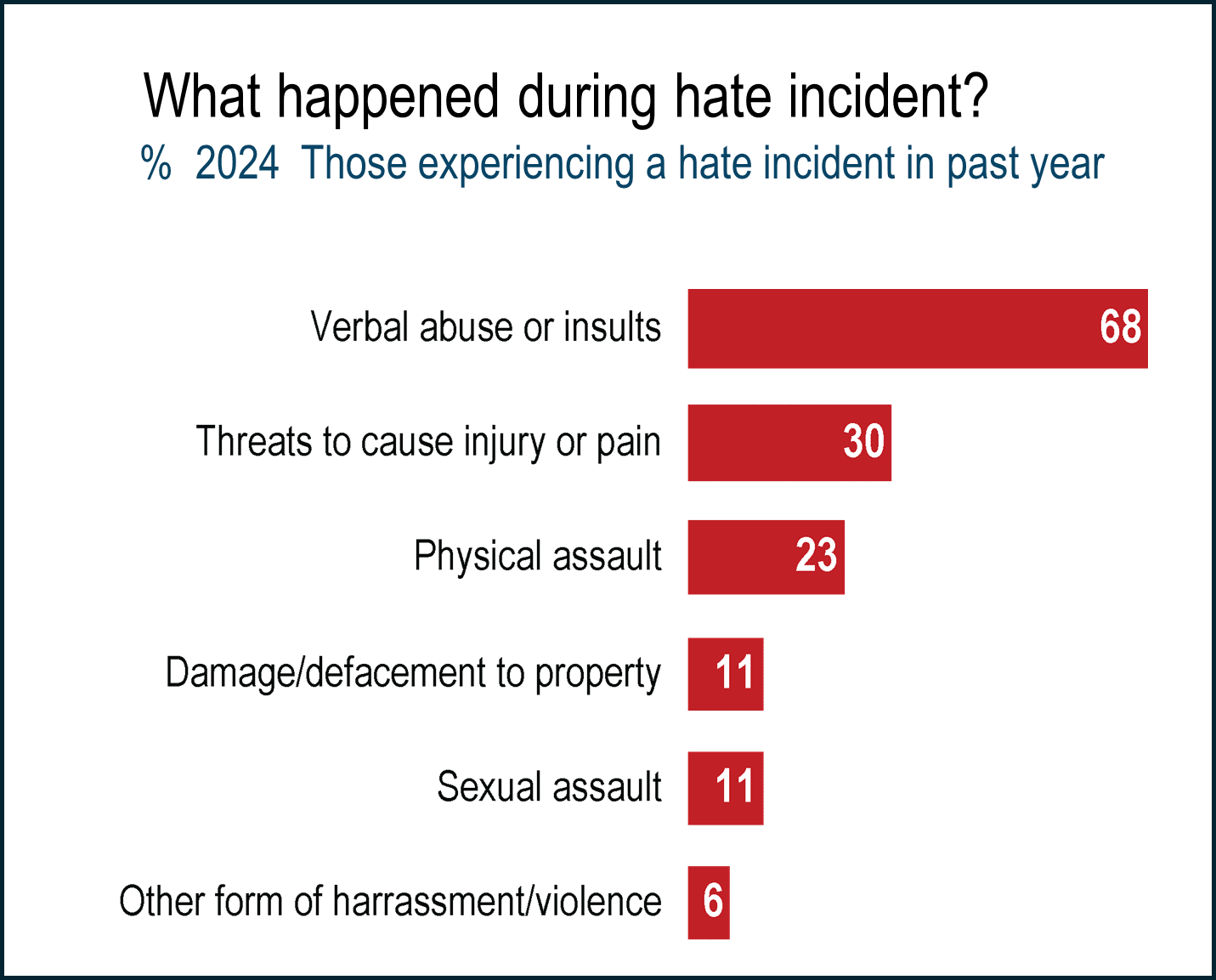
Hate-motivated acts can take a variety of forms. Canadians reporting such experiences are most likely to say they experienced verbal abuse or insults (68%), followed by threats to cause harm or injury (30%), physical assault (23%) or, specifically, sexual assault (11%).
One in ten (11%) say hate took the form of damage to or defacement of property, while six percent indicate it involved some other form of harassment or violence (e.g., told to speak another language, their work was not good enough, treated differently than other people, followed in a store).
Impact of recent experiences with hate
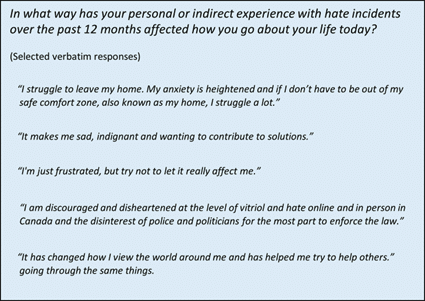
How has being a target of hate affected Canadians? The impacts vary noticeably. Of those reporting such experiences, four in ten (40%) downplay or dismiss the impact, saying there has been no effect on their lives. An equivalent proportion (39%) describe various ways in which they have been affected, including changing how they move through the world and deal with other people, experiencing strong emotions (e.g., making them sad, disappointed, angry or upset), causing them physical or mental health distress, and motivating them to respond in positive ways (e.g., treating others with more kindness).
What Canadians experiencing hate have not done is report these incidents to the police or another authority. Just one in four (26%) say they have taken such action in response to an incident in the past year. Those who chose not to cite a variety of reasons, but mostly because they do not feel it would make a difference, lack confidence in the process or are concerned about how they would be treated. Such caution is understandable given that among those who did report a hate incident only one in ten (11%) said this had resulted in a positive outcome to date; the rest reported that nothing happened or were still awaiting a satisfactory response.
Conclusion
We already know that hate-fueled aggression is a serious and growing problem in our society. This research brings some diagnostic clarity to the scope of how this is being experienced by Canadians, in terms of who is affected, where it is taking place, what form it takes and how it is affecting those targeted.
The study results underscore how poorly official reports reflect the prevalence of hate incidents, and reveal the barriers that discourage people from coming forward when this happens to them. A worthy focus of anti-hate initiatives would be to develop effective strategies to encourage Canadians to report hate incidents when they occur, and ensure there is proper follow-up on how these reports are handled. Boosting citizen reporting of hate experiences would both improve our understanding of the problem, and communicate more broadly the normative message that hate is not acceptable in our society.
References
[1] How do Canadians know when they have been subjected to a hate incident or crime? The survey provided participants with a definition, along with examples of what this might include (e.g., an elderly Asian man being shoved in a grocery store by a person who makes racist remarks”). Even so, the results show that many Canadians cannot be certain about whether what happened to them fits clearly into this definition of hate, which highlights the challenge in both documenting and addressing the problem.

In 2019, the Environics Institute for Survey Research partnered with the Canadian Race Relations Foundation (CRRF) to conduct the first-ever national survey on race relations in Canada. This landmark research established new benchmark indicators across the country from the perspective of its citizens, and provides the foundation for monitoring progress over time.

Related reading

The Black Experience Project Video
This video documents the personal stories of identity, strengths, challenges and lived experiences of members in the Black Community across Toronto and the Greater Toronto Area.

The Black Experience Project Video 2
The Black Experience Project led by the Environics Institute, in partnership with Ryerson's Diversity Institute, the United Way of Greater Toronto, and the YMCA of Greater Toronto, is launching a groundbreaking research study focusing on the Black community in the Greater Toronto Area (GTA).

Focus Canada 2012
Focus Canada is an ongoing public opinion research program that provides a credible, independent and sustained source of Canadian public opinion data on important issues facing the country.