


Building Faster?
Most Canadians support the federal government’s intention to act quickly to expand the country’s infrastructure, but not in the absence of agreements with its provincial or Indigenous partners.
May 11, 2026
May 11, 2026Reportconfederation of tomorrow,indigenous peoples,federalism,politics
Looking for something specific?
Rising concerns about the impact of new technologies on employment
In the past few years, evidence has appeared suggesting that concerns about the implications of technological change may be growing. According to the most recent survey waves, a growing proportion of workers are now expressing concern with the pace of change in general, and more specifically with the prospect of automation leading to unemployment.
December 15, 2025
December 15, 2025economy,artificial intelligence,survey on employment and skills,social change,technologyReport

Perceptions of trades training gaining traction over university
The latest wave of the Survey on Employment and Skills asked Canadians to think about what advice they would give to a young person regarding their career path.
September 26, 2025
September 26, 2025economy,survey on employment and skills,educationReport

The Impact of Having Children on Careers
This report presents the results of survey questions asking Canadians age 18 to 44 who are in the labour force about their expectations and experiences relating to having children and its impact on their careers.
July 10, 2025
July 10, 2025economy,survey on employment and skills,gender inequalityReport
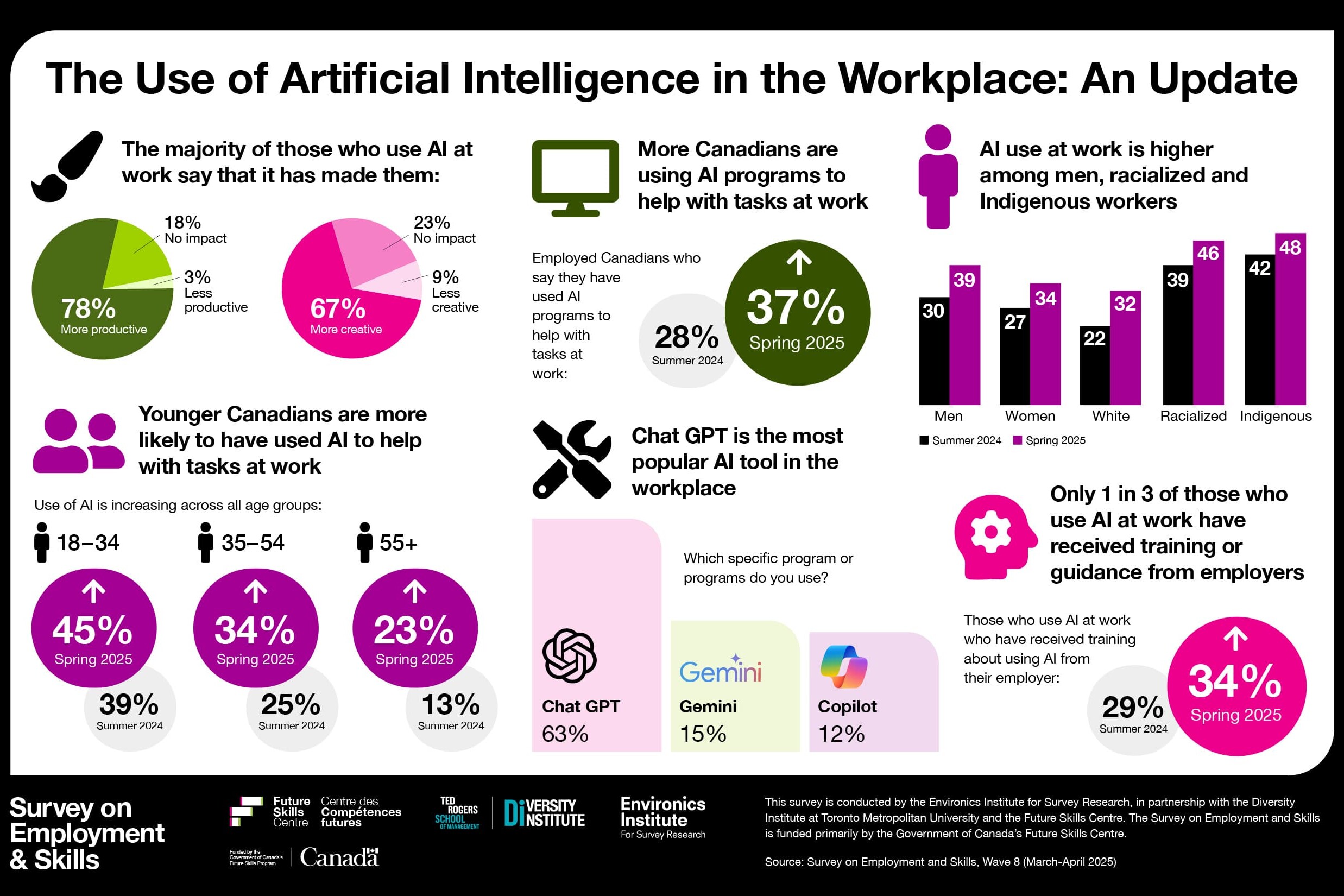
The use of artificial intelligence in the workplace: an update
In 2024, the Survey on Employment and Skills reported that early 3 in 10 employed Canadians are using AI tools in the workplace, but almost one-half of those have not received any formal training.
June 18, 2025
June 18, 2025artificial intelligence,workplace,survey on employment and skills,technologyReport,Infographic

Canadians worry about impact of trade wars as pessimism about economy deepens
Concerns about the impact of U.S. tariffs are contributing to a growing pessimism among Canadians about the economy, employment and their own financial situation.
June 4, 2025
June 4, 2025economy,united states,survey on employment and skillsReport

Strong Schools, Stronger Future: What Canadians Expect from Public Education
To explore how Canadians view public education, the latest wave of the Survey on Employment and Skills asked Canadians two questions about schools in their communities. The first addressed the objectives that schools should have, and the second assessed school performance.
June 3, 2025
June 3, 2025survey on employment and skills,education,youthReport

How working from home is affecting the workplace
Exploring how the shift to working from home is affecting job satisfaction, productivity, teamwork, and equity and inclusion is an important step in assessing the current state of the workplace in Canada.
November 28, 2024
November 28, 2024economy,survey on employment and skills,social changeReport
The Burden of Care: Addressing Challenges in Employment in the Nonprofit Sector
This report examines the perceptions of workers in the nonprofit sector and how these differ from workers in other sectors. Workers in the nonprofit sector have lower job satisfaction than workers in either the public or private sectors.
December 12, 2023
December 12, 2023economy,survey on employment and skillsReport

The Lingering Effects of COVID-19
This report helps to fill the information gap by documenting how many Canadians have missed work or school due to COVID-19 in the 12 months prior to the time of the survey in March 2023, and the length of their absences.
December 7, 2023
December 7, 2023economy,COVID-19,survey on employment and skills,healthReport

Participation in Skills Training
The COVID-19 pandemic severely disrupted the workplace. Some businesses closed either temporarily or permanently. Others enabled their employees to work from home.
November 23, 2023
November 23, 2023economy,COVID-19,survey on employment and skillsReport

The shift to remote work
The majority of those who have been working from home say they prefer this arrangement and want it to continue once the pandemic is over. And most of those who want to continue to work from home prefer to do so on a regular basis, rather than occasionally.
September 15, 2022
September 15, 2022economy,COVID-19,survey on employment and skillsReport

Disconnecting from work
The Survey on Employment and Skills confirms that many Canadians find it a challenge to keep their work, family and personal lives in balance. But experiences vary widely. Some workers, such as those who are self-employed, are more likely to appreciate the flexibility of modern work arrangements
September 15, 2022
September 15, 2022economy,survey on employment and skills,government roleReport

Working when sick
Efforts to improve public health and contain the spread of serious illness must focus on both the lack of paid sick days for many workers and the behaviour of those who have access to paid sick days but choose not to use them because of the prevailing workplace culture.
December 28, 2021
December 28, 2021economy,survey on employment and skills,government roleReport

Making up time
This report explores the experiences during the pandemic of younger adults, defined as those between the ages of 18 and 34.
November 30, 2021
November 30, 2021economy,survey on employment and skills,government roleReport

Lessons learned
For many students, the short-term effect of the COVID-19 pandemic, through the switch to online learning, has been to effectively “privatize” our educational infrastructure, as families have had to rely on their own resources to provide the spaces, tools and connections needed for ongoing learning.
September 1, 2021
September 1, 2021COVID-19,survey on employment and skills,educationReport

Mind and body
This report focuses on Canadians’ perceptions of their physical and mental health, and how these have changed during the pandemic. It also highlights implications for governments and employers as they begin to prepare for the post-pandemic recovery.
June 2, 2021
June 2, 2021COVID-19,mental health,survey on employment and skills,healthReport

Widening inequality
This report from Wave 2 of the Survey on Employment and Skills examines the overall impact of the pandemic, as well as more specific experiences such as loss of hours of work, loss of employment or loss of income.
May 14, 2021
May 14, 2021economy,COVID-19,survey on employment and skillsReport

Work at home or live at work
This report from Wave 2 of the Survey on Employment and Skills focuses on the experience of working from home.
April 12, 2021
April 12, 2021economy,COVID-19,survey on employment and skillsReport

Adapting to the changing world of work
The survey finds that Canadians tend to have a positive assessment of both the impact of technological change and the value of the post-secondary education and skills training that they have received.
September 16, 2020
September 16, 2020economy,survey on employment and skills,social changeReport
Canadians’ shifting outlook on employment
The survey finds that Canadians tend to have a positive assessment of both the impact of technological change and the value of the post-secondary education and skills training that they have received.
May 20, 2020
May 20, 2020economy,COVID-19,survey on employment and skillsReport