

By Michael Adams. Published in The Globe and Mail. October 9, 2015.
US Democratic Party strategist James Carville famously coined the phrase “It’s the economy, stupid” as the theme of Bill Clinton’s successful 1992 presidential campaign. That may have been true in 1992 but eight years later Republican strategist Karl Rove helped elect George Bush using wedge values issues. Economic issues were not the dominant factors in 2000 or in 2004 when Bush won re-election after the 9/11 attacks; rather, values issues like gay rights, abortion, guns, and terrorism did.
While polls in this election may have indicated that the economy and health care were the campaign’s top issues, Stephen Harper wasn’t defeated on Monday because he was seen as a poor steward of the economy or an enemy of Canadians’ beloved public health care system. Rather, he offended the values of two-thirds of Canadians. Despite some suggestions to the contrary, these values did not change much during Harper’s time in office. Canada’s political centre of gravity has not shifted.
In addition to a divided centre-left, Stephen Harper’s success could mainly be traced to deft riding-by-riding tactics and to the use of wedge values issues to build out incrementally from his base (not very far, but enough for a majority in 2011). In addition to customized offerings for specific groups of voters (such as targeted foreign-policy gestures and boutique tax cuts), our outgoing PM did find a few issues on which he could appeal to large majorities of Canadians.
On crime, Harper took populist positions that were out of step with the evidence about crime reduction and represented sharp departures from both Liberal and Progressive Conservative policies of the past. Public opinion has historically been more punitive than government policy. Mr. Harper saw an opportunity and took it: his government gave the people (especially his base) what they wanted: a tough stance on bad guys.
During this campaign, another values issue came to the fore when a decision by the federal court of appeal enabled Zunera Ishaq to swear her citizenship oath while wearing a niqab. A government-sponsored poll had shown that 82% of Canadians agreed with the Conservative government’s attemp to prevent her from doing so—including 93% in Quebec, where secularism and gender equality have become religion. While Ishaq exercised her clear Charter right to cover her face, the government put its impotent—but widely shared—objection on prominent display.
Crime and punishment, the niqab, revoking the citizenship of convicted terrorists, establishing a “barbaric cultural practices” hotline, foot-dragging on Syrian refugees (and, earlier, revoking refugees’ health care)—all these symbolic gestures appealed to the Conservative base, but some in fact appealed to large majorities of Canadians.
If some of these moves were so popular, why didn’t they gain Conservatives more traction in the election?
The reason is that other Canadian values run deeper. Research by the Environics Institute tells us that Canadians deeply value their pluralistic society; they believe government has a role to play in building a fair country; they believe in empathy and compromise as social habits. Many Canadians might be uncomfortable with the niqab, but they take the Charter seriously and in the grand scheme they want a just, inclusive society. Most Canadians’ thinking on sentencing for offenders might be driven more by emotion than by reviews of criminology literature, but traditionally most have not objected when governments have acted on data rather than gut.
Over time, a collection of wedge-politics gestures, however cleverly designed, were no longer able to hold back the tide of public sentiment that wanted another kind of big picture.
American poet Walt Whitman wrote: “Do I contradict myself?/Very well then, I contradict myself,/(I am large. I contain multitudes.)” Like Whitman, the Canadian public contains multitudes. We have lesser angels and better angels. When we are not fearful we try to be inclusive, fair, and generous. And perhaps even when we are fearful, we try to find our way back to being otherwise.
In acknowledging that his platform entailed deficits, Justin Trudeau was saying not only that we need infrastructure spending, but that government has a role to play in the lives of Canadians—a role that has human meaning, that cannot simply be abdicated when money is tight. He resolved not just to protect the entitlements we have given the elderly but also to support the success and wellbeing of other groups, such as parents whose children need day care; Aboriginal students; and, yes, refugees. In adopting an aspirational vision of a Canada where government husbands initiatives we value as a society, Trudeau appealed to the hopeful liberal-progressive values that came to define Canada after 1960. This vision resonated for many Baby Boomers who liked that Canada the first time they met it. It seemed also to work for younger people, who, not surprisingly, wanted to take their own turn at having a country that sees outside itself more than just threat, and sees within itself something more than just a ledger.
Related reading

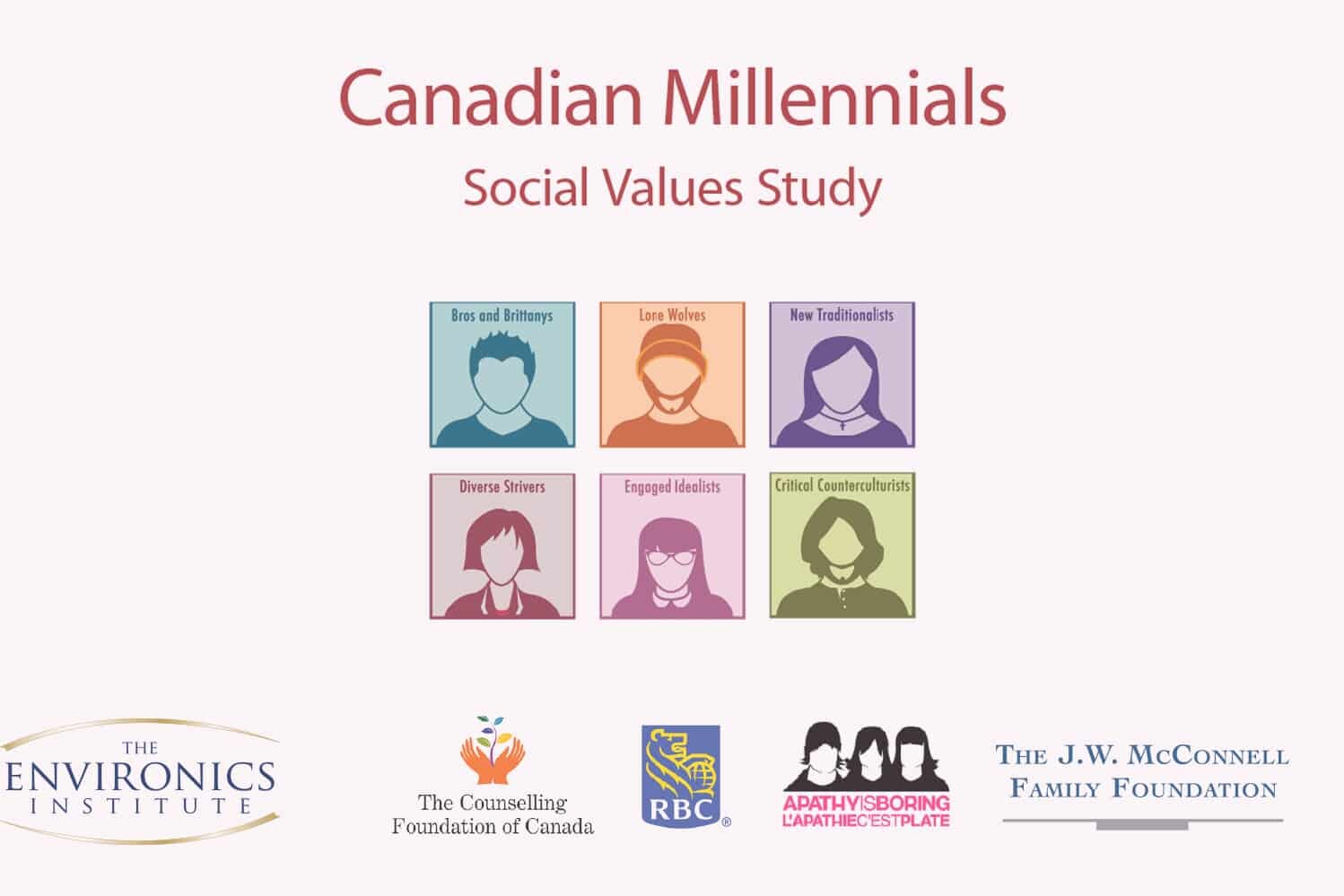
Canadian Millennial Social Values Study
A major national survey conducted in 2016 reveals a bold portrait of Canada’s Millennials (those born between 1980 and 1995), that for the first time presents the social values of this generation, and the distinct segments that help make sense of the different and often contradictory stereotypes that so frequently are applied to today’s young adults.
February 28, 2017Reportsocial values,social change,youth,millennials & genz,michael adams
Canadian Youth
A new national research project documents for the first time the social norms that govern how Canadians think about and act on different types of racial micro-aggressive actions directed at people who are Indigenous or Black.
March 31, 2022Reportcanadian identity,social values,values,youth,millennials & genz,civic engagement