

Michael Adams and Kathy Bullock. Globe and Mail. April 28, 2016. Michael Adams is Founder and President of the Environics Institute for Survey Research. Kathy Bullock is Director of Research at the Tessellate Institute.
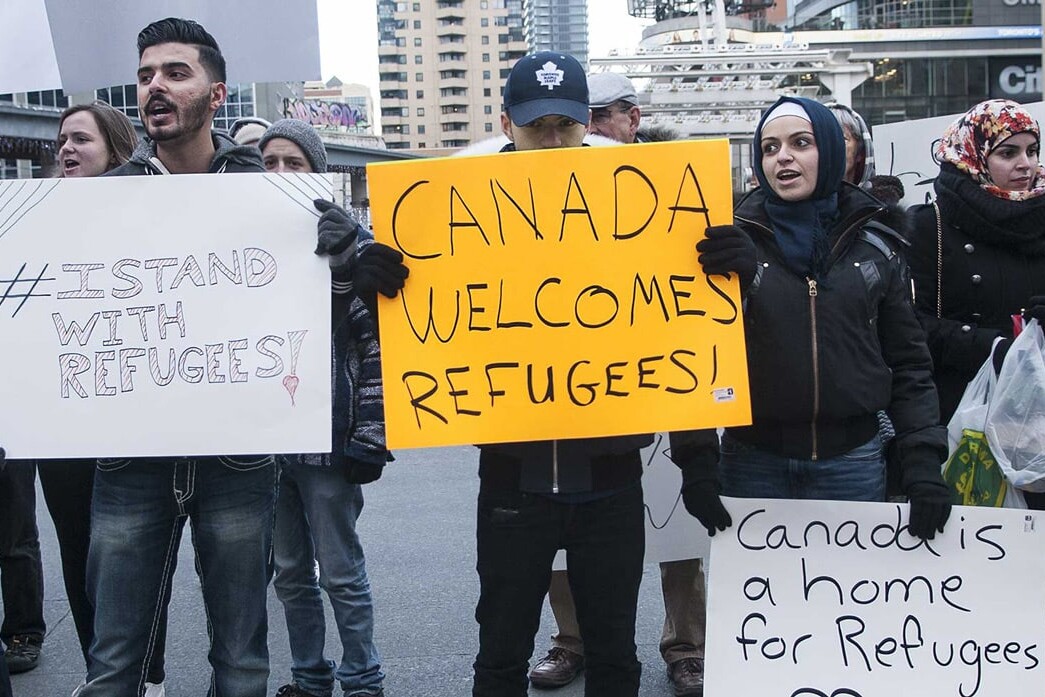
On any given day, Canadians might wake up to a range of news stories related to Muslims in Canada. Most recently, it might be a story about Muslims and non-Muslims working together to welcome some of the 25,000 Syrian refugees who have arrived here in recent months. In the fall, it might have been a story about the previous government’s efforts to ban niqabs from citizenship ceremonies. Or the story of the vandalism of mosques in Peterborough, ON or Cold Lake, AB. Or a story about Maryam Monsef, our new federal Minister of Democratic Institutions, a Muslim who arrived in Canada as a child refugee from Afghanistan.
What are the deeper trends that lie behind the sometimes heartening, sometimes troubling stories we see in the news? It was to answer this question that the Environics Institute undertook its first survey of Canadian Muslims in 2006 (combined with a parallel survey of non-Muslims). Earlier this year, we undertook a second survey to update our findings. The results tell a fascinating story about Muslims and non-Muslims in Canada, the perceived realities of each group, and how those realities have evolved over the past tumultuous decade.
Remarkably, almost six in ten (58%) Canadian Muslims say their sense of belonging to Canada has increased over the past five years, while a third (33%) say it has remained unchanged and only five percent feel a weakened sense of belonging. Part of the explanation for this might lie in recent election results: nine in ten Muslims say they are optimistic that the new federal government will improve relations between Muslims and other Canadians.
Muslims, nearly seven in ten of whom are immigrants, are happy to be in Canada. Canadian Muslims express even greater pride in Canada than do other Canadians, and a larger proportion than ten years
ago report that they are very proud (83% up from 73%). The sources of Muslims’ pride in Canada are the same as those we find among other Canadians: freedom and democracy, followed by multiculturalism and diversity, then peace and stability.
Eighty-four percent of Canadian Muslims believe they are treated better in Canada than their coreligionists are in other western countries, and this number has increased since 2006. This sentiment prevails despite the fact that one third (35%) have experienced discrimination in Canada in the past five years, most commonly in the workplace and public places. (One in four reports difficulty at border crossings.)
Muslims’ descriptions of what makes for a good Canadian align precisely with what other Canadians say: official language acquisition, tolerance and respect for others, respect for Canadian history and culture, and respect for the rule of law. As for radicalization, Muslims in Canada believe there is very little to no support in their communities for violent extremists who claim to represent Islam, and 88 percent say it is important for Canadian Muslim communities to work actively with government to address radicalization.
Over the 20th century in Canada, society became more secular and children became less religious than their parents. So we assumed this would be true for the Muslim community as well, but surprisingly this does not appear to be the case. Our survey reveals that young Muslims are often more religious than their immigrant parents. For many, their religious identity is becoming more, not less, important to them over time. At the same time, Canadian-born Muslims are now among the most likely to believe their community wants both integration and to remain distinct, suggesting the development of a unique “Canadian Muslim identity.” More than nine in ten (93%) Muslim youth surveyed believe that “other
cultures have a lot to teach us; contact is enriching.” Canada promises freedom of religion, and young Muslims appear ready to take the country up on its constitutional offer.
Interestingly, however, while religious practice and identity remain salient, other values change: a big one is patriarchy. In Muslim households, as in most other Canadian households, gender roles are becoming more equal. In 2006 70 percent of Canadian Muslims strongly agreed “that taking care of home and kids is as much a man’s job as a woman’s”; in 2016 that number is up to 76 percent. Indeed,
among those born in Canada, more than eight in ten reject the notion that the “father in the family must be the master in his own house,” signaling value convergence over time between many in the younger Muslim community and the broader Canadian society.
Modernization and secularization evolve in different ways in different countries as majorities and minorities interact; groups can fight each other or they can accommodate. In Canada we have the aspirational ideology of multiculturalism, as well as the actual policy framework that goes by the same name. Neither inoculates us against discrimination or injustice, but if we look at public attitudes, citizenship acquisition among immigrants, and minority representation in our legislatures, it seems that ours may be the worst system in the world except for all the others.
In spite of the controversies we see in the media—including ones that verge on the absurd like a young girl being excluded from a soccer game because she was wearing a head scarf—Muslims report positive feelings toward Canada and non-Muslin Canadians are more likely to have positive impressions of Islam than negative ones. Moreover, the more Canadians report encountering Muslims in daily life, the more positive their impressions: familiarity breeds good feeling, not contempt.
These findings may explain why we so little conflict between Muslims and other Canadians in this country: when such conflict does erupt (as when a woman in a hijab was harassed in Toronto in the fall), public figures are unanimous in their condemnation. The data may also help to explain why Canadians, in such sharp contrast to our American neighbours, have been so supportive of accepting 25,000 Syrian refugees by our government and through private sponsorship—a move that is upheld by all the parties represented in the House of Commons. Only in Canada does such a strong political consensus prevail.
These numbers are the big picture within which the news of the day unfolds. They offer an empirical grounding against which individual incidents—stories of harmony or harassment—can be judged as typical or unusual, and they serve as a useful corrective to inflammatory anecdotes and stereotypes. Whatever the headlines of the day, the deeper story is that Muslims are proud to be Canadian and they appreciate the same things about Canada that other Canadians do.
Related reading
Survey of Muslims in Canada 2016
Muslims represent the fastest growing religious minority in Canada today, but their emerging presence has been contentious, fuelled in part by security concerns (in the long wake of 9/11) and some religious practices (e.g., Sharia law).
April 30, 2015Reportimmigration,multiculturalism,racism,religion,lived experience,discrimination,identity,muslims
Survey of Canadian Muslims
The Institute’s first project was a national survey to examine the relationship between Canadian Muslims and Canadian society at large. This research was conducted as part of Environics Research FOCUS CANADA, and built upon an earlier study conducted by the US-based Pew Research Center with Muslims and non-Muslims that covered 13 countries (but not Canada).
February 28, 2007Reportimmigration,multiculturalism,racism,lived experience,discrimination,muslims

Canadians are still committed to decentralized federalism
There is never any shortage of reasons to track the ups and downs of regional grievances in Canada: Every year brings new developments that fuel perceptions of regional winners and losers.