

The following opinion article was published online in Maclean’s on August 26, 2020. The co-authors of this article are Donald Abelson (Brian Mulroney Institute of Government), Colleen Collins (Canada West Foundation), Charles Breton (Centre of Excellence on the Canadian Federation), Alain-G Gagnon (Centre d’analyse politique – constitution et fédéralisme) and Andrew Parkin (Environics Institute for Survey Research).
The year 2020 will forever be remembered for the COVID-19 pandemic, but it remains significant in other ways. Among other things, it marks 40th and 25th anniversaries of Quebec’s two referendums on sovereignty. Some Quebecers might choose to mark these events by reliving the emotions—joyful or sorrowful—that they felt as the results were announced. For many Quebecers, however, the referendums are not something they experienced directly. Only one in two Quebecers alive today were old enough to vote in 1995. In the case of the 1980, it is only one in three.
Does this mean that the sovereigntist dream no longer holds an appeal for the young Quebecers? At first look, the results of the Confederation of Tomorrow surveys would suggest that the opposite is the case. For instance, with the passage of time, Quebec francophones are becoming more likely to identify primarily with Quebec and less likely to identify primarily with Canada (the proportion identifying as a Quebecer only or first increased from 57 per cent in 2003 to 67 per cent in 2020). Equally important, concern about the security of the French language has increased over time. In 2003, 59 per cent of Quebec francophones agreed that the French language in Quebec was threatened, compared to 68 per cent today.
But in both cases, these shifts are the result of changes among older Quebecers, as the pre-Quiet Revolution generation is replaced by the province’s baby boomers. The overall strengthening of the Quebec identity among francophones, for instance, is due to a drop in the proportion of those age 55 and older who identify as a Canadian only or first (falling from 32 per cent in 2003 to 10 per cent in 2020). Younger francophone Quebecers, meanwhile, are now less likely than their older counterparts to see themselves as a Quebecer only or first (although a majority still do).
Similarly, while a majority (55 per cent) under the age of 40 say that the French language in Quebec is threatened, the proportion holding this view is higher among the older generations (reaching 75 per cent among those age 55 and older). This is a reversal of the pattern in 2003, when older francophones in the province were much less concerned than their younger counterparts.
The most striking differences between the views of younger and older francophone Quebecers, however, appear in their expectations of the Quebec state. Our survey asked which government—federal, provincial or municipal—Quebecers believe best represents their interests. Among francophones, baby boomers are twice as likely as millennials to say the provincial government best represents their interests.
It is not that younger Quebec francophones are more likely than their older counterparts to look to Ottawa—it is that they are more likely not to look to any government at all. Among those between the ages 18 to 39, 46 per cent say that no government best represents their interests, or offer no opinion— twice the proportion as among those age 55 and older (24 per cent).
Similar differences are apparent on questions about whether the federal or provincial government is more trusted to make the right decisions in specific policy areas. Francophone Quebecers ages 55 and over are twice as likely to trust the provincial government to manage both health care and immigration compared to francophone Quebecers between the ages of 18 and 39.
In short, there is a clear difference in outlook between the generations of Quebecers who built the Quebec state, through the Quiet Revolution and the push for provincial autonomy, and those who came of age after the era of referendums and constitutional debates. Baby boomers have a stronger sense of Quebec identity and tend to look to Quebec City to represent and defend their interests. Millennials and Gen Z are not necessarily more federalist, but are less preoccupied by the building blocks of nationalist identity and less focused on the Quebec state (or on government at all).
The irony is that, if younger Quebecers are less wedded to traditional nationalist concerns, it is likely due to the nationalist movement’s successes. While some baby boomers may have hoped for a “yes” 40 or 25 years ago, many of the other dreams of the Quiet Revolution have been realized. No doubt this leaves room for new generations to pursue their own dreams, no less noble or ambitious.
L’année 2020 marquera les esprits en raison de la pandémie de COVID-19, mais elle est aussi importante pour d’autres raisons : on y souligne les 40e et 25e anniversaires des deux référendums portant sur la souveraineté du Québec. Elle offre donc une occasion de mesurer l’appui à la souveraineté et, de façon plus générale, la force du nationalisme québécois, qui a façonné en grande partie la politique québécoise et influencé la politique canadienne de la deuxième moitié du 20e siècle.
Notons que les Québécois qui étaient en âge de voter lors de ces deux référendums représentent aujourd’hui une minorité, le quart de la population québécoise étant né après 1995 et la moitié après 1980. Seulement une personne sur deux de la population actuelle a donc pu participer au référendum de 1995. Pour la majorité des Québécois, les référendums font partie de l’histoire.
Cela signifie-t-il que le rêve souverainiste est chose du passé pour les plus jeunes générations de Québécois ? Depuis le premier référendum, le débat resurgit périodiquement et on se demande si le passage du temps rendra une victoire du oui ou du non inévitable. Les jeunes Québécois francophones sont-ils plus attachés ou moins attachés au Canada que leurs aînés ? Ont-ils plus tendance à appuyer le nationalisme québécois ou le délaissent-ils ? S’en soucient-ils même ?
Les sondages du projet Confédération de demain, menés en 2019 et en 2020 par l’Environics Institute for Survey Research, en collaboration avec la Canada West Foundation, le Centre d’analyse politique – Constitution et fédéralisme, l’Institut de recherche en politiques publiques et le Brian Mulroney Institute of Government, nous fournissent quelques réponses à ces questions. Certaines peuvent nous sembler familières, d’autres, plus surprenantes. Prises ensemble, elles permettent de conclure que le clivage politique entre souverainistes et fédéralistes, qui a dominé au Québec pendant plusieurs décennies, ne représente plus nécessairement le meilleur angle pour analyser la politique québécoise.
Related reading
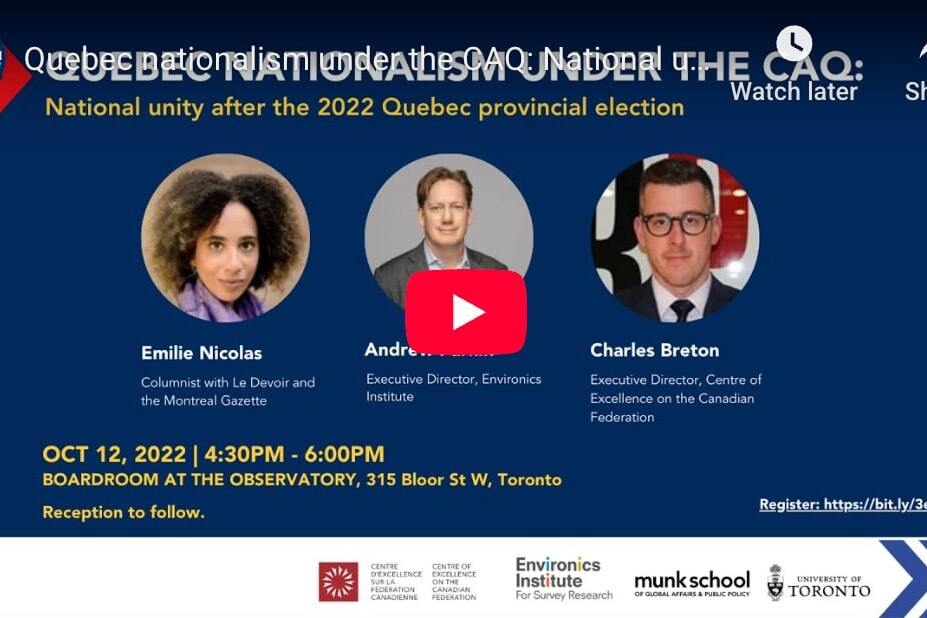
Quebec nationalism under the CAQ: National unity after the 2022 Quebec provincial election
Canadian observers face a paradox in Quebec politics: while sovereignty is declining, the CAQ government's identity politics through Bills 21 and 96 may spark a renewed debate on the Canadian constitution's legitimacy among francophone Quebecers, potentially leading to a new national unity crisis.

November 10, 2022Videoidentity politics,quebec,supreme court
Support for sovereignty in Quebec: the role of identity, culture and language
A surprising resurgence of popularity for the Parti Québécois is not driven by growing support for sovereignty. But many Quebecers nonetheless identify themselves as mainly sovereigntist. What underpins this preference? Beyond an obvious preference for sovereignty, which of their views distinguish them from other Quebecers? | By Charles Breton & Andrew Parkin
Quebec’s “winning conditions”
The members of the Parti Québécois have spoken, electing as their new leader a young, handsome, gay, and postcocaine André Boisclair, who has assured supporters a vote for him is a vote for a referendum " immédiatement" upon his moving across the aisle in the National Assembly.
November 25, 2005federalism,politics,Insight,government rolemichael adams


