

Concerns about the impact of U.S. tariffs are contributing to a growing pessimism among Canadians about the economy, employment and their own financial situation.
The latest wave of the Survey on Employment and Skills finds that:
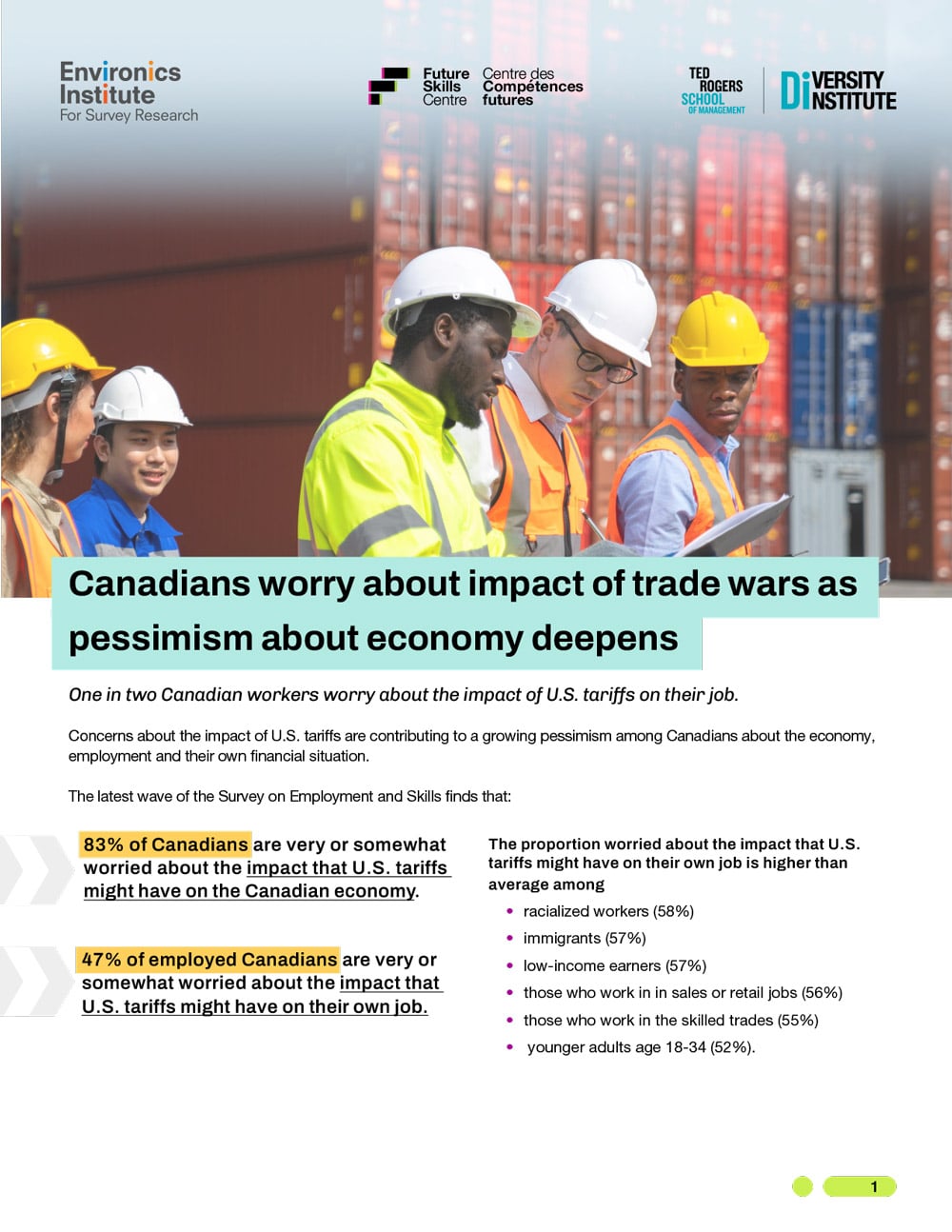
- 83% of Canadians are very or somewhat worried about the impact that U.S. tariffs might have on the Canadian economy.
- 47% of employed Canadians are very or somewhat worried about the impact that U.S. tariffs might have on their own job.
The dispute over trade and tariffs with the United States is only one factor contributing to a more pessimistic economic outlook that has emerged following the pandemic. The Survey on Employment and Skills finds that Canadians’ outlook on the economy and their own personal financial situation has been steadily worsening over the past few years. The more negative trends emerged following the peak of the COVID-19 pandemic, and long before the most recent U.S. presidential election.
Survey Details
Wave 8 of the survey of 5,603 adult Canadians was conducted online (in the provinces) and by telephone (in the territories) between March 12 and April 15, 2025.
Funder
The Survey on Employment and Skills is funded primarily by the Government of Canada’s Future Skills Centre / Le sondage sur l’emploi et les compétences est financé principalement par le Centre des Compétences futures du gouvernement du Canada.


The Survey on Employment and Skills is conducted by the Environics Institute for Survey Research, in partnership with the Diversity Institute at Toronto Metropolitan University and the Future Skills Centre.


Related reading

Canadians don’t need to worry about identity politics
Should Canadians be worried about identity politics? Some commentators lament the current obsession with identity, which they say focuses on what makes us different from one another rather than on what we have in common; that identity politics only serve to divide society into resentful silos. | By Michael Adams & Andrew Parkin

Canadians: richer than they think
Americans don’t often talk about Canada, except when they need a foil in a political debate. Bernie Sanders has praised our health-care system. Gun-control advocates point to radically lower rates of firearms fatalities north of the border.

Canadians on Hockey 2012
Hockey has long held a central place in Canada, and the National Hockey League is the flagship arena for the sport. Professional hockey has long stood out for the aggressive style of play, which has largely been accepted as just a part of the game.