

Michael Adams. The Globe and Mail. September 6, 2016. Michael Adams is founder and president of the Environics Institute for Survey Research.

Conservative leadership hopeful Kellie Leitch attracted attention last week with a proposal to screen would-be newcomers to Canada for “anti-Canadian values.” On Sunday, political consultant Nick Kouvalis, a key adviser to Toronto’s late mayor Rob Ford, retweeted a claim that according to a 2011 Environics survey, most Canadians would think Dr. Leitch had a point.

Yes and no.

It is true that, despite generally world-leading positive attitudes toward immigrants and multiculturalism, we found signs of worry among Canadians about whether newcomers are integrating successfully into Canadian society by adopting Canadian values (a concept that our Environics survey questions leave open to respondents’ interpretation).

Where this anxiety comes from is up for debate. One likely factor is concern about immigrants’ support for gender equality. Canadians prize the feminist gains of the last several decades and want gender equality to prevail in society at large – including in households where dad is not a girl-power kind of guy. During the 2015 edition of the debate about Muslim women’s head coverings, spurred by Stephen Harper (Dr. Leitch’s old boss), niqabi women spoke eloquently about their choice of religious garments as a free expression of their Charter-protected rights as Canadians, not a forced choice. Nevertheless, many Canadians worry that not all niqabs are worn by women so empowered.

A second concern that has become entangled with our immigrant-integration conversation is the fear of terrorism. However unhelpful the conflation of these two issues, they are indeed mingled in the minds of many here and elsewhere. Even when a Canadian-born, Christian-raised man apparently of European descent embarks on an attack in the name of Islamic State, some see it as a problem that has come from “there” to “here” and from “them” to “us.”

This surge of worry about cultural integration is stronger among Conservative supporters than it is among Canadians at large. Indeed, when we examine the values of Canadians broken out by party preference, wariness of cultural difference is a key differentiating value of Conservatives. Given that Dr. Leitch is currently running not for prime minister of Canada, but for leader of the Conservative Party, critics who say that her threat of cracking down on anti-Canadian values is itself anti-Canadian are unlikely to do her much harm and may do her some good – for now.

Recent years have shown us that a backlash constituency does exist – a constituency alarmed by some aspects of living in a diverse society, and affronted that they are not permitted to air their alarm without being accused of racism. (It is no accident that Dr. Leitch’s campaign literature had an aggrieved tone: “If you are tired of feeling like we can’t discuss what our Canadian values are, then please help me to fight back by making a donation.…”) U.S. presidential candidate Donald Trump is one champion of this backlash; he proposed ideological screening for immigrants a few weeks before Dr. Leitch did. Here in Canada, there was Rob Ford, lavish in his political incorrectness yet beloved by many newcomers, who

embraced his little-guy-fighting-smug-liberal-elites narrative. And there was the Parti Québécois’s Charter of Values, which would likely have won them an election had their leader not careened off-message.

A political opportunity exists with those who feel angry and dismissed, but when Dr. Leitch courts Conservatives who want to “fight back,” she is playing a risky game that may trade short-term partisan gain for long-term political pain.

Yes, the wider Canadian context is more fearful than it was 20 years ago, but it is still positive toward immigrants and, importantly, proud of not being xenophobic. Canadians feel pride in their country (and immigrants are especially proud, surveys show), but one of the things Canadians are most proud of is a belief that different kinds of people can live here in harmony and that immigrants can be just as good citizens as anyone born here – sometimes better.

If voters see particular groups of immigrants as a threat to that harmony, Dr. Leitch might win support among Conservatives. But if many Conservatives and even more ordinary Canadians, including the four in 10 of us who are immigrants or their children, see Dr. Leitch as the threat, she will not become prime minister – and Conservatives will feel that so-called hotline sting for a second time.

Related reading

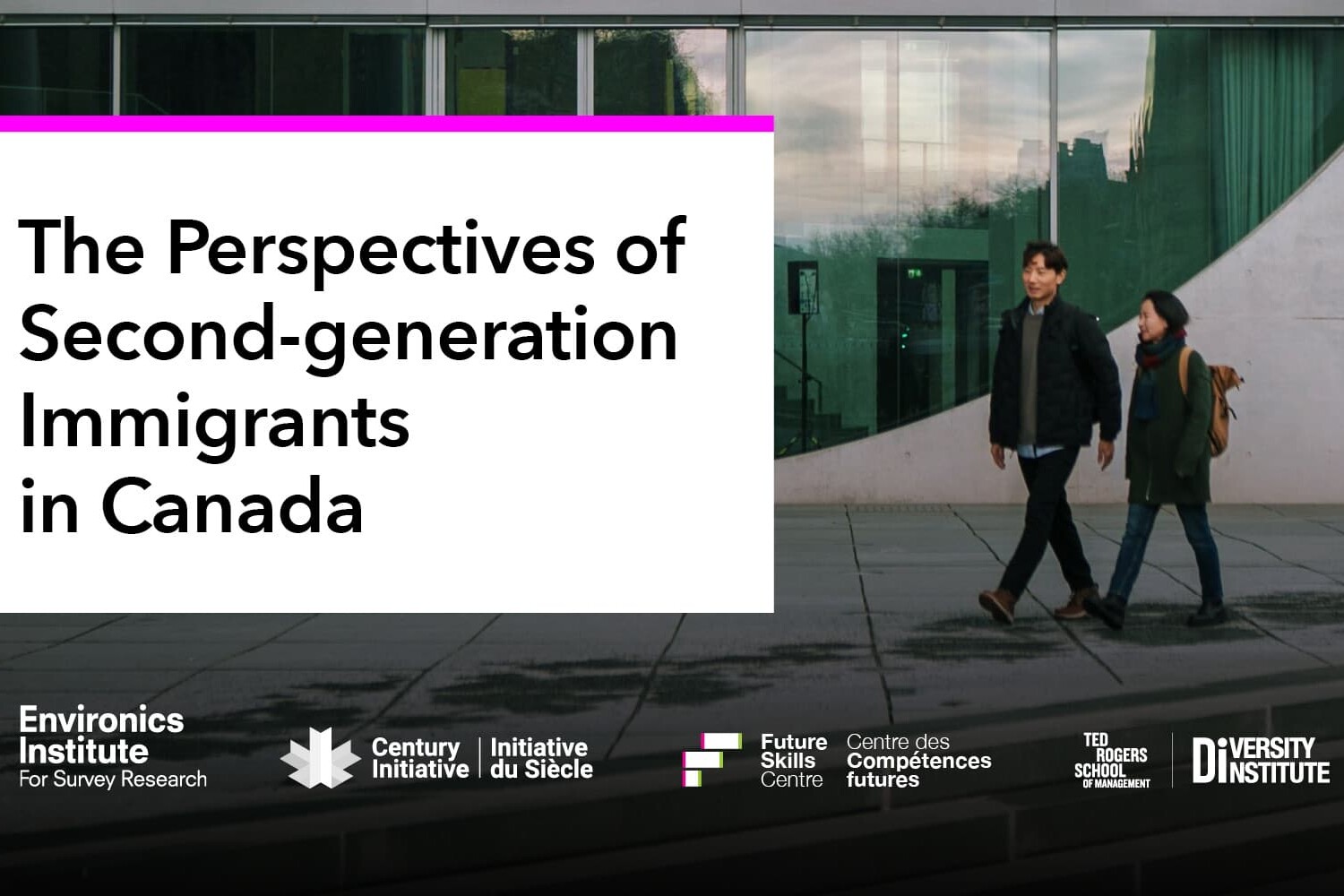
Two people walk past a modern glass building. A large white box highlights The Perspectives of Second-generation Immigrants in Canada, with logos of several organizations displayed below.

The Perspectives of Second-generation Immigrants in Canada

Outcomes for second-generation immigrants are typically measured in terms of educational attainment, employment rates and income. These indicators are important, but they tell us little about the experience that second-generation have balancing the values and expectations of their immigrant parents with those of Canadian society more generally.

People sit and talk in a spacious, modern lounge with large windows overlooking a snowy landscape and a historic building. Despite recent challenges, Coronavirus will not dent the trust Canadians have in each other as they relax or work together.

As many turn away from immigrants, Canada continues our embrace

Although mass migration has been happening for decades, in recent years the flight of refugees from conflict zones in Africa and the Middle East has produced striking images of desperate people searching for a safe place to land.

What Canada can teach the US about immigration?

America is deeply divided on issues related to immigrants and refugees, while in Canada, which accepts larger proportions of newcomers, there is a general consensus in the country over the issue.

Environics Institute for Survey Research

701-33 Bloor Street East
Toronto, ON M4W 3H1

info@environicsinstitute.org

Subscribe to our eNews

Subscribe to our eNews to stay apprised of our latest reports, Insights, events, and media mentions.

Stay Connected