

By Michael Adams. Globe & Mail. May 28, 2012. Michael Adams is president of Environics Group.

The first rule of fight club was don’t talk about fight club. The first rule of Canadian hockey seems to be never stop talking about it.

The past few years have produced a huge amount of debate about the nature and value of our national sport. Rule changes, fighting, head shots, concussions, “big hits” – fans, journalists and concerned health professionals have hashed it all out again and again.

Why so much talk? Because there is a tension between the broad trends of social change and the take-no-prisoners machismo we see on the ice. A large proportion of Canadians feel they have a stake in the game of hockey. Eighty-four per cent of us say that hockey is “a key part of what it means to be Canadian.”

That said, the millions of Canadians who feel some ownership over the game of hockey represent a range of constituencies. There are lovers of the sport who want a technically demanding, fast-paced game to watch. There are parents who want their kids to enjoy the camaraderie of a team sport while staying active during our long winters. There are Canadians who perk up around playoff time, feeling a sentimental, vaguely patriotic attachment to the game.

But the group that is understandably most important to the league and its advertisers is a set of hard-core fans, on average anglophone men aged 30 to 49 who feel quite at ease with the violence that makes some of hockey’s other constituencies cringe. Just 18 per cent of serious hockey fans describe themselves as uncomfortable with the violence in hockey, as compared to 32 per cent of occasional fans and half (49 per cent) of those who say they dislike the game.

Old-fashioned masculinity does not have many places to prove its mettle these days. Our information economy prizes creativity and networking over physical strength. Our social mores less often call on men to defend women from rogues in the street, and more often ask them to meet women as equals at work and in social life. Even the military seldom affords opportunities to fight bad guys and scumbags: Historical and cultural understanding in complex places like Afghanistan may now be more important than target practice. For those who long for a venue in which to express their raw testosterone, a rock ’em, sock ’em game – complete with all the traditional etiquette, such as punishing aggressors, defending teammates and upholding manly honour – is a welcome release.

But even as some will wish for hockey to serve as a fight club-like refuge from a culture in which machismo seems outmoded and violence grows ever less acceptable, others will

insist that sport does not exist in a vacuum. On a basic level, hockey must conform to society’s ideas about acceptable behaviour. Off the ice, sneaking up behind someone and hitting them so hard they lose consciousness can get you jail time. On the ice, you risk a modest fine and a few games on the bench.

I suspect that hockey will eventually trend toward a compromise between the desire of hard-core fans for a tough, physical game and the belief of more casual fans that whatever happens on the ice should not be so brutal as to debilitate players long after the final buzzer. In short, hockey will have to find a way to remain an arena that stands a little apart from ordinary social norms while at the same time remaining basically aligned with the contemporary Canadian expectation that no job (however rich the pay) should cost you your health or your life.

Some of the off-ice discussions that have emerged around hockey recently (the breaking of the code of silence about sexual abuse by coaches, and Brian Burke’s continuation of his late son’s campaign against homophobia) have revealed that a growing number of hockey stalwarts believe manly heroism in sport does not mean stoic silence in the face of any and all abuse. Might doesn’t automatically make right. Changing the rules – and especially the unwritten codes – of professional hockey means changing our expectations about what it means to be a real man, even a heroic man, in the 21st century. And contrary to some tough guys’ intuitions, it’s men themselves who stand to gain the most from those changes.

Related reading

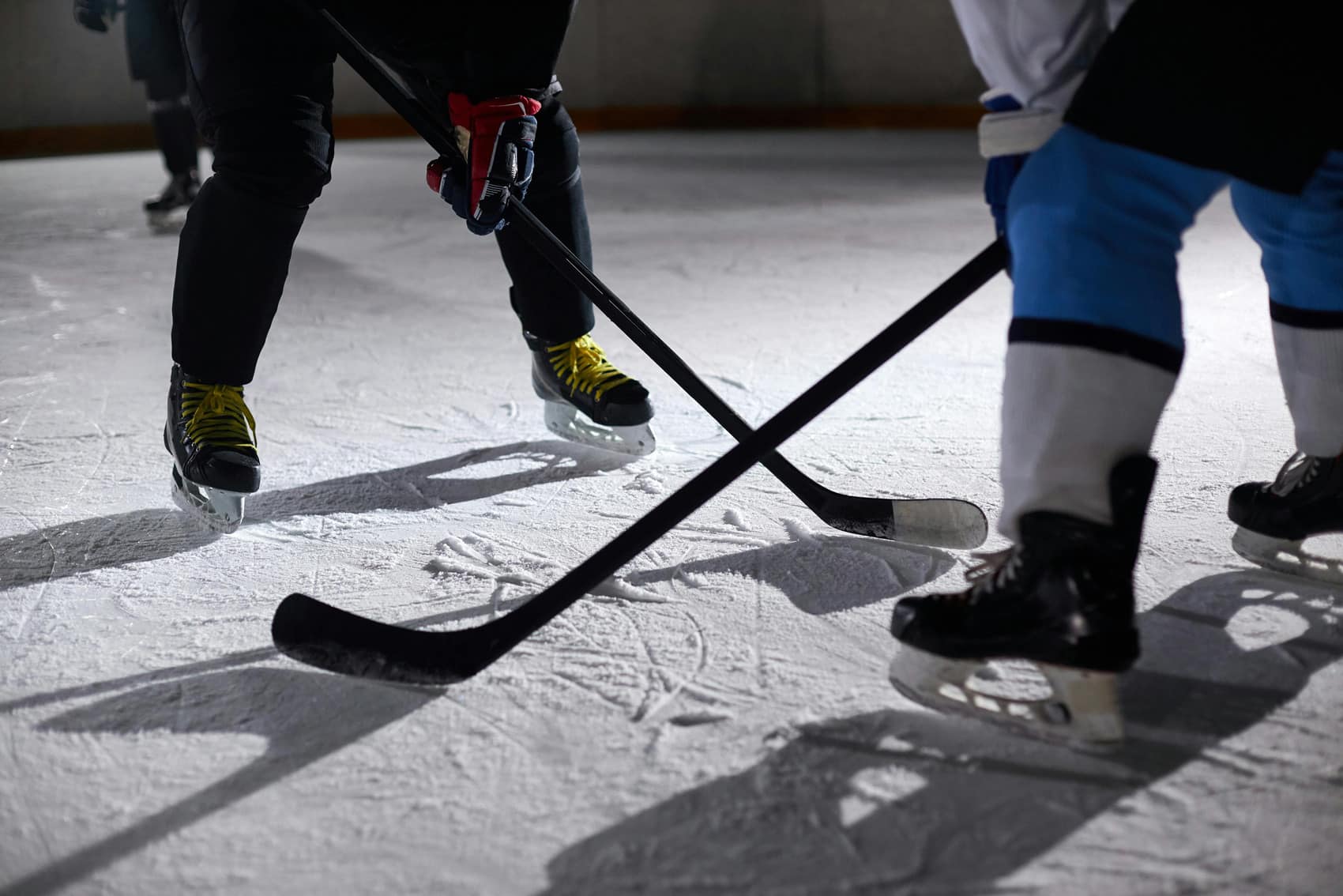
Close-up of two hockey players facing off on an ice rink, their skates and sticks poised, capturing the intensity of Hockey Fighting and What it Means to Be A Man as they battle for the puck.

Canadians on Hockey 2012

Hockey has long held a central place in Canada, and the National Hockey League is the flagship arena for the sport. Professional hockey has long stood out for the aggressive style of play, which has largely been accepted as just a part of the game.
Hockey’s still close to our hearts

The Canadian media have been almost obsessed with hockey these past couple of weeks. Although global events have occupied some of our attention, domestic matters (namely Sidney Crosby's concussion and Max Pacioretty's fractured vertebra) have forced reputedly peaceful Canadians to meditate on violence in our unofficial national sport.

Two people walk past parked bikes outside a café or restaurant, perhaps discussing three ways that Toronto could become more autonomous from Ontario. Inside the dimly lit establishment, a few people can be seen enjoying their meals.

Two Toronto men on what it is to be a man

News of two exceptional Toronto men has reached every corner of the world. One of the young men, who reportedly struggled to establish successful social relationships, especially with women, mowed down 25 pedestrians, killing 10, on Yonge Street last Monday.

Environics Institute for Survey Research

701-33 Bloor Street East
Toronto, ON M4W 3H1

info@environicsinstitute.org

Subscribe to our eNews

Subscribe to our eNews to stay apprised of our latest reports, Insights, events, and media mentions.

Stay Connected