

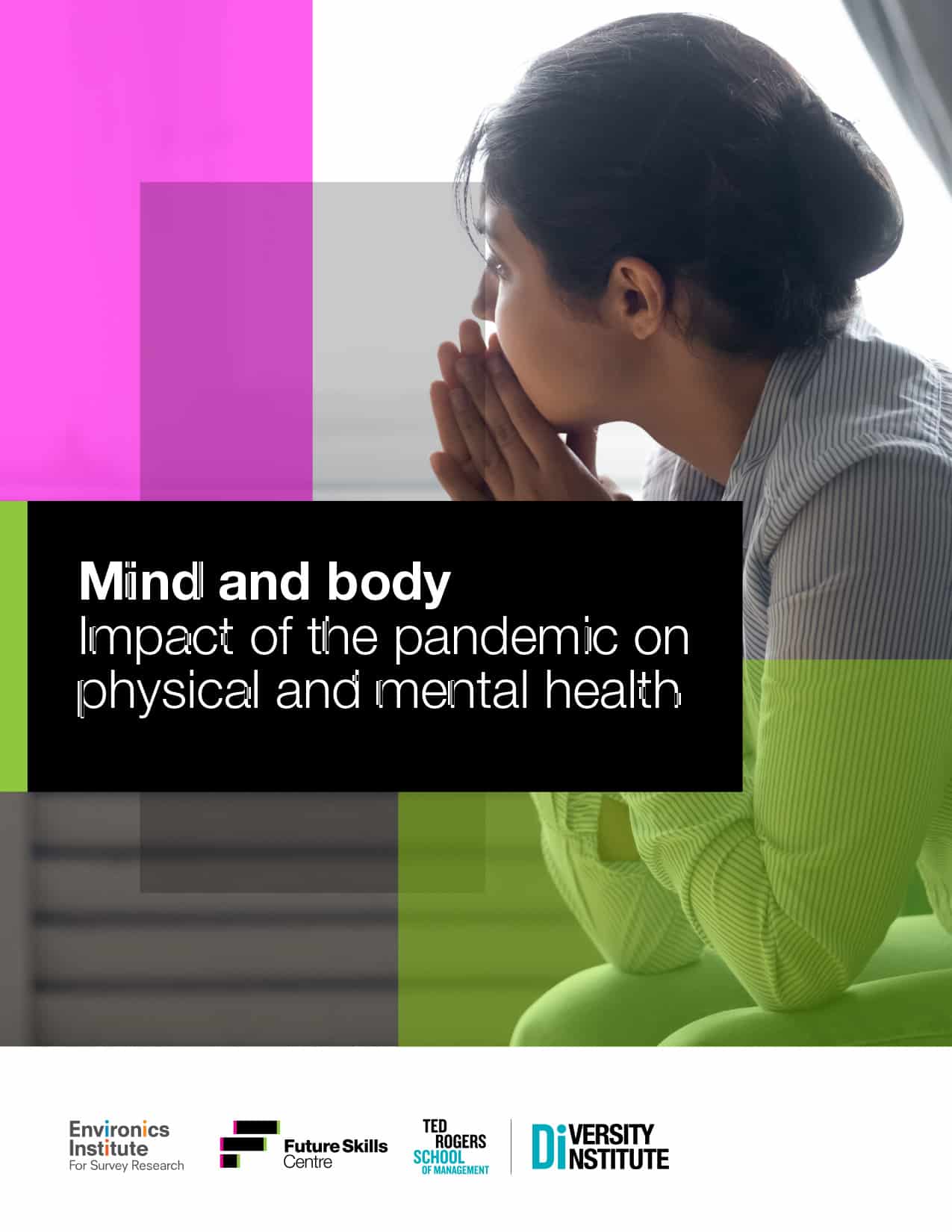
Mind and Body: Impact of the Pandemic on Physical and Mental Health
A report from the Survey on Employment and Skills (2nd wave)
This report focuses on Canadians’ perceptions of their physical and mental health, and how these have changed during the pandemic. It also highlights implications for governments and employers as they begin to prepare for the post-pandemic recovery.
The report finds that, between April 2019 and December 2020, Canadians’ perceptions of their physical health and especially their mental health deteriorated. In the case of mental health, the change has been especially dramatic among those age 65 and older. But while the decline in perceptions of mental health have been greater among seniors than among younger adults, it remains the case that younger Canadians, especially younger women, continue to rate their mental health more poorly than others.
Survey Details
The Survey on Employment and Skills is conducted by the Environics Institute for Survey Research, in partnership with the Future Skills Centre and the Diversity Institute at Toronto Metropolitan University.
The second wave of the study consists of a survey of 5,351 Canadians age 18 and over, conducted between November 24 and December 22, 2020, in all provinces and territories. It was conducted both online (in the provinces) and by telephone (in the territories).
Funder
The Survey on Employment and Skills is funded primarily by the Government of Canada’s Future Skills Centre / Le sondage sur l’emploi et les compétences est financé principalement par le Centre des Compétences futures du gouvernement du Canada.

Corps et âme : l’impact de la pandémie sur la santé physique et mentale
Ce rapport se concentre sur la perception des Canadiens et des Canadiennes à l’égard de leur santé physique et mentale ainsi que les façons dont celle-ci a changé durant la crise sanitaire. Il met également en lumière ce que ce constat implique pour les gouvernements et les employeurs, alors que ceux-ci se préparent à la relance postpandémique.
Selon le rapport, entre avril 2019 et décembre 2020, la perception des Canadiens et des Canadiennes sur leur santé physique, et particulièrement sur leur santé mentale, s’est détériorée. En ce qui a trait à la santé mentale, le changement a été particulièrement marqué chez les 65 ans et plus. Si le déclin dans la perception de la santé mentale s’est fait davantage sentir chez les personnes âgées que chez les adultes plus jeunes, il n’en demeure pas moins que les jeunes Canadiens et Canadiennes, en particulier les jeunes femmes, continuent d’évaluer leur santé mentale comme étant moins bonne que celle de la population en général.
L’enquête sur l’emploi et les compétences est menée par l’initiative d’Environics Institute for Survey Research en partenariat avec le Centre des Compétences futures et le Diversity Institute de la Toronto Metropolitan University.
La deuxième phase de l’étude a été réalisée auprès de 5 351 Canadiens et Canadiennes âgés de 18 ans et plus dans toutes les régions du Canada entre le 24 novembre et le 22 décembre 2020. Elle a été menée à la fois en ligne (dans les provinces) et par téléphone (dans les territoires).
The Survey on Employment and Skills is conducted by the Environics Institute for Survey Research, in partnership with the Diversity Institute at Toronto Metropolitan University and the Future Skills Centre.

Related reading
Widening inequality
This report from Wave 2 of the Survey on Employment and Skills examines the overall impact of the pandemic, as well as more specific experiences such as loss of hours of work, loss of employment or loss of income.
AmericasBarometer 2014
The AmericasBarometer is a multi-country public opinion survey on democracy, governance and civic engagement, conducted every two years by a consortium of of research partners across the western hemisphere. The 2014 survey included 26 countries, encompassing 99% of the population of the Americas.
Trust in Elections
Political news headlines in 2023 have been dominated by concerns about potential interference by foreign governments in recent Canadian elections, with opposition parties calling for a public inquiry into the matter.